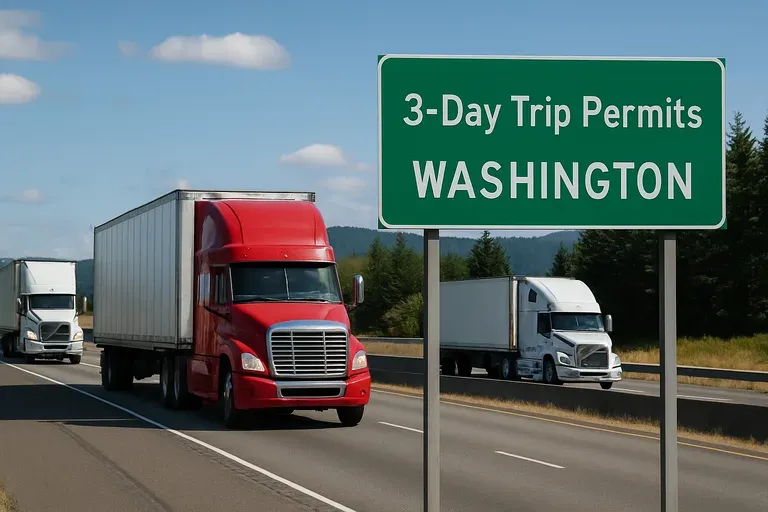
What Is a 3-Day Trip Permit?
-
A trip permit (also called a trip license) allows you to operate a commercial vehicle on Washington public highways for three consecutive days.
-
It’s typically used when: your vehicle isn’t licensed for its current load, or you just need short-term legal licensing without getting full registration/tonnage.
-
The permit applies per vehicle (by VIN/plate).
Weight Limits & Legal Capacity
-
For a single-unit vehicle, the trip permit allows up to 40,000 lbs legal (licensed) weight.
-
For a combination vehicle (e.g., truck + trailer), the permit allows up to 80,000 lbs.
-
The vehicle must be unlicensed, or have insufficient tonnage licensing for its current load.
-
However, if a vehicle is already licensed/registered with valid tonnage, a trip permit can’t be used instead of regular tonnage, unless that tonnage isn’t at its maximum allowed.
-
Trip permits are not valid if the carrier (or vehicle) is under a Washington State Patrol “out-of-service” order.
Issuance Limits & Restrictions
-
You can only purchase up to three trip permits per vehicle in any 30-day period.
-
For recreational vehicles (RVs), the cap is two trip permits per year.
-
Permits are issued for specific vehicle details — you need to provide VIN, plate, etc.
-
The permit must be completed, signed, and dated before you operate the vehicle. Any alterations (e.g., correcting dates, VIN) will invalidate it.
Fees
-
Standard 3-day trip permit fee: $95.
-
If you also need a special fuel permit (for vehicles not covered by IFTA), there is a combined “Trip/Fuel” permit option: cost is $95 for 3 days.
-
(Note: in some county-level sources, slightly different prices may appear, but $25 is the standard for state-issued, per WSDOT’s Permit Desk Guide.)
How to Get It / Where to Buy
-
Permits can be purchased via www.washingtontruckingonline.com or Phone (206) 339-6683
-
For oversize / overweight permits via www.washingtontruckingonline.com or phone (206) 339-6683
-
When buying via self-issue or electronic system, you must enter complete, accurate details (VIN, dates, etc.).
Use Cases & Practical Notes
-
Unlicensed vehicles: If a vehicle’s tabs are expired or its registered weight is too low for the cargo, a 3-day trip permit lets you legally operate while figuring out longer-term licensing.
-
Weight increase: If a vehicle is already licensed but at a lower tonnage than needed, a trip permit can temporarily “boost” its allowed weight up to the trip permit limits (40K / 80K) for the 3 days.
-
Out-of-state/Prorate vehicles: Interestingly, according to WSDOT’s guide, prorated (IRP) vehicles may not need to buy a trip permit.
-
Route restrictions: Even with a trip permit, commercial vehicles need to follow route restrictions (bridges, height, etc.). Drivers are responsible for verifying overhead clearances and restricted routes.
Risks & Common Mistakes
-
Over-using permits: Trying to use more than 3 in 30 days can lead to permit rejection / non-compliance.
-
Incorrect permit data: Mistakes in VIN, dates, or license info can void the permit.
-
Not checking route: Just having a trip permit doesn’t exempt drivers from route restrictions — bridges, low-clearance areas, or restricted roads still apply.
-
Assuming fuel is covered: If your vehicle needs a special fuel permit (because it's not IFTA-licensed), forgetting that means non-compliance.
-
Not printing and signing: According to WSDOT, digital copies may not suffice — you must complete, sign, and date the permit.
Why Use a Trip Permit Instead of Full Registration / Licensing?
-
Cost-effective for short-term or one-off trips — better than paying for full licensing if you only need legal weight for a few days.
-
Useful for new/unregistered vehicles — for example, transporting a newly purchased truck that hasn’t yet been permanently registered.
-
Helps bridge gap during administrative delays or when waiting for tonnage licensing.