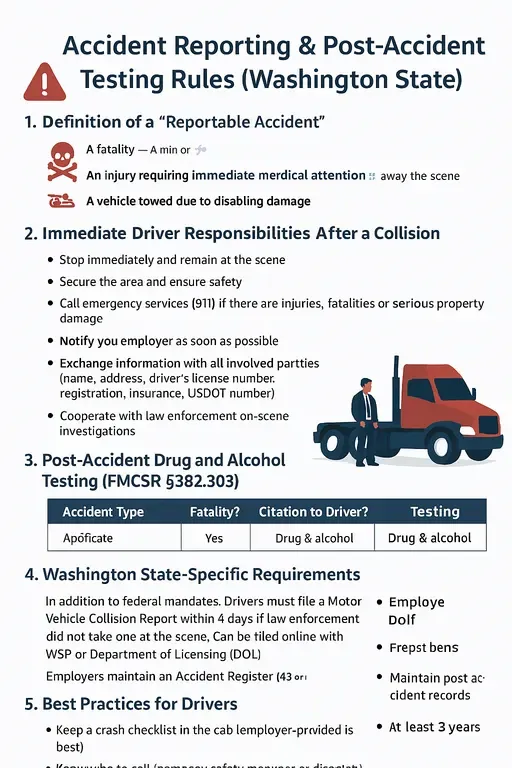
1. Definition of a “Reportable Accident”
Under Federal Motor Carrier Safety Regulations (FMCSR §390.5) and Washington State law (RCW 46.52), a “reportable accident” involves any of the following:
-
A fatality (any person dies as a result of the crash),
-
A person is injured and requires immediate medical attention away from the scene, or
-
A vehicle is towed due to disabling damage.
If any of these occur, the driver has specific reporting and testing responsibilities.
2. Immediate Driver Responsibilities After a Collision
When involved in a crash, truck drivers in Washington must:
-
Stop immediately and remain at the scene.
Leaving the scene can result in criminal penalties. -
Secure the area and ensure safety.
Use hazard lights, warning triangles, and reflective devices. -
Call emergency services (911) if there are any injuries, fatalities, or serious property damage.
-
Notify your employer as soon as possible.
Employers are responsible for determining if post-accident testing is required and for filing the federal crash report (if applicable). -
Exchange information with all involved parties:
-
Name, address, driver’s license number, registration, insurance, and USDOT number.
-
-
Cooperate with law enforcement on-scene investigations.
3. Post-Accident Drug and Alcohol Testing (FMCSR §382.303)
Federal law (FMCSA) requires commercial drivers to undergo drug and alcohol testing after certain types of crashes.
Testing must occur when:
| Accident Type | Fatality? | Citation to Driver? | Testing Required? |
|---|---|---|---|
| Fatal crash | Yes | Regardless | Yes (drug & alcohol) |
| Injury requiring medical attention | No fatality | If driver is cited | Yes (drug & alcohol) |
| Vehicle towed due to disabling damage | No fatality | If driver is cited | Yes (drug & alcohol) |
Testing time limits:
-
Alcohol test: within 2 hours (no later than 8 hours after the accident).
-
Drug test: within 32 hours of the accident.
If testing cannot be completed, the employer must document the reason for the delay.
4. Washington State-Specific Requirements
In addition to federal mandates:
-
Drivers must file a Motor Vehicle Collision Report (MVC Report) within 4 days if law enforcement did not take one at the scene.
This can be filed online with the Washington State Patrol (WSP) or Department of Licensing (DOL). -
Employers should also maintain an Accident Register under 49 CFR §390.15, recording:
-
Date, city, and state of the accident
-
Driver’s name
-
Number of injuries/fatalities
-
Whether hazardous materials were released
-
5. Employer Responsibilities
-
Ensure compliance with FMCSA §382.303 testing requirements.
-
Remove the driver from safety-sensitive duties until test results are received.
-
Report positive test results to the FMCSA Drug & Alcohol Clearinghouse.
-
Maintain post-accident records for at least 3 years.
6. Penalties for Non-Compliance
Failure to follow reporting or testing requirements can lead to:
-
Driver disqualification from operating a CMV,
-
Employer fines up to $5,000 per violation,
-
FMCSA enforcement action, and
-
Potential criminal penalties for leaving the scene or falsifying reports.
7. Best Practices for Drivers
-
Keep a crash checklist in your cab (employer-provided is best).
-
Know who to call — company safety manager or dispatch.
-
Always document accident details, photos, and witness information.
-
Never leave the scene until cleared by authorities.