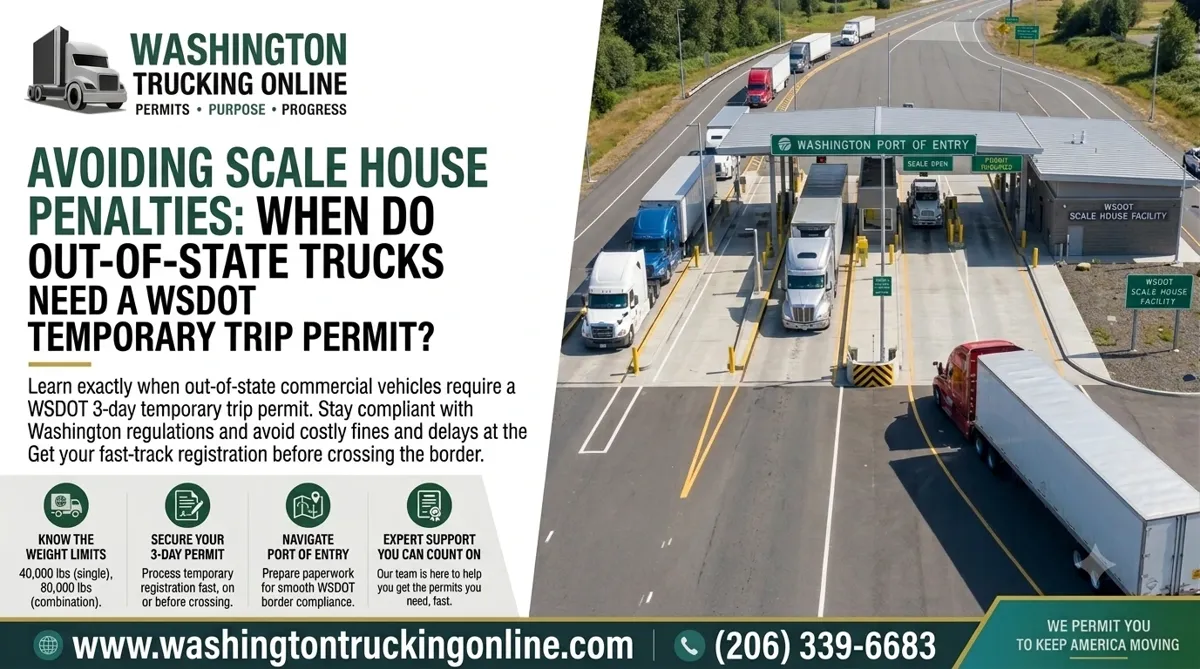
Avoiding Scale House Penalties: When Do Out-of-State Trucks Need a WSDOT Temporary Trip Permit?
Table of Contents
-
Introduction
-
What is a WSDOT Temporary Trip Permit?
-
When Does an Out-of-State Truck Need a Trip Permit?
-
Understanding the Weight and Usage Limits
-
The Consequences of Bypassing the Permit Process
-
Why Choose Our Service for Washington Temporary Permits
-
Frequently Asked Questions
Introduction
Driving commercial routes into the Pacific Northwest means staying on top of strict state-specific transport rules. For out-of-state fleet operators and owner-operators, rolling up to a Washington State Department of Transportation (WSDOT) scale house without the right paperwork can bring your haul to a costly, sudden halt.
Washington closely monitors commercial vehicle registration and tax compliance at its borders. If your truck is not fully registered for Washington highways, or if your current load exceeds the weight limits listed on your cab card, you cannot simply cross state lines and hope for the best. This guide outlines exactly when out-of-state carriers need a WSDOT temporary trip permit, the structural limits you must follow, and how to stay fully compliant before you hit the scales.
What is a WSDOT Temporary Trip Permit?
A Washington temporary trip permit is a short-term regulatory document that grants a commercial vehicle temporary registration authority to travel legally on Washington public highways. It essentially acts as a quick-access license for trucks that lack permanent state credentials or need temporary additional tonnage for a heavy haul.
Each permit is valid for three consecutive calendar days, or 72 hours. It is tied specifically to one vehicle identification number (VIN) and license plate, meaning you cannot transfer a single permit across multiple trucks in your fleet.
When Does an Out-of-State Truck Need a Trip Permit?
Out-of-state carriers generally fall into two categories when entering Washington. You will need to secure a temporary trip permit on or before your border crossing if your operation matches either of these compliance triggers:
-
Unregistered or Apportioned Vehicles Without Washington Mileage: If your truck is registered in your home state but you do not have Washington listed on your International Registration Plan (IRP) cab card, you lack the legal credentials to operate on Washington highways. A trip permit provides that temporary authority.
-
Insufficient Registered Tonnage: Sometimes your truck is registered in Washington or through an IRP account, but your current load is heavier than the registered weight limit listed on your paperwork. A trip permit can be used to legally increase your licensed weight capacity for that specific haul.
It is important to remember that these permits are for occasional or emergency use. They cannot be used as a permanent, loophole alternative to full commercial vehicle registration if you operate in the state long-term.
Understanding the Weight and Usage Limits
While a temporary trip permit gives you short-term highway access, it still operates within strict legal boundaries. You must know your configuration weights before purchasing.
Axle and Vehicle Configuration Weight Limits
Under a standard temporary trip permit, your vehicle configuration is capped at specific maximum legal weights:
-
Single-Unit Vehicles: May operate at a maximum weight up to 40,000 pounds.
-
Combination Vehicles, such as a standard tractor-trailer setup, may operate at a maximum weight up to 80,000 pounds.
If your load exceeds these standard legal limits, a basic trip permit is not enough. You will need to purchase separate WSDOT oversize or overweight permits to legally handle your dimensions.
Frequency and Timing Restrictions
WSDOT limits how often a single vehicle can rely on temporary transit. You can only purchase and use a maximum of three trip permits for any single vehicle within a rolling 30-day window.
The Consequences of Bypassing the Permit Process
Rolling past a Washington enforcement site without your permit properly filled out is a major compliance risk. Scale house officers regularly audit incoming trucks, and the penalties add up fast.
If an officer catches an under-registered or unregistered truck on a public highway, they will issue heavy monetary fines for operating without proper licensing. Furthermore, the enforcement officer can place your vehicle out of service on the spot, forcing you to park the truck at the scale facility until a valid permit is purchased and processed. These delays can destroy delivery schedules and damage broker relationships.
To keep your fleet moving smoothly, your driver must complete, sign, and date the physical permit before the truck tires ever touch Washington pavement. Any structural alterations or corrections made to the text after it is printed will immediately invalidate the document during an inspection.
Why Choose Our Service for Washington Temporary Permits
Managing out-of-state compliance across multiple state lines takes time and precision. At Washington Trucking Online, we take the administrative stress off your shoulders so you can keep your focus on routing and dispatching.
Our team expedites the temporary permitting process to get your drivers moving quickly and safely:
-
Instant Online Delivery: We process your trip requests fast, delivering valid digital documentation straight to your inbox.
-
Full Fleet Compliance: We make sure your vehicle details, VINs, and requested start dates perfectly align with state guidelines to prevent scale house issues.
-
Comprehensive Logistics Support: Whether you need a 3-day trip permit, an unapportioned fuel use pass, or specialized oversize route assistance, we provide a single point of contact for your Washington freight needs.
FAQ
Do I need a separate fuel permit alongside my WSDOT trip permit?
Yes, if your commercial vehicle is powered by diesel or propane and you do not participate in the International Fuel Tax Agreement (IFTA), you will need a temporary fuel use permit alongside your standard trip permit. The fuel use permit is required for any two-axle truck over 26,000 pounds or any vehicle setup with three or more axles.
Can I use a temporary trip permit if my truck is placed out of service?
No. A temporary trip permit does not override safety enforcement actions. If your commercial motor vehicle or your carrier authority has been placed under an official out-of-service order by the Washington State Patrol or the Federal Motor Carrier Safety Administration (FMCSA), a trip permit is completely invalid.
What information do I need to provide to get my 3-day trip permit?
To secure your permit cleanly, you must provide your vehicle identification number (VIN), the current license plate information if available, the desired start date and time for the 72-hour window, and your vehicle configuration type.