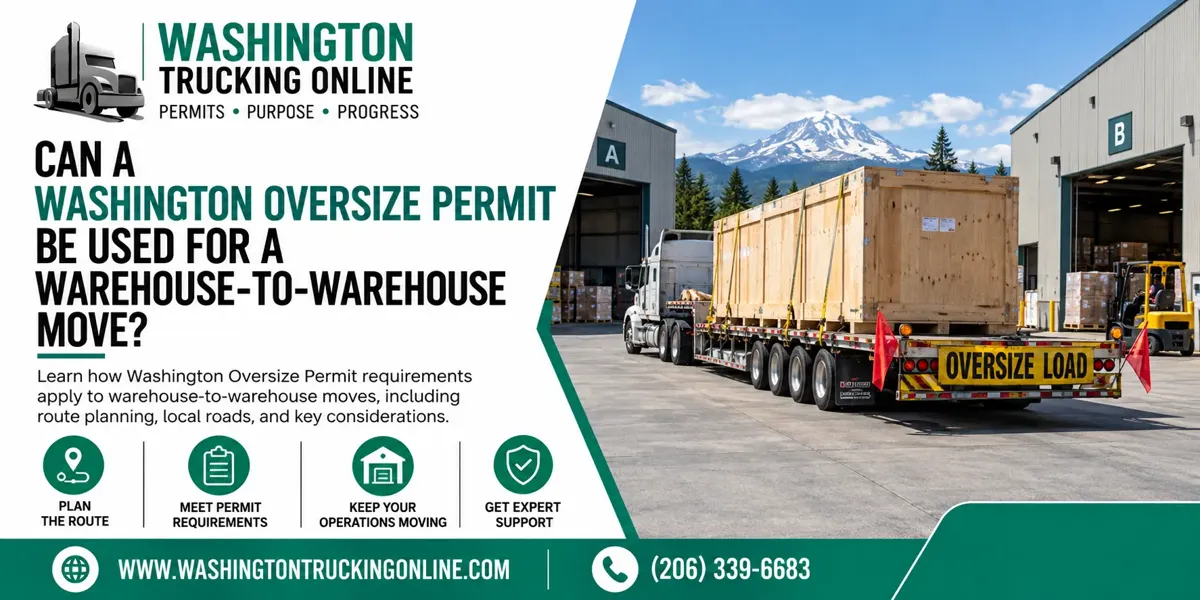
Can A Washington Oversize Permit Be Used For A Warehouse-to-Warehouse Move?
Table Of Contents
-
Introduction
-
Can A Washington Oversize Permit Cover A Warehouse-to-Warehouse Move?
-
Why The Origin And Destination Matter
-
What Information Should Be Included?
-
Does The Route Need Special Review?
-
What If The Warehouses Are On Local Roads?
-
What If The Load Is Moved Between Warehouses?
-
What Should Dispatch Verify Before Departure?
-
How To Avoid Permit Problems
-
Why Many Trucking Companies Choose Our Service
-
FAQ
Introduction
Not every oversize movement involves a long-haul delivery to a customer. A trucking company may need to move oversized equipment from one warehouse to another, transfer machinery between storage facilities, or relocate a large piece of equipment within Washington.
This raises an important question: Can the same Washington Oversize Permit be used for a warehouse-to-warehouse move?
A warehouse transfer can qualify for an oversize or overweight permit when the vehicle or non-divisible load exceeds Washington's legal limits. However, the carrier needs to make sure the permit matches the actual vehicle, load, origin, destination, and approved route.
Can A Washington Oversize Permit Cover A Warehouse-to-Warehouse Move?
Yes. A warehouse-to-warehouse movement can be permitted when the load requires authorization because it exceeds legal size or weight limits and meets Washington's applicable permit criteria.
Washington requires permits for vehicles that exceed legal dimensions or weight on state highways. Oversize permits are issued for non-divisible loads, meaning a load that cannot reasonably be reduced to legal dimensions or weight.
The fact that the movement is between two warehouses does not by itself prevent the carrier from obtaining a permit.
The important consideration is whether the proposed movement qualifies and whether the permit accurately describes the operation.
Why The Origin And Destination Matter
The origin and destination are important because they help determine the route the vehicle will use.
A warehouse transfer might seem straightforward, but two facilities could be several miles apart and require travel on multiple state highways. The route may also involve city streets or county roads.
The carrier is responsible for providing its route and verifying restrictions and overhead clearances before moving the load.
For that reason, dispatch should determine the exact warehouse addresses before applying rather than using a general city location.
What Information Should Be Included?
The carrier should provide accurate information about the complete movement.
Important details can include:
-
Warehouse pickup location
-
Warehouse delivery location
-
Vehicle configuration
-
Load description
-
Width
-
Height
-
Length
-
Gross weight
-
Axle configuration
-
Planned route
-
Travel dates
Accurate measurements are particularly important because the permit conditions depend on the characteristics of the vehicle and load.
Washington's single-trip oversize/overweight permits are route-specific and are intended for non-divisible loads.
Does The Route Need Special Review?
Yes. A warehouse-to-warehouse move should be reviewed just like another permitted oversize movement.
The carrier must verify current restrictions, bridge clearances, and other route conditions. WSDOT specifically states that carriers are responsible for checking restrictions and overhead clearances before moving an oversize load.
This is especially important when the warehouse sits in an industrial area where the shortest route may involve local streets, low-clearance structures, or restrictions that are not suitable for an oversize vehicle.
The approved route should be followed as stated on the permit.
What If The Warehouses Are On Local Roads?
A state-issued permit does not automatically provide authority to use every local roadway.
WSDOT explains that permits are valid for state routes, while carriers must contact the appropriate local jurisdiction for approval when travel involves city streets or county roads.
This means dispatch should identify every local-road segment before the trip begins.
A warehouse may be located just off a state highway, but reaching its entrance could require travel on a city street. That short section can still matter for permitting and route planning.
What If The Load Is Moved Between Warehouses?
A warehouse transfer can involve more than one stage.
For example, a carrier might pick up machinery at one storage facility, transport it to another warehouse for temporary storage, and later move it again to a final customer.
The carrier should not assume that the original permit automatically applies to the later movement. A future trip may have a different origin, destination, route, or schedule.
Each movement should be evaluated according to the permit type and conditions that apply to that specific operation.
What Should Dispatch Verify Before Departure?
Before the truck leaves the first warehouse, dispatch should compare the permit with the actual movement.
The review should confirm:
-
Correct vehicle
-
Correct load
-
Accurate dimensions
-
Accurate weight
-
Pickup warehouse
-
Delivery warehouse
-
Approved route
-
Permit dates
-
Special conditions
-
Local-road approvals, when applicable
Dispatch should also confirm that no changes occurred after the permit was issued.
A different trailer, revised warehouse location, increased load dimensions, or new route can create a mismatch that should be addressed before departure.
How To Avoid Permit Problems
The easiest way to avoid problems is to plan the warehouse transfer as carefully as a customer delivery.
Start with the exact origin and destination. Then confirm the vehicle and load measurements, identify the proposed route, and review current restrictions and clearances.
WSDOT's single-trip permit guidance states that road and bridge restrictions are displayed on the permit and must be followed without exceptions.
Drivers should receive the current permit and route information before leaving the warehouse.
Good preparation can help prevent an oversized load from reaching a local road, bridge, or clearance problem that was overlooked during planning.
Why Many Trucking Companies Choose Our Service
Many trucking companies choose Washington Trucking Online because warehouse transfers can involve complicated route, vehicle, and local-road requirements.
Our service helps simplify the permitting process with fast processing, experienced permit specialists, secure online applications, and convenient customer support.
We help trucking companies prepare their Washington permit information and keep warehouse-to-warehouse movements organized.
FAQ
Can A Washington Oversize Permit Be Used For A Warehouse-to-Warehouse Move?
Yes. A warehouse-to-warehouse movement can qualify when the vehicle or non-divisible load exceeds Washington's legal limits, and the operation meets applicable permit requirements.
Does The Warehouse Location Need To Be Included?
The carrier should provide the actual origin and destination so the appropriate route can be established.
Are Local Roads Covered By A WSDOT Permit?
Not automatically. City streets and county roads may require approval from the appropriate local jurisdiction.
Does The Route Need To Be Checked Before Travel?
Yes. The carrier is responsible for checking restrictions and overhead clearances before moving an oversize load.
Can The Same Permit Be Used For A Later Warehouse Transfer?
Carriers should not assume that a later movement is covered. A new movement should be reviewed based on its origin, destination, vehicle, load, route, and permit conditions.
What If The Trailer Changes Before Pickup?
Dispatch should review the permit before departure because vehicle configuration can affect the permitted operation.
What If The Warehouse Is Only A Short Distance Away?
Distance does not eliminate permit requirements. If the vehicle or load exceeds applicable legal limits, the required authorization still needs to be addressed.
What Should Dispatch Verify Before The Truck Leaves?
Dispatch should verify the vehicle, load dimensions and weight, warehouse locations, route, permit dates, restrictions, and any local road approvals.
For more information, visit the Washington State Department of Transportation.