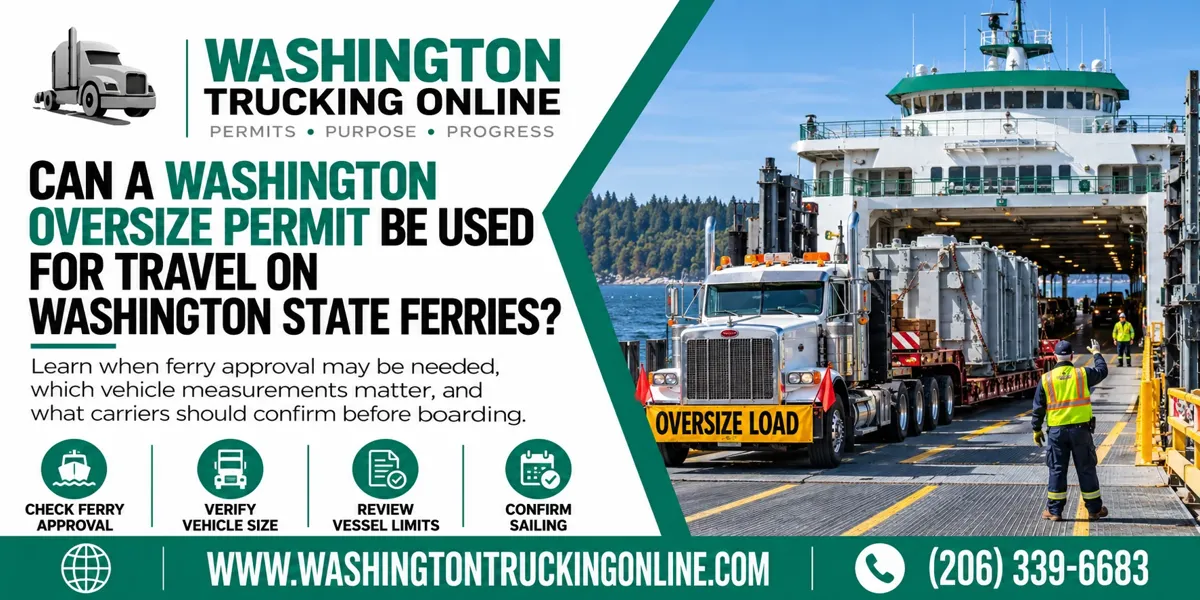
Can a Washington Oversize Permit Be Used for Travel on Washington State Ferries?
Table Of Contents
-
Introduction
-
Does a Highway Permit Cover Ferry Travel?
-
When a Ferry Travel Request Is Required
-
Why Route and Vessel Conditions Matter
-
How to Prepare Before Booking a Sailing
-
Common Mistakes to Avoid
-
Why Many Trucking Companies Choose Our Service
-
FAQ
Introduction
A permitted oversize load may be allowed to travel on certain Washington highways but still needs separate approval before boarding a Washington State Ferries vessel. Ferry travel introduces additional considerations, including vessel clearance, loading-ramp angles, tide conditions, terminal restrictions, and the space available on a sailing.
Before planning a Washington Oversize Permit trip that includes a ferry, confirm both the highway permit conditions and the ferry operator's requirements. Approval for the road portion does not automatically guarantee acceptance aboard a ferry.
Does a Highway Permit Cover Ferry Travel?
Not by itself. A Washington State Department of Transportation (WSDOT) highway oversize or overweight permit authorizes movement subject to its terms and the roads it covers. Washington State Ferries (WSF) has a separate process for certain commercial and oversized vehicles.
The ferry operator evaluates the vehicle and load against vessel clearance, terminal and route restrictions, loading conditions, and other operating factors. A load that meets the highway permit's dimensions may still be unsuitable for a particular vessel, terminal, or sailing.
Treat the ferry portion as a separate part of the trip plan. Check the exact route and planned sailing, and confirm whether a WSF Oversized/Overweight Vehicle Travel Request must be submitted before arriving at the terminal.
When a Ferry Travel Request Is Required
WSF requires an Oversized/Overweight Vehicle Travel Request for a vehicle that meets any of these criteria:
-
Gross vehicle weight over 80,000 pounds.
-
Width greater than 8 feet 6 inches.
-
Ground clearance below 14 inches.
-
Height greater than 13 feet 4 inches.
The request asks for information such as the vehicle's dimensions, total weight, license plate, destination, proposed travel date, requested sailing, axle weights, and axle spacing. Drivers transporting a modular home must also complete a separate modular-home measurement diagram.
Submit the request using the current WSF instructions and allow processing time. WSF recommends allowing two business days. Because the request must be approved, do not treat sending the form as permission to board. Confirm the status if approval has not been received before departure.
Vehicles outside those listed thresholds may not need the same request, but that does not remove the need to check posted load restrictions, vessel clearance, ramp conditions, and other route-specific requirements.
Why Route and Vessel Conditions Matter
Ferry suitability depends on more than the vehicle's overall height and width. Vessel clearances vary, and the assigned vessel can affect whether a truck and load can board safely. Check the sailing information and the vessel assigned to the route when that information is available.
Ground clearance, wheelbase, long rear overhang, and approach angle can also matter. At low tides, vehicle ramps may become steep and create problems for long trucks or vehicles with low clearance. Some routes have tidal restrictions that can affect loading or unloading even when the load is otherwise permitted.
Weight restrictions may apply at particular terminals or routes, especially to certain single-unit vehicles and concrete mixer trucks. A truck that is acceptable on one route may not meet the restrictions for another. Confirm the complete vehicle configuration and load rather than relying on a previous ferry trip.
Peak commuter traffic can also affect whether vessels have room for oversized loads. Ask about suitable sailings and plan enough time for any required inspection or instructions at the terminal.
How to Prepare Before Booking a Sailing
Use this checklist before dispatch:
-
Review both authorizations. Keep the highway Washington Oversize Permit and any required WSF travel approvals are available to the driver.
-
Measure the loaded vehicle. Confirm height, width, total length, ground clearance, and gross vehicle weight using the actual trip configuration.
-
Record axle information. Have axle weights and spacing available if WSF requests them.
-
Check the route and sailing. Review vessel clearance, terminal load postings, tides, ramp conditions, and the sailing schedule.
-
Submit early. Send the ferry travel request with complete details and allow the processing time identified by WSF.
-
Confirm before departure. Make sure the request has been approved and clarify any special conditions or sailing instructions.
-
Plan an alternative. If the ferry route cannot accommodate the load or the preferred sailing is unavailable, assess a suitable alternate route before the truck departs.
If the vehicle, load dimensions, weight, route, date, or sailing changes after approval, contact WSF to confirm whether the existing authorization remains valid or revised information is needed.
Common Mistakes to Avoid
Do not assume a highway oversize permit automatically authorizes ferry travel. Do not arrive with a tall, wide, low-clearance, or heavy vehicle without checking whether a ferry travel request is required. Avoid relying on generic vessel clearance figures without checking the vessel and sailing for your route.
Do not overlook terminal weight postings, tide-related ramp conditions, or restrictions on specific vehicle configurations. A reservation or ticket also does not replace required oversize/overweight approval. Keep the approved paperwork accessible and follow any instructions issued by WSF staff.
Why Many Trucking Companies Choose Our Service
Washington Trucking Online helps carriers navigate permit applications and organize the vehicle, load, and route details needed for Washington travel. Accurate information can reduce paperwork confusion and help dispatch teams identify requirements before a truck reaches a restricted route or terminal.
Our service offers practical permit assistance and customer support. When a trip includes a ferry, carriers should verify both highway permit conditions and WSF requirements so that an approved road movement is not delayed by missing ferry authorization.
FAQ
-
Does a Washington Oversize Permit automatically allow ferry travel?
No. A highway permit does not replace any separate WSF Oversized/Overweight Vehicle Travel Request or approval required for the ferry. -
Which vehicles need a WSF travel request?
WSF requires a request for vehicles over 80,000 pounds GVW, wider than 8 feet 6 inches, taller than 13 feet 4 inches, or with less than 14 inches of ground clearance. -
How early should I submit the ferry request?
WSF recommends allowing two business days for processing. Submit the current form early and confirm approval before travel. -
Can a vehicle be approved for one ferry route but restricted on another?
Yes. Vessel clearance, route-specific weight postings, terminal conditions, and tides can differ. Check the exact route and sailing. -
Does a ferry reservation replace ferry travel approval?
No. Reservations and fares are separate from any required oversized/overweight travel approval.
For more information, visit the Washington State Department of Transportation.