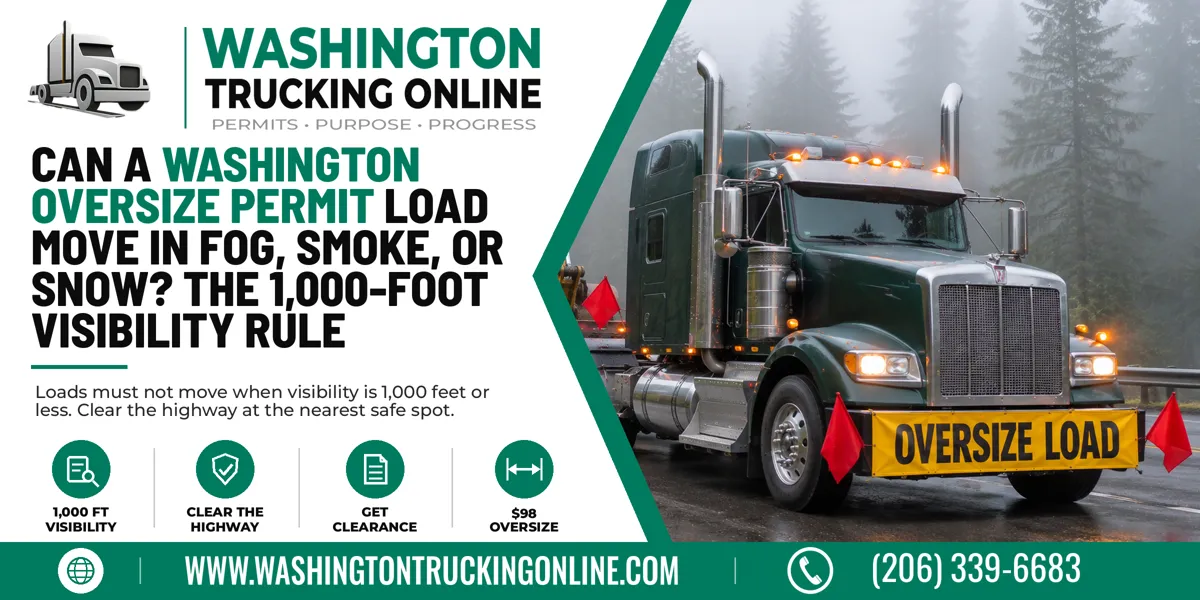
Can a Washington Oversize Permit Load Move in Fog, Smoke, or Snow? The 1,000-Foot Visibility Rule
Table Of Contents
-
Introduction
-
The Short Answer
-
What the 1,000-Foot Rule Says
-
Fog, Rain, and Snow
-
What About Wildfire Smoke?
-
Chains, Snow, and Ice
-
What to Do When Visibility Drops Mid-Trip
-
When Can the Load Move Again?
-
What Happens If You Keep Driving
-
Tips for Planning Around Washington Weather
-
Why Many Trucking Companies Choose Our Service
-
FAQ
Introduction
Washington weather can change fast. Fog settles into river valleys, rain sweeps in from the coast, snow closes in on mountain passes, and wildfire smoke can cover whole regions in summer. For a regular truck, that means slowing down. For an oversize load, it can mean stopping completely.
Wide, tall, and long loads need extra room and extra time for other drivers to react. That is why Washington sets a clear visibility limit for vehicles running on a special permit. This guide explains the 1,000-foot rule, how it applies to fog, smoke, and snow, and what to do when conditions turn bad during a move on a Washington Oversize Permit.
The Short Answer
Not when visibility is 1,000 feet or less. Under WAC 468-38-095(5), moves must not be made when visibility is reduced to one thousand feet or less. If visibility drops during transport, the vehicle or vehicle combination must clear the highway at the nearest safe location.
The rule is about visibility, not the cause. Fog, rain, snow, or smoke can all stop a load on a Washington Oversize Permit once you can't see far enough.
What the 1,000-Foot Rule Says
WAC 468-38-095 covers emergency road restrictions due to weather or other conditions. The key points are:
-
No moves at 1,000 feet or less of visibility under 095(5).
-
Clear the highway at the nearest safe location if visibility drops during the trip.
-
Restrictions can be put in place when weather or other conditions have created a substantial risk to public safety, under 095(2).
-
An enforcement officer can require a permitted vehicle to pull off when conditions become unsafe, under 095(6).
1,000 feet is about the length of three football fields. At highway speed, that is only a few seconds of warning for the drivers around you.
Fog, Rain, and Snow
WAC 468-38-095(10) names specific conditions. A vehicle operating under a special permit for oversize must stop movement at the nearest safe location during periods when:
-
Snow is falling to a degree that visibility is limited to less than 1,000 feet.
-
Fog or rain limits visibility to less than 1,000 feet.
-
Compact snow and ice conditions require the use of chains.
This matters most in places like Snoqualmie, Stevens, and White Pass in winter and in valleys where morning fog is common in fall.
What About Wildfire Smoke?
Smoke is not named in the list in 095(10), but the general rule in 095(5) is based on visibility alone. If smoke cuts visibility to 1,000 feet or less, the load must not move, and a load already on the road must clear the highway at the nearest safe location.
Heavy smoke can also lead to restrictions under 095(2) when conditions create a substantial risk to public safety.
Chains, Snow, and Ice
Visibility is not the only winter trigger. Under 095(10)(d), an oversize load must stop when compact snow and ice conditions require the use of chains. Even on a clear day, a chain requirement on a pass means a load on a Washington Oversize Permit has to wait.
There is also a stricter rule at night. WAC 468-38-175(3) says no movements shall be made when visibility is reduced to five hundred feet or when hazardous roadway conditions exist, including snow, ice, mudslide, wind, or water flooding over the roadway.
What to Do When Visibility Drops Mid-Trip
-
Slow Down Safely. Don't brake hard or stop in a travel lane.
-
Find the Nearest Safe Location. A rest area, pullout, truck stop, or wide shoulder away from traffic.
-
Clear the Highway Completely. The rule requires the load to clear the highway, not just slow down.
-
Keep Pilot Cars With the Load. Escorts should help guide the load off the road and protect it.
-
Record the Stop. Note the time, place, and conditions for your records.
When Can the Load Move Again?
Under 095(10), movement must not resume until conditions have abated and clearance is obtained from the nearest department or state patrol office.
That means two things must happen:
-
Conditions improve, so visibility is back above 1,000 feet and roads are safe.
-
You get clearance from the nearest WSDOT or Washington State Patrol office.
Waiting for the fog to lift is not enough on its own. Get the clearance before you roll.
What Happens If You Keep Driving
WAC 468-38-095(10) states that failure to stop is a violation of the permit and subject to the penalties of RCW 46.44.105. Under that law:
-
A violation is a traffic infraction, with penalties of not less than $50, $75, or $100 for the first, second, and third or later finding.
-
An officer may confiscate the permit and send it to WSDOT, which may revoke, cancel, or suspend it.
On top of the fine, an oversize load moving in poor visibility is a real crash risk for the driver, the pilot cars, and everyone around them.
Tips for Planning Around Washington Weather
-
Check forecasts the night before. Look for fog, snow, and smoke along the whole route.
-
Check WSDOT pass reports. Chain requirements can stop a load even in clear weather.
-
Build extra time into the schedule. Weather delays are common in fall and winter.
-
Know your safe stopping points. Plan pullouts and rest areas before the trip.
-
Watch air quality maps in summer. Wildfire smoke can cut visibility quickly.
Why Many Trucking Companies Choose Our Service
Washington Trucking Online helps carriers get the right Washington Oversize Permit and plan moves around weather, pass conditions, and travel restrictions, so loads stay safe and legal.
-
Oversize permit: $98
-
Trip permit: $95
-
Fuel permit: $95
We provide support 24/7 and also work weekends and holidays.
or
FAQ
Can an oversize load move in fog in Washington?
Not when visibility is 1,000 feet or less. The load must clear the highway at the nearest safe location.
Does the visibility rule apply to wildfire smoke?
Yes. The 1,000-foot rule is based on visibility, whatever the cause.
Can an oversize load move when chains are required?
No. The load must stop when compact snow and ice conditions require chains.
When can the load start moving again?
Once conditions improve and you get clearance from the nearest WSDOT or State Patrol office.
How much does your Washington Oversize Permit service cost?
Our Washington Oversize Permit service is $98.
For more information, visit the Washington State Department of Transportation.