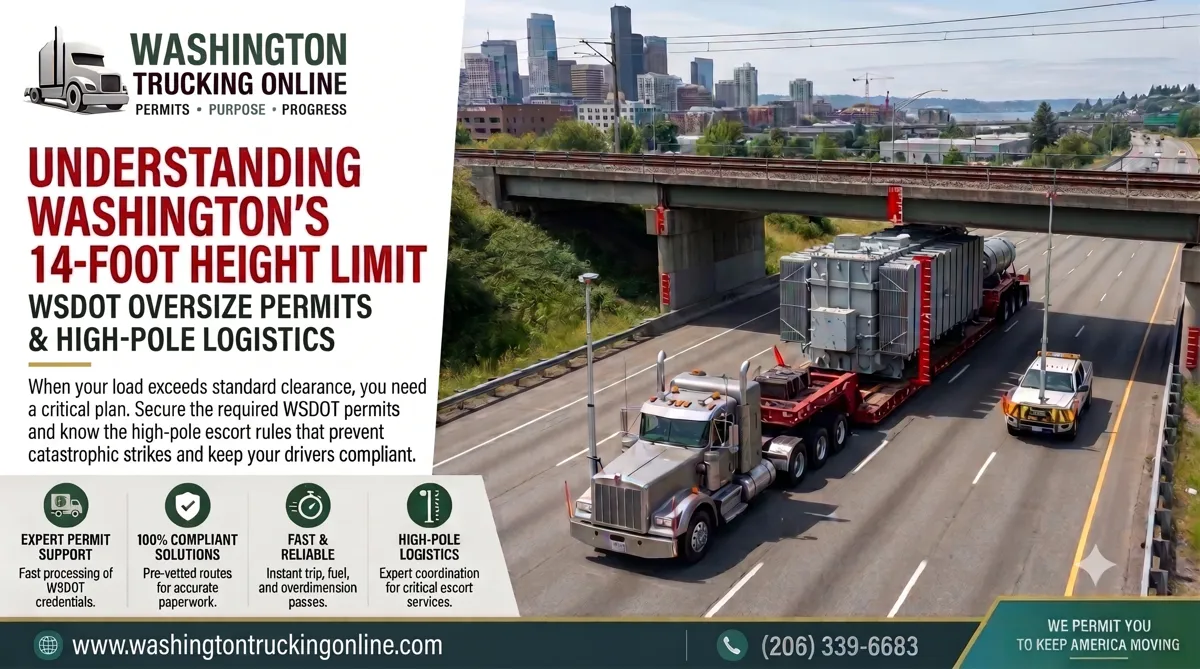
Clearing the 14-Foot Threshold: Height Triggers for WSDOT Oversize Permits
Table of Contents
-
Introduction
-
The Statutory Ceiling: When Does a Load Become Overheight?
-
The Critical Risk of Low Clearance Routes in Washington
-
Navigating the WSDOT Escort and High-Pole Triggers
-
Nighttime Travel Exemptions and Restricted Curfews
-
Carrier Liability: Why a Permit Alone Isn't Enough
-
Why Many Trucking Companies Choose Our Service
-
FAQ
Introduction
Running specialized, heavy-haul freight through the Pacific Northwest demands strict attention to shifting clearance levels. From urban infrastructure bottlenecks along the Interstate 5 corridor to low-hanging timber canopies on rural state routes, vertical obstacles can quickly halt an unvetted commercial haul. For dispatchers and owner-operators, dropping a high-profile trailer onto Washington roads without verifying legal parameters is a costly gamble.
The Washington State Department of Transportation (WSDOT) maintains an aggressive enforcement stance regarding overlegal heights. To stay compliant, protect state bridge structures, and avoid catastrophic cargo damage, carriers must understand exactly when Washington Oversize Permits are required, how height thresholds dictate pilot car deployment, and where the financial liability lands if a structural strike occurs.
The Statutory Ceiling: When Does a Load Become Overheight?
In the state of Washington, standard legal vehicle height maxes out at exactly 14 feet. This measurement includes both the trailer structure itself and the highest point of the non-divisible cargo secured to the deck.
If your load measures even a fraction of an inch above 14 feet, it is legally classified as an overlegal vertical configuration. Before that vehicle can wheel out from a yard or enter a Washington port of entry, a specialized transit authorization must be secured. Trying to run an overheight load without a valid single-trip document will land your driver an immediate out-of-service order and steep administrative penalties at the nearest Washington State Patrol scale house.
The Critical Risk of Low Clearance Routes in Washington
Obtaining Washington Oversize Permits handles your baseline legal status, but it does not guarantee a clear path to your destination. WSDOT explicitly states that standard overdimension permits do not act as an absolute structural guarantee for bridge or overpass clearance.
Washington features highly diverse road infrastructure. Older bridges, railway overpasses, and regional parkway structures frequently drop below the standard highway clearance minimums. Furthermore, seasonal pavement overlays and active construction zones can alter the actual vertical distance between the road surface and an overhead bridge deck, rendering standard map data inaccurate. Carriers must verify their paths using active state bridge lists and real-time vertical clearance trip planning utilities before starting the engine.
Navigating the WSDOT Escort and High-Pole Triggers
As a load scales higher, standard visual markers and caution signs are no longer sufficient to guarantee highway safety. WSDOT applies graduated safety protocols that become exponentially stricter as load height hits specified benchmarks:
-
Loads Between 14 Feet and 14 Feet 6 Inches: These moves require a standard single-trip permit and meticulous route planning, but can typically move without a dedicated escort vehicle under normal daytime conditions.
-
Loads Exceeding 14 Feet 6 Inches: This is a major regulatory threshold. Any general freight haul measuring over 14 feet 6 inches tall strictly requires a front pilot car equipped with a physical, calibrated height pole. The pilot car driver must travel a safe distance ahead of the tractor-trailer, using the high pole to physically test structural clearances before the heavy load arrives.
-
Superloads (Over 16 Feet): Once a load crosses the 16-foot barrier, it transitions into "Superload" status. Automated permitting stops completely. WSDOT mandates a comprehensive, manual engineering review, a certified route survey, and mandatory utility coordination to lift or temporarily disconnect overhead power lines along the route.
Nighttime Travel Exemptions and Restricted Curfews
While standard oversize transport is legally confined to the daytime window between one-half hour before sunrise and one-half hour after sunset, specific vertical limits allow for a bit of operational flexibility.
Vehicles that do not exceed 14 feet 6 inches in height, 12 feet in total width, and 105 feet in overall combination length are legally allowed to run 24/7, provided they possess the correct permit and deploy the mandatory warning lights and reflective safety gear. However, if your overweight load operates near major metro centers like Seattle, Tacoma, or Olympia, your permit will include rigid morning and evening commuter curfews that completely restrict movement during peak traffic hours.
Carrier Liability: Why a Permit Alone Isn't Enough
A common pitfall for interstate operators is assuming that a state-issued document relieves the trucking company of local liabilities. A state permit only clears travel on designated state highways and interstates.
The moment a driver transitions onto a city street or county road to reach a final delivery site, they are subject to local municipal jurisdictions. Most Washington cities and counties enforce separate permitting requirements. Operating on local infrastructure without these specialized local validations exposes your fleet to steep municipal fines and severe insurance liabilities. If an unpermitted overheight vehicle clips a local bridge or pulls down a city utility line, your primary cargo and liability insurance providers can legally deny coverage, leaving your business exposed to massive civil repair claims.
Why Many Trucking Companies Choose Our Service
Managing the specialized routing, structural deadlines, and evolving regulations of heavy-haul transport can be an administrative burden for busy logistics departments. That is why so many fleets trust Washington Trucking Online to handle their state-level compliance. We take the complexity out of the entire procurement process. Our experienced team specializes in rapid processing for Washington Oversize Permits, short-term trip authorizations, and non-IFTA temporary fuel tax permits. We double-check your vehicle dimensions against state parameters to secure accurate, route-vetted paperwork that keeps your drivers safe, legal, and moving forward.
FAQ
Can I haul a divisible load with a Washington overheight permit?
No. WSDOT rules dictate that oversize permits are reserved strictly for non-divisible cargo, meaning items that cannot be easily dismantled or split without causing extreme expense or structural damage. If your load can be reduced to fit under the legal 14-foot mark, you must reduce it.
How long is a standard single-trip oversize permit valid in Washington?
A standard single-trip oversize document issued for Washington state highways is valid for three consecutive days. The permit must be actively secured before the commercial vehicle crosses the state line.
What are the signage rules for an overheight truck in Washington?
Any commercial vehicle running under an active oversize authorization must prominently display a yellow "OVERSIZE LOAD" banner on both the front bumper of the tractor and the rear of the trailer. The signs must measure exactly 7 feet long by 18 inches high with bold, 10-inch black lettering.