1. Permit types
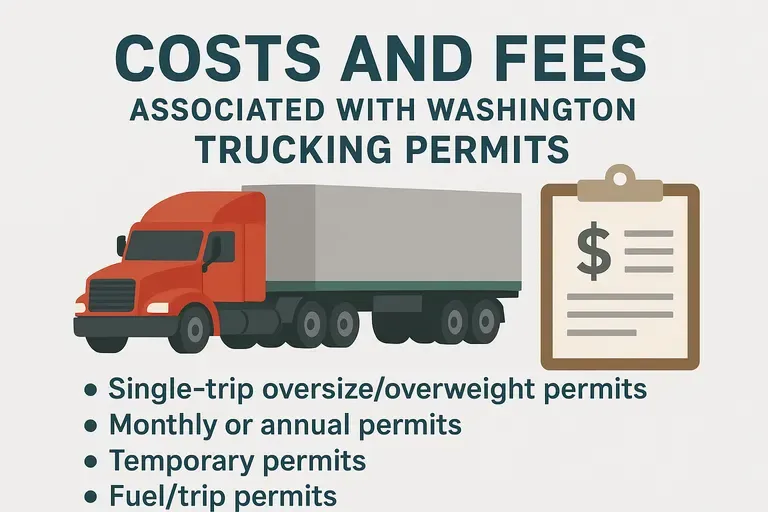
There are several permit types relevant for trucking (especially non-divisible loads, oversize, overweight, etc.). Some of the more common ones:
-
Single-trip oversize/overweight (“route-specific” non-divisible loads)
-
Monthly or annual permits for recurring oversize/overweight operations
-
Temporary permits (e.g., additional tonnage, farm implements)
-
Fuel/trip permits for commercial vehicles entering the state
2. Key fee schedules & examples
a) Single Trip Oversize/Overweight Permits
-
For a 3-day single-trip oversize/overweight (non-divisible) permit: if only dimension (width/height/length) is exceeded, the permit fee is US $95.00.
-
For loads exceeding legal weight: there is a graduated “fee per mile” scale depending on how much weight is over the legal limit. The minimum fee is US $95.00.
-
Example fee per mile for overweight by excess:
-
1-9,999 lbs over → $0.47 per mile
-
45,000-49,999 lbs over → $0.178 per mile
-
Over 100,000 lbs over → $10.25 per mile plus $0.90 for each additional 5,000 lbs increment.
-
b) Monthly / Annual Permits
-
A “single trailer” monthly or annual permit (divisible load up to 56 ft trailer + load) – $100/month or $1000/year.
-
Double trailer up to 68 ft – same $100/month, $1000/year.
-
Manufactured-home (15ft wide / 15ft high / trailer length 75ft) – $300/month or $3600/year.
-
Log-tolerance permit (for certain 3-axle truck + 2-axle pole trailer hauling unprocessed logs) – $500 annual if purchased April1-June30; reduced rates if purchased later in the year ($67.50 after July1; $25 after Oct1; $62.50 after Jan1) as it’s prorated.
c) Trip Permits & Fuel Permits
-
A “trip permit” (commercial vehicle permit to operate temporarily) – $125 for 3 days.
-
A “fuel use permit” (for vehicles entering Washington not under IFTA, diesel/propane powered, etc.) – $133 for 3 days.
3. Important details & caveats
-
The overweight permit fee schedule is based on excess weight over what’s legally authorized.
-
For oversize/overweight loads, if both dimension and weight are exceeded, you’ll typically pay the weight fee schedule (which may dominate) rather than separate fees for both.
-
Many of the permits are “non-divisible load” permits; divisible loads fall under different rules.
-
The “monthly/annual” permits are frequently for recurring operations where you exceed certain dimensions or weights in a regular fashion (rather than single trips).
-
Always check for route-specific restrictions (bridges, clearances, local jurisdictions) — permit fee is only part of the cost; compliance and routing may add time/cost.
-
5. Why these fees matter
-
They reflect the extra wear and structural stress oversize/overweight loads impose on roads and bridges, so the fees help offset infrastructure costs.
-
They also function as a regulatory mechanism: permit fees + routing/escort requirements ensure carriers plan properly rather than just move loads without oversight.
-
For logistics planning, knowing the fee schedule helps estimate permit cost ahead of time and factor it into haul rate or bid.
-
Failing to secure the proper permit (or paying wrong fees) can lead to fines, impoundment of load or vehicle, and delays which cost more than the permit itself.
6. Tips for carriers in Washington
-
Self-issue when possible: www.washingtontruckingonline.com
-
Calculate carefully: Use WSDOT’s “Permit Fee Calculator” to estimate costs when weight is heavily over the threshold.
-
Track route miles: Since overweight fees are per-mile, accurate mileage on state highways matters. Extra miles or mis-routing could increase cost.
-
Watch for local jurisdictions: Even with a state permit, you may need city/county approval if you use non-state routes. For example in city of Seattle there are separate permit fees if the load enters city streets.
-
Plan ahead: For annual/recurring permits it may make sense to purchase the permit up front (especially if you’ll operate many loads), because monthly/annual permits often have lower per-load cost.
-
Budget for extras: Escort vehicles, special signage, route clearance (bridges, overpasses) may add time/cost beyond the permit fee itself.
-
Stay current: The fee schedules are set in statute/regulation (e.g., RCW 46.44 etc) and can change — always verify before you haul.