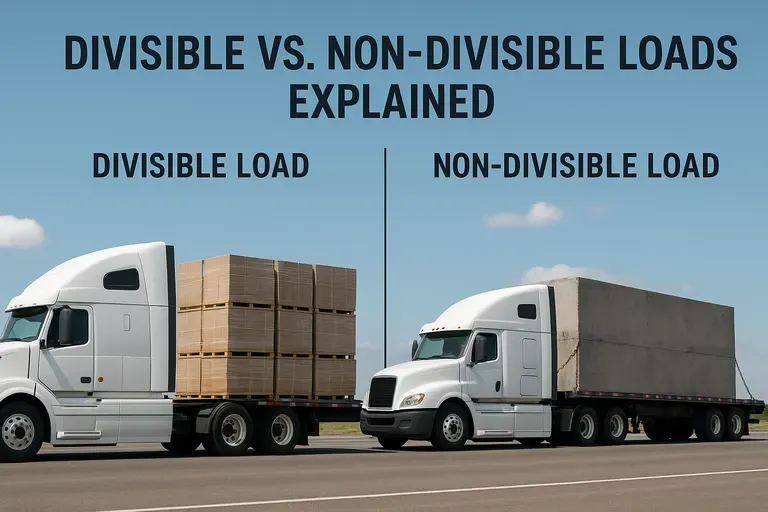
Divisible vs. Non-Divisible Loads Explained
When transporting freight, understanding whether a load is divisible or non-divisible is essential — it determines what kind of permits, equipment, and route authorizations are required. These classifications are defined by the Federal Highway Administration (FHWA) and enforced by state DOTs.
Divisible Loads
A divisible load is one that can be reduced in weight or size without compromising the load’s intended use or value.
In other words, the cargo can be split into smaller parts to meet legal weight and dimension limits.
Examples of Divisible Loads
-
Pallets of boxed goods
-
Sand, gravel, or grain
-
Multiple vehicles on an auto carrier
-
Construction materials (pipes, lumber, etc.)
Key Rules
-
Divisible loads must comply with standard weight and size limits.
-
Carriers cannot obtain oversize/overweight (OS/OW) permits for divisible loads, except under special exemptions (e.g., emergency relief or certain state allowances).
-
Carriers must adjust load distribution or use additional trips/trailers if needed.
Non-Divisible Loads
A non-divisible load is one that cannot be readily or safely separated into smaller parts without:
-
Destroying its intended function,
-
Compromising the load’s integrity, or
-
Requiring more than 8 working hours to dismantle, per FHWA rules.
Examples of Non-Divisible Loads
-
Construction equipment (cranes, bulldozers, excavators)
-
Bridge beams or wind turbine blades
-
Prefabricated homes or tanks
-
Large generators or industrial presses
Key Rules
-
Non-divisible loads qualify for oversize/overweight permits.
-
Carriers must comply with state-specific OS/OW regulations, including:
-
Route surveys
-
Escort or pilot vehicle requirements
-
Time-of-day restrictions
-
Why It Matters
Knowing the difference affects:
-
Permit eligibility – Divisible loads rarely qualify for OS/OW permits.
-
Operational costs – Non-divisible loads require specialized trailers and routing.
-
Compliance – Misclassifying a load can result in fines, citations, and trip delays.
Quick Comparison Table
| Category | Divisible Load | Non-Divisible Load |
|---|---|---|
| Can it be split safely? | Yes | No |
| Eligible for OS/OW permit? | Rarely | Yes |
| Common Examples | Gravel, lumber, pallets | Cranes, beams, turbines |
| Load Adjustment Allowed? | Yes | No |
| Permit Type | Standard | Oversize/Overweight |