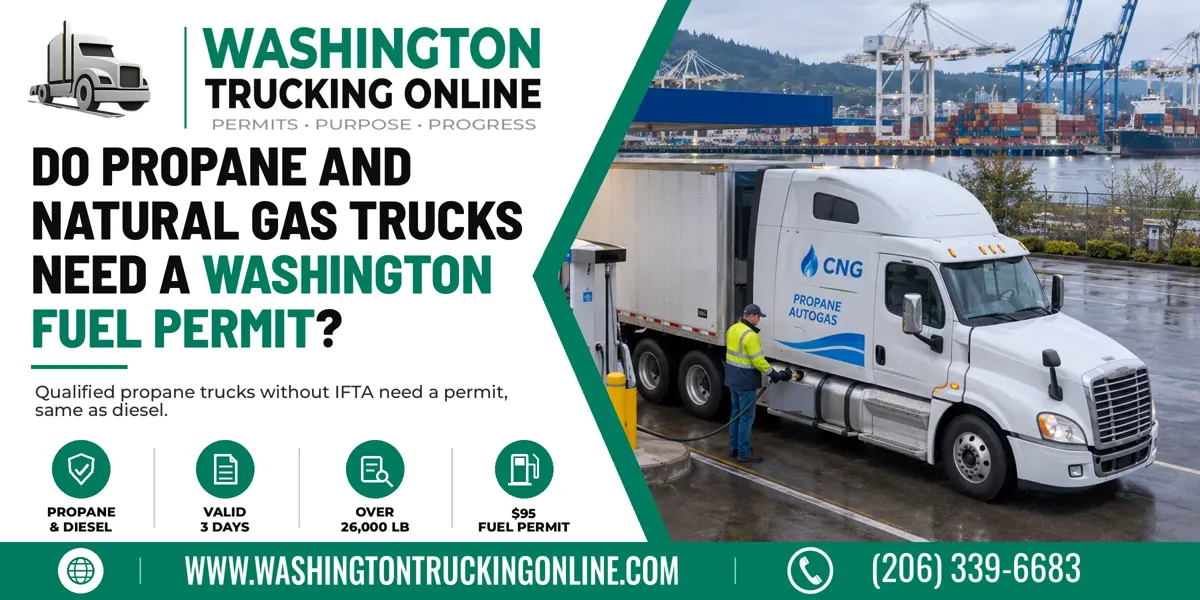
Do Propane and Natural Gas Trucks Need a Washington Fuel Permit?
Table Of Contents
-
Introduction
-
The Short Answer
-
What Washington Law Says
-
The Vehicle Test Comes First
-
Propane Trucks
-
Natural Gas Trucks
-
Dual-Fuel Trucks
-
How IFTA Handles Alternative Fuels
-
Don't Forget Registration
-
Quick Checklist
-
Common Mistakes to Avoid
-
Why Many Trucking Companies Choose Our Service
-
FAQ
Introduction
Alternative fuels are common in the Pacific Northwest. Port drayage fleets in Seattle and Tacoma, refuse haulers, beverage distributors and school districts all run trucks on propane or natural gas. Many of those trucks also cross into Washington from Oregon, Idaho and British Columbia.
When a carrier without IFTA sends one of those trucks into the state, the question comes up fast: does a truck that doesn't burn diesel still need a Washington Fuel Permit? This guide explains how Washington treats propane and natural gas trucks, and what to check before the trip.
The Short Answer
-
Propane trucks: yes, if the truck is a qualified motor vehicle and the carrier doesn't have IFTA. The permit covers diesel and propane.
-
Natural gas trucks (CNG or LNG): they're still qualified vehicles if they meet the size and weight test, but the permit listing doesn't clearly name natural gas. Carriers usually cover them through IFTA, or confirm with the state before the trip.
-
Dual-fuel trucks: yes, because they burn diesel too.
In every case, the truck's weight and axles decide whether it's covered at all.
What Washington Law Says
Washington's fuel tax rules are in RCW Chapter 82.38. Interstate carriers running qualified motor vehicles in Washington need either an IFTA license with decals or a Washington Fuel Permit, also called a temporary fuel use permit.
-
Under RCW 46.17.400, the permit is paid in lieu of the special fuel tax.
-
The permit is valid for three consecutive days.
-
Under RCW 82.38.100, altering a permit invalidates it, and running without the required credential is a gross misdemeanor.
The WSDOT permit listing describes the temporary fuel use permit as covering vehicles that use diesel or propane.
The Vehicle Test Comes First
Before looking at the fuel, look at the truck. A qualified motor vehicle is a power unit with:
-
Two axles and a gross or registered weight over 26,000 pounds,
-
Three or more axles, regardless of weight, or
-
A combination weighing over 26,000 pounds.
A truck that doesn't meet this test doesn't need IFTA or a Washington Fuel Permit, no matter what it burns. A truck that does meet it needs a fuel credential, whether it runs on diesel, propane or a mix.
Propane Trucks
Propane, also called liquefied petroleum gas (LPG) or autogas, powers many medium-duty trucks, school buses and delivery units.
-
Many propane trucks are two-axle units under 26,000 pounds. Those aren't qualified vehicles and don't need a permit.
-
A propane truck over 26,000 pounds, or with three or more axles, is held to the same test as a diesel truck.
-
Propane is one of the fuels the Washington Fuel Permit covers, so a qualified propane truck without IFTA should have one.
Check the axles and registered weight before the trip. That settles most propane cases.
Natural Gas Trucks
Compressed natural gas (CNG) and liquefied natural gas (LNG) are popular in heavy regional fleets, especially port drayage and refuse.
-
A natural gas tractor over 26,000 pounds is still a qualified motor vehicle.
-
With IFTA, the carrier reports its natural gas use on the quarterly return, along with any other fuel.
-
The WSDOT listing for the temporary permit names diesel and propane, but doesn't clearly address natural gas.
For a natural gas truck without IFTA, check with Washington before the trip instead of assuming it's exempt. A quick call clears up whether a Washington Fuel Permit or another option fits that truck.
Dual-Fuel Trucks
Some trucks run on both diesel and natural gas, or switch between diesel and propane. These dual-fuel or bi-fuel trucks are the easiest call.
-
They burn diesel, which the permit clearly covers.
-
If they're qualified motor vehicles, they need IFTA or a Washington Fuel Permit.
-
An IFTA carrier reports each fuel type separately on the quarterly return.
How IFTA Handles Alternative Fuels
IFTA covers far more than diesel. The agreement includes gasoline, diesel, propane, CNG, LNG and other fuels.
-
An IFTA carrier lists miles and fuel for each fuel type on its quarterly return.
-
Natural gas is usually reported in gasoline gallon equivalents or diesel gallon equivalents.
-
The same IFTA license and decals cover the truck, whatever it burns.
For fleets that run alternative fuel trucks into Washington often, IFTA is usually simpler than ordering a permit every three days.
Don't Forget Registration
Fuel tax and registration are separate. A Washington Fuel Permit doesn't cover registration.
-
If Washington is on the truck's IRP cab card, registration is covered.
-
If not, the truck needs a Washington Trip Permit too.
Many carriers order the fuel permit and trip permit together, with matching dates.
Quick Checklist
-
Is It a Qualified Motor Vehicle? Two axles over 26,000 pounds, three or more axles, or a combination over 26,000 pounds.
-
What Fuel Does It Use? Propane, natural gas, diesel or a mix.
-
Does the Carrier Have IFTA? If yes, report each fuel type.
-
Propane or Dual-Fuel Without IFTA? Get a Washington Fuel Permit.
-
Natural Gas Without IFTA? Confirm with the state before the trip.
-
Is Washington on the Cab Card? If not, add a trip permit.
Common Mistakes to Avoid
-
Assuming alternative fuel means exempt. The vehicle test still applies.
-
Forgetting the diesel side of a dual-fuel truck. Diesel is clearly covered.
-
Mixing fuel types on an IFTA return. Each fuel is reported on its own.
-
Skipping the trip permit. Fuel and registration are separate.
-
Letting the permit run out mid-trip. It lasts three consecutive days.
Why Many Trucking Companies Choose Our Service
Washington Trucking Online helps carriers with propane, natural gas and dual-fuel trucks get the right Washington Fuel Permit and trip permit before the truck reaches the state line.
-
Fuel permit: $95
-
Trip permit: $95
-
Oversize permit: $98
We provide support 24/7 and also work weekends and holidays.
or
FAQ
Do propane trucks need a Washington Fuel Permit?
Yes, if the truck is a qualified motor vehicle and the carrier doesn't have IFTA.
Do natural gas trucks need a Washington Fuel Permit?
They're still qualified vehicles if they meet the weight and axle test. Most carriers use IFTA, or confirm the right option with the state before the trip.
What about dual-fuel trucks?
They burn diesel too, so a qualified dual-fuel truck needs IFTA or a Washington Fuel Permit.
Does IFTA cover alternative fuels?
Yes. IFTA carriers report propane, CNG and LNG along with diesel and gasoline.
How long is a Washington Fuel Permit valid?
Three consecutive days, as shown on the permit.
For more information, visit the Washington State Department of Licensing.