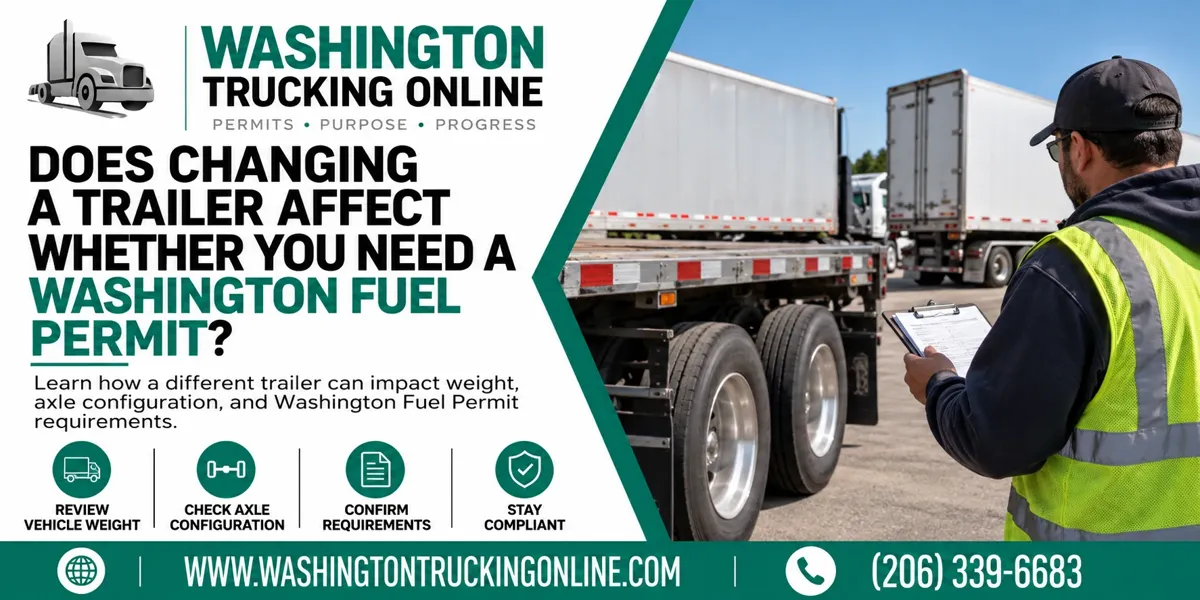
Does Changing a Trailer Affect Whether You Need a Washington Fuel Permit?
Table Of Contents
-
Introduction
-
How Washington Determines Fuel Permit Requirements
-
Why Changing a Trailer Can Matter
-
What If the New Combination Exceeds 26,000 Pounds?
-
Does Changing a Trailer Automatically Invalidate a Fuel Permit?
-
What Carriers Should Check Before Departure
-
Common Mistakes to Avoid
-
Why Many Trucking Companies Choose Our Service
-
FAQ
Introduction
Changing a trailer can affect more than a delivery schedule. It can change the combined weight and configuration of a commercial vehicle, which may affect whether the carrier needs a Washington Fuel Permit before entering Washington.
The answer depends on the power unit, the new truck-and-trailer combination, fuel type, and whether the carrier operates under an active International Fuel Tax Agreement (IFTA) license. A trailer swap does not automatically mean a new fuel permit is required, but carriers should recheck eligibility whenever the vehicle combination changes.
How Washington Determines Fuel Permit Requirements
Washington generally requires a temporary special fuel permit for a qualifying commercial vehicle entering the state when the carrier is not an IFTA licensee. The state identifies three relevant situations: a two-axle vehicle with a gross or registered gross vehicle weight exceeding 26,000 pounds; a vehicle with three or more axles, regardless of weight; or a combination of vehicles with a combined gross or registered gross vehicle weight exceeding 26,000 pounds.
These requirements apply to covered special-fuel vehicles, including diesel- or propane-powered commercial vehicles. Carriers operating under an active IFTA license with the applicable credentials generally do not need this temporary fuel permit for covered operations.
A fuel permit is different from a trip permit. A trip permit addresses temporary vehicle registration or weight authority, while a fuel permit addresses fuel-tax authorization. Having one does not replace the other when both are required.
Why Changing a Trailer Can Matter
A different trailer can change the combined gross weight or registered gross vehicle weight of the vehicle combination. For example, a two-axle tractor paired with a lighter trailer may remain below the 26,000-pound combination threshold, while pairing it with a heavier trailer may put the combination above that threshold.
The trailer can also affect the overall configuration and number of axles in the combination. Carriers should assess the actual configuration being operated rather than relying only on the tractor’s standalone weight or the details used for a previous dispatch.
This does not mean every trailer change creates a permit obligation. If the carrier already qualifies for IFTA coverage, or the combination remains outside the applicable thresholds, a trailer swap alone may not change the fuel-permit requirement. The important step is to reassess the new setup against Washington’s criteria.
What If the New Combination Exceeds 26,000 Pounds?
If a non-IFTA carrier operates a covered diesel- or propane-powered commercial vehicle combination whose combined gross or registered gross vehicle weight exceeds 26,000 pounds, Washington’s rules generally require a temporary fuel permit before the vehicle enters the state.
Do not rely solely on the scale weight on the day of travel. Washington’s rule refers to gross vehicle weight or registered gross vehicle weight, so review the vehicle and registration information that applies to the combination. If the correct figure is unclear, ask the licensing authority or permit provider to confirm which weight applies.
This is especially important when dispatch replaces a standard trailer with a heavier flatbed, lowboy, refrigerated trailer, or other specialized equipment. Update the trip plan and permit check before the driver reaches the state line.
Does Changing a Trailer Automatically Invalidate a Fuel Permit?
Not necessarily. Changing the trailer while keeping the same power unit does not, by itself, establish that an existing fuel permit is invalid. The key questions are whether the permit remains valid for the operating vehicle, whether the combination now meets the fuel-permit criteria, and whether other permit or registration documents identify the original configuration.
Washington does not allow fuel permits to be transferred from one power unit to another. If the tractor itself changes, do not assume the existing fuel permit can be used for the replacement truck.
A trailer change can also affect separate trip, weight, or oversize authorizations. Check those documents independently because fuel-tax authorization and vehicle or load permits serve different purposes.
What Carriers Should Check Before Departure
Before sending a truck into Washington with a different trailer, dispatch should:
-
Confirm whether the carrier has an active IFTA license and valid credentials covering the power unit.
-
Check whether the truck uses diesel or propane and falls within Washington’s special-fuel rules.
-
Verify the power unit’s axle configuration and the combination’s gross or registered gross vehicle weight.
-
Review the fuel permit’s validity dates and the vehicle information shown on it.
-
Check separately whether the trailer change affects trip, weight, or oversize permits.
-
Keep the required permits and supporting vehicle details available to the driver.
If the change occurs after the truck has entered Washington, contact the permit provider or state licensing authority before continuing whenever the new configuration may affect compliance.
Common Mistakes to Avoid
Do not assume that the tractor’s weight alone determines the requirement when the truck is operating with a trailer. Do not assume that adding or changing a trailer always triggers a fuel permit, either. Apply the relevant weight, axle, fuel, and IFTA criteria.
Avoid using a fuel permit issued for one power unit on another truck, confusing a fuel permit with a trip permit, or waiting until a roadside inspection to check the combination’s status.
Why Many Trucking Companies Choose Our Service
Washington Trucking Online helps carriers navigate permit applications and organize the vehicle information needed for Washington operations. Clear, accurate details can reduce paperwork confusion and help dispatch teams identify questions before a truck reaches the state line.
Our service provides practical permit assistance and customer support to make the application process easier. When a trailer change raises questions about the required credentials, carriers should review the official rules and confirm the requirements for their actual setup.
FAQ
Can changing a trailer make a truck require a Washington Fuel Permit?
Yes. It can if the new combination meets Washington’s applicable weight or axle criteria and the carrier is not covered by IFTA. The trailer change alone does not automatically determine the answer.
Does a trailer swap automatically cancel an existing Washington Fuel Permit?
Not necessarily, if the same power unit remains in use. Check the permit’s scope and confirm that the new combination still meets the applicable requirements.
What weight threshold applies to a truck-and-trailer combination?
Washington’s rule includes a combined gross or registered gross vehicle weight exceeding 26,000 pounds for a combination of vehicles, subject to the other applicable criteria.
Can I use the same fuel permit if I replace the tractor?
Do not assume you can. Washington states that fuel permits cannot be transferred from one power unit to another.
Do I need a fuel permit if my carrier has an active IFTA license?
Qualifying vehicles operating under an active IFTA license and applicable credentials generally do not need a temporary fuel permit. Confirm that the credentials cover the vehicle and operation.
For more information, review the Washington State Department of Licensing.