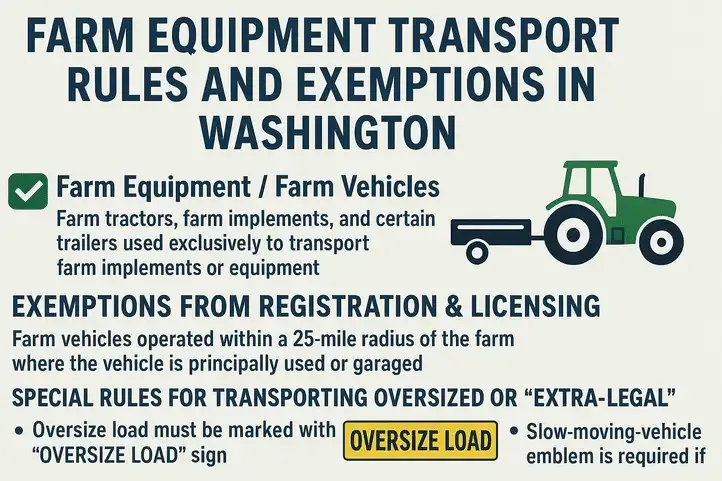
1. What Counts as Farm Equipment in Washington?
Washington generally classifies farm equipment as machinery used exclusively for agricultural operations, such as:
-
Tractors
-
Combines
-
Seeders and cultivators
-
Sprayers
-
Hay balers
-
Implements towed behind tractors
If the equipment is used solely for farming, it may qualify for certain exemptions.
2. When Farm Equipment Does Not Need a Permit
Farm equipment often qualifies for permit exemptions when:
It is moved short distances for agricultural purposes
-
Typically between fields or local farm properties.
-
Must still follow safety requirements (lighting, marking, escort if needed).
It stays within legal size limits
Even without a permit, farm equipment must respect certain baseline thresholds:
-
Width: Up to 10 feet is generally allowed without a permit.
-
Height: Standard maximum of 14 feet applies unless marked oversize.
-
Length: Farm implements towed behind a tractor may exceed normal limits if operated safely.
-
Weight: Farm equipment is usually exempt from axle weight limits if operated off-highway, but not always on public roads.
The equipment is moved during daylight hours
Most exempt moves must occur during daylight, unless specific lighting is installed.
3. When a Washington Oversize/Overweight (OS/OW) Permit Is Required
Farm equipment needs a permit if:
It exceeds 10 feet in width on state highways
-
Exceeding this threshold triggers oversize permit requirements.
-
Escort/pilot cars may also be required depending on width.
It travels long distances or on major state routes
Even if agricultural, long-haul moves often fall under OS/OW rules.
The equipment exceeds legal height or weight limits
-
Overheight requires a permit.
-
Overweight requires approval through WSDOT’s Commercial Vehicle Permit Office.
-
The equipment is transported on a trailer
Once farm equipment is loaded onto a truck or trailer, OS/OW rules apply like any other load.
4. Escort Requirements for Farm Equipment
Washington may require pilot/escort cars when farm machinery exceeds:
-
12 feet wide: 1 pilot car
-
14+ feet wide: 2 pilot cars
-
Longer than 110 feet: escort requirements vary by route
These values can change by region or roadway, so checking WSDOT rules is essential.
5. Safety Requirements for Farm Equipment on Public Roads
Whether exempt from permits or not, farm equipment must comply with:
Lighting and Reflectors
-
SMV (Slow-Moving Vehicle) emblem required for equipment traveling under 25 mph.
-
Flashing amber lights recommended or required for night or low-visibility moves.
Marking of Overwidth Equipment
Loads over 8’6’’ must display:
-
Red/orange flags at front and rear
-
“OVERSIZE LOAD” signs if above permit threshold
Proper Towing Connections
All towed implements must have:
-
Safety chains
-
Secure drawbar connections
6. Exemptions for Farm Operations
Washington provides beneficial exemptions:
No registration required for certain farm implements
Implements of husbandry that are towed may not need full vehicle registration.
Reduced permitting during harvest season
Special allowances may apply for seasonal movements of large harvest machinery.
Farm-use exemptions for weight rules
Certain axle weight rules may not apply to self-propelled machinery moving between farm locations.
7. Best Practices for Farmers and Carriers in Washington
-
Plan your route and avoid tight bridges or urban areas with narrow lanes.
-
Move during daylight whenever possible.
-
Use pilot cars when near width thresholds.
-
Keep equipment clean and functioning—light obstructions can lead to citations.
-
Know when an escort or permit is required, especially on state highways.