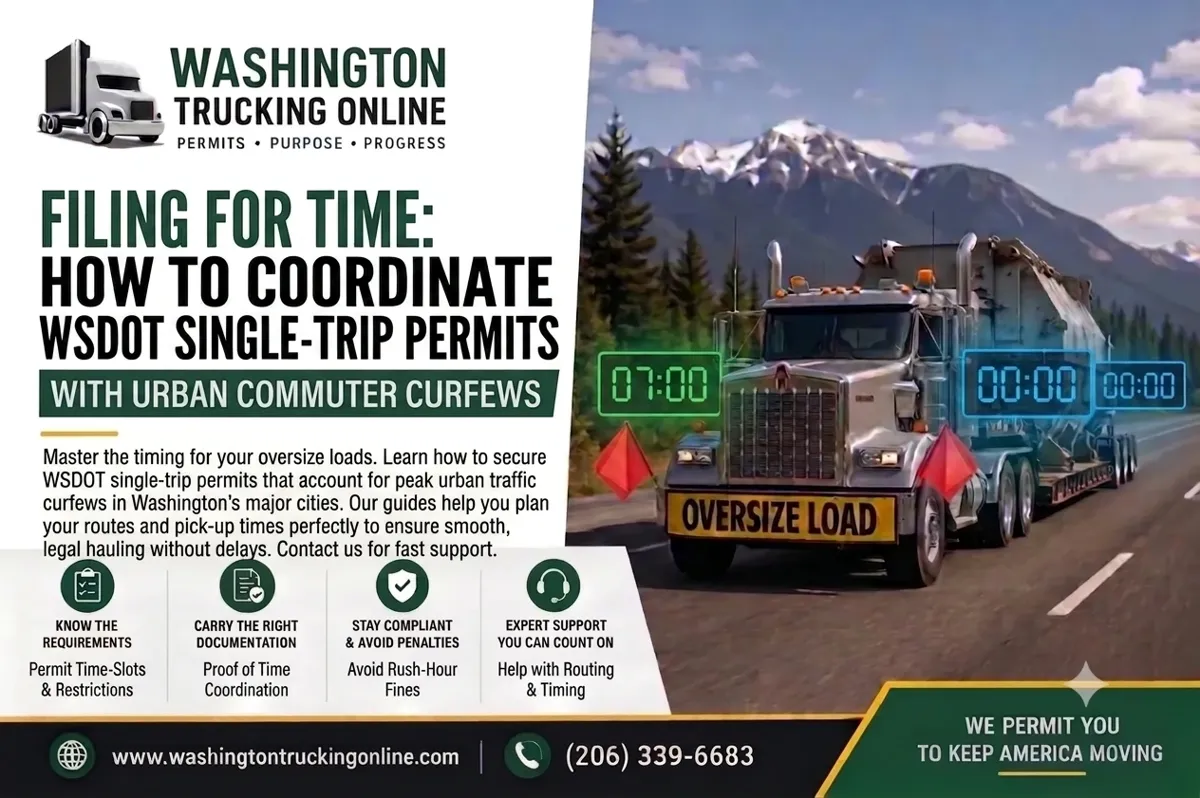
Filing for Time: How to Coordinate WSDOT Single-Trip Oversize Permits with Urban Commuter Curfews
Table of Contents
-
Introduction
-
The WSDOT Over-Dimension Triggers
-
Mapping out Washington’s Metro Commuter Curfew Zones
-
The Clock vs. The Scale: Timing Your Route Around Restrictive Windows
-
The 12-Foot Envelope: Leveraging Nighttime Movement Variations
-
Why Strategic Dispatching Matters for Single-Trip Permits
-
Frequently Asked Questions (FAQ)
Introduction
For commercial transport dispatchers and heavy-haul drivers, routing an oversize load through Washington State is a masterclass in timing. While securing a Washington State Department of Transportation (WSDOT) single-trip permit grants the legal authority to haul over-dimension cargo, it does not give you a free pass to drive whenever you want.
Washington enforces strict commuter curfew hours designed to keep massive loads out of dense urban bottlenecks during peak traffic times. If a driver reaches a metro boundary even five minutes too late, they face a mandatory shutdown at the roadside—or worse, heavy enforcement fines for violating permit provisions. Coordinating your single-trip permits with these regional freezes is the only way to protect your delivery windows and your operating budget.
The WSDOT Over-Dimension Triggers
Before looking at timing restrictions, it is critical to recognize exactly when a truck transitions from a standard load into an over-dimension configuration under Washington law. WSDOT defines standard maximum legal dimensions as:
-
Width: 8 feet, 6 inches
-
Height: 14 feet
-
Overhang: 3 feet at the front, 15 feet at the rear
The moment a non-divisible load exceeds any of these standard parameters, a Special Motor Vehicle Permit becomes mandatory. Consequently, any vehicle running under this permit that is required to display "Oversize Load" signs automatically falls under the state's Monday-through-Friday commuter curfew regulations. Purely overweight loads are typically exempt from these time blocks, provided the tractor can easily maintain the regular speed of surrounding highway traffic.
Mapping out Washington’s Metro Commuter Curfew Zones
WSDOT’s urban commuter curfews do not apply blanket-wide across the entire state. Instead, they target the high-density shipping lanes where merging freight traffic meets heavy passenger vehicle volume. These restrictions occur exclusively Monday through Friday, primarily affecting five major metropolitan vicinities:
-
Seattle-Everett Corridor
-
Tacoma Area
-
Olympia Region
-
Vancouver Vicinity
-
Kelso Zone
During the specific rush hour blocks detailed on the Commuter Curfew Hours sheet attached to every single-trip permit, over-dimension travel inside these sectors is completely frozen. For example, inside city operations like Tacoma, over-dimensional loads are strictly barred from moving on municipal streets from 7:00 AM to 9:00 AM and from 4:00 PM to 6:00 PM.
The Clock vs. The Scale: Timing Your Route Around Restrictive Windows
Successfully coordinating a single-trip permit means back-calculating your trip based on your point of entry and your target destination. A 3-day single-trip permit provides a clean window to execute the move, but your physical wheels can only turn during daylight hours—defined as one-half hour before sunrise to one-half hour after sunset.
If an oversize load is traveling westbound on I-90 toward the Port of Seattle, the dispatcher cannot simply look at the total driving miles. They must map exactly where the truck will be when the morning curfew drops at 7:00 AM. If the driver cannot completely clear the Seattle-Everett restriction zone before the curfew hits, they must pull over and wait out the block at a safe location outside the restricted boundary. Attempting to creep through a metro area during a curfew block runs the risk of a state trooper grounding the truck right on the shoulder, creating immediate logistical delays.
The 12-Foot Envelope: Leveraging Nighttime Movement Variations
When a payload faces exceptionally tight delivery deadlines that conflict with daytime traffic constraints, dispatchers should review WSDOT’s "defined envelope" rules for nighttime transit.
Under WAC regulations, a vehicle combination can legally move at night, defined as one-half hour after sunset to one-half hour before sunrise, if it fits within the following strict boundaries:
-
Maximum Width: 12 feet
-
Maximum Height: 14 feet, 6 inches
-
Maximum Length: 105 feet
   STANDARD LEGAL                 NIGHTTIME ENVELOPE             SUPERLOAD TIER
+--------------------+         +--------------------+         +--------------------+
| Width:  8'6"       |  ====>  | Width:  12'0"      |  ====>  | Width:  Over 16'0" |
| Height: 14'0"      |  Exceed | Height: 14'6"      |  Exceed | Height: Over 16'0" |
| Length: 53' Trailer|         | Length: 105'0"     |         | Length: Over 125'0"|
+--------------------+         +--------------------+         +--------------------+
Running during the night requires proper safety lighting (including amber side-marker lights and a red rear lamp projection marker) and must explicitly display "Nighttime movement approved" on the face of the single-trip permit. If your equipment exceeds this 12-foot envelope, nighttime authorization is strictly limited to custom preferred routes manually audited and approved by WSDOT structural engineers.
Why Many Trucking Companies Choose Our Service
Filing for a temporary permit without a clear transit timeline is a primary cause of logjams for modern carriers. Because Washington no longer sells physical oversize permits at Port of Entry (POE) scale houses, your administrative paperwork must be finalized, paid for, and active prior to your truck rolling across the state line.
At Washington Trucking Online, we remove the guesswork from regional over-dimensional planning. Our online permit system assists your team in logging vehicle dimensions, managing axle distributions, and securing temporary state permits quickly. Rather than spending valuable hours trying to navigate complex state regulations, you can utilize our automated tools to establish clean compliance pathways. Secure your essential travel authorizations via our portal or log into your client hub to verify that your active configurations are ready for the road.
Frequently Asked Questions (FAQ)
Do WSDOT commuter curfews apply on Saturdays and Sundays?
No. Washington's time-of-day urban commuter curfews are strictly active Monday through Friday. Weekend travel is generally permitted for standard oversize configurations under 10 feet wide and 105 feet long.
What happens to my permit validity if a mountain pass closes due to weather?
If WSDOT activates severe weather traction advisories or explicitly posts signs reading "Traction Advisory Oversize Vehicles Prohibited," your over-dimension permit is temporarily suspended. The driver must safely park until the traction notice is deactivated.
Can I buy a Washington single-trip oversize permit at a state scale house?
No. Washington State has phased out the sale of over-dimensional and temporary trip credentials at physical Ports of Entry. All permits must be secured via certified online processing routes before the vehicle enters state borders.
Does my overweight-only single-trip permit lock me into curfew restrictions?
No, as long as your total physical dimensions remain within standard legal limits (8'6" wide, 14' high) and your tractor has the necessary horsepower to seamlessly maintain regular traffic flow along the highway.