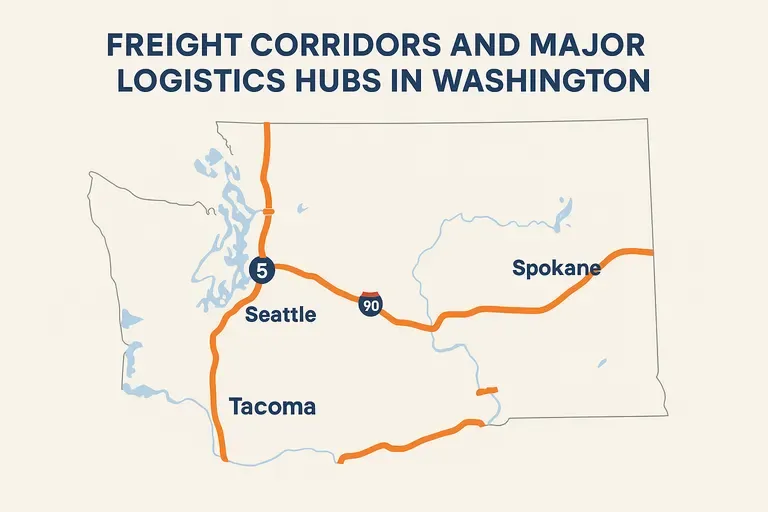
Freight Corridors and Major Logistics Hubs in Washington State
(Seattle • Tacoma • Spokane)
Washington State is one of the most important freight gateways in the United States, connecting Asia-Pacific trade routes, West Coast ports, and inland U.S. distribution networks. Its geography — from coastal ports to eastern agricultural plains — makes it a vital link for domestic and international supply chains.
Let’s explore the key freight corridors and logistics hubs that keep Washington’s economy moving.
1. The Importance of Washington’s Freight Network
Washington’s freight system handles more than 500 million tons of goods annually, valued at over $600 billion.
It supports major industries such as:
-
Agriculture and food processing
-
Aerospace (Boeing and suppliers)
-
Forestry and paper products
-
E-commerce and retail distribution
-
Manufacturing and technology
Efficient trucking routes and multimodal connections (rail, air, and sea) are crucial to keeping these industries competitive.
2. Seattle: The Urban Freight Hub of Western Washington
Seattle serves as the commercial and logistics heart of the state.
Key features include:
Major Freight Corridors:
-
Interstate 5 (I-5): The primary north-south trucking artery from Canada to California.
-
I-90: Connects Seattle to eastern Washington and beyond to Chicago.
-
State Route 99 and SR 509: Urban freight routes serving industrial zones and port access.
Logistics and Industrial Zones:
-
Port of Seattle: A major West Coast port handling containerized imports from Asia.
-
SODO (South of Downtown): A dense freight zone housing warehouses, logistics firms, and truck terminals.
-
Seattle-Tacoma International Airport (Sea-Tac): A growing hub for air cargo logistics.
Challenges:
-
Heavy congestion during peak hours
-
Limited truck parking
-
Strict urban delivery windows and environmental regulations
3. Tacoma: Washington’s Port Gateway
Tacoma is home to one of the largest container ports in North America, operating jointly with Seattle as the Northwest Seaport Alliance (NWSA).
Major Freight Corridors:
-
I-5 and SR 16: Key connectors between the Port of Tacoma and regional logistics centers
-
SR 167 Extension: Planned upgrade improving freight flow between Tacoma and Kent/Auburn’s warehouse district
Logistics Strengths:
-
Port of Tacoma: Specializes in autos, bulk cargo, and international containers
-
Freight Rail Connectivity: Served by BNSF and Union Pacific with intermodal terminals nearby
-
Kent Valley Industrial Area: One of the largest warehouse clusters in the Pacific Northwest
Tacoma’s infrastructure supports high-volume trucking and export operations, making it a central point for freight moving to and from the Pacific Rim.
4. Spokane: The Inland Freight and Distribution Center
Located in eastern Washington, Spokane functions as a strategic inland port linking the Pacific Northwest to the Rocky Mountain and Midwest regions.
Major Freight Corridors:
-
I-90: The main east-west transcontinental route connecting the Pacific ports to the Midwest.
-
US-395 and US-195: Provide access to Tri-Cities, Pasco, and agricultural areas.
Logistics Highlights:
-
Spokane International Airport (GEG): Supports air cargo and regional distribution.
-
West Plains Industrial Park: Expanding freight and warehouse zone.
-
Proximity to BNSF rail lines: Facilitates intermodal and bulk goods movement.
Spokane’s location offers cost-effective distribution for regional food products, timber, and manufacturing supplies.
5. Key Freight Corridors Across Washington
Washington’s freight backbone consists of several critical trucking routes:
-
I-5 Corridor: North-south movement between Seattle, Tacoma, Vancouver, and Portland, OR
-
I-90 Corridor: East-west freight artery connecting ports to inland destinations
-
SR 14, SR 167, SR 18: Secondary freight connectors serving ports and industrial centers
Together, these routes enable smooth flow between Washington’s coastal ports and inland markets across the western U.S.
6. Future Developments and Challenges
Washington is investing heavily in freight infrastructure modernization through WSDOT and local partnerships:
-
Expansion of SR 167 and SR 509 to relieve congestion near ports
-
Truck parking and rest area improvements across I-5 and I-90 corridors
-
Adoption of electric truck infrastructure and green logistics incentives
Challenges include balancing freight efficiency with environmental sustainability and managing rapid urban growth around Seattle-Tacoma.
7. Key Takeaway
Washington’s freight system — anchored by Seattle, Tacoma, and Spokane — connects the Pacific trade gateways with America’s heartland.
For truckers and logistics companies, mastering these corridors means smoother operations, fewer delays, and greater profitability across one of the most important freight networks in the United States.