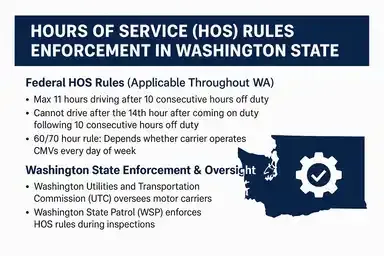
1. Federal HOS Rules (applicable throughout WA)
These are FMCSA rules that apply to most commercial motor vehicle (CMV) drivers, especially those in interstate commerce (hauling across state lines). Key points:
-
Property-carrying drivers:
-
Max 11 hours driving after 10 consecutive hours off duty.
-
Cannot drive after the 14th hour after coming on duty following 10 consecutive hours off duty.
-
60/70 hour rule: Depends whether carrier operates CMVs every day of week.
-
Use of a sleeper berth to split off-duty/rest time under certain conditions.
-
-
Passenger-carrying drivers: Rules differ slightly (e.g. 10-hour driving after 8 consecutive hours off, etc.).
-
Break requirements: A 30‑minute break required after 8 cumulative hours of driving, under the federal rules.
-
ELDs (Electronic Logging Devices): Drivers subject to HOS regulations must keep accurate logs, and most are required to use ELDs to automatically record duty status.
2. Washington State Enforcement & Oversight
-
Washington Utilities and Transportation Commission (UTC) handles oversight for many motor carriers. Part of their responsibilities include reviewing Hours of Service compliance.
-
Washington State Patrol (WSP) also enforces HOS rules during roadside inspections and safety enforcement.
-
The Washington Department of Transportation (WSDOT) tracks freight, infrastructure and safety goals (including HOS and ELD compliance) as part of planning and safety strategy.
3. State‑Specific Rules and Preemption Issues
-
Washington had its own Meal and Rest Break (MRB) laws for commercial drivers, which required more frequent breaks than federal HOS.
-
Preemption: In November 2020, the FMCSA granted a petition (by the Washington Trucking Association) that Washington State’s meal/rest break rules are preempted by federal HOS rules for property-carrying CMVs. That means WA can no longer enforce those state‑level break rules when they conflict with federal HOS.
4. Intrastate vs Interstate Differences
-
Drivers operating intrastate (within Washington only) may have some exemptions or different log requirements in certain cases (e.g. short‑haul, farm/agricultural operations).
-
However, many of the federal rules are adopted via Washington state law/regulation for intrastate carriers, particularly under WAC (Washington Administrative Code) and RCW (Revised Code of Washington).
5. Penalties & Consequences
-
If a driver is found in violation (for example driving past allowed hours, failing to take required rest break, falsifying logs), roadside enforcement can put the driver out-of-service.
-
Carriers may face fines, downgrades in safety ratings, and be subject to administrative proceedings.
-
Drivers and carriers must retain supporting records (logbooks, ELD data, on‑duty/off‑duty status records) for inspections.
6. Key Takeaways / Practical Advice for Drivers & Carriers in WA
-
Always follow federal HOS rules; state rules for breaks (meal/rest) are no longer enforceable when conflicting for property‑carrying CMVs.
-
Use Electronic Logging Devices (ELDs) properly, with accurate off-duty, on-duty, driving, rest status.
-
Make sure logbooks or records are available for inspection.
-
Know whether your operation is interstate or intrastate, and whether any exemptions apply (short‑haul, agriculture, etc.).
-
Keep updated: law/regulations can change, so check with FMCSA, WSP, UTC and WSDOT for current guidance.