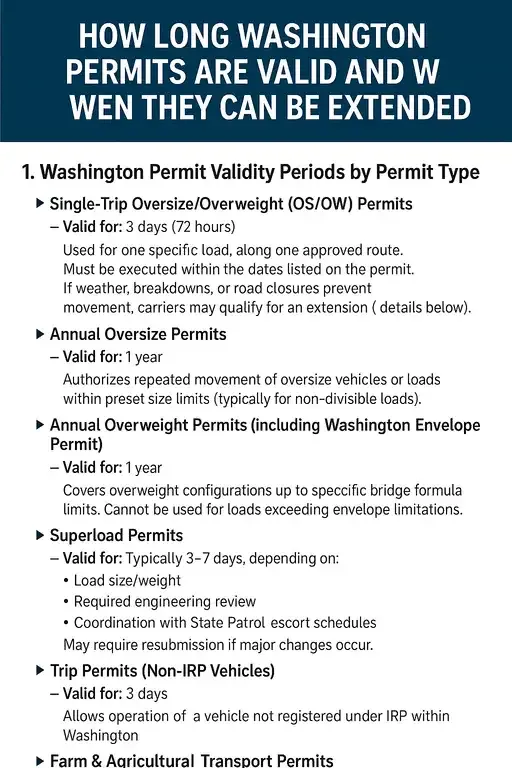
1. Washington Permit Validity Periods by Permit Type
Single-Trip Oversize/Overweight (OS/OW) Permits
-
Valid for: 3 days (72 hours)
-
Used for one specific load, along one approved route.
-
Must be executed within the dates listed on the permit.
-
If weather, breakdowns, or road closures prevent movement, carriers may qualify for an extension (details below).
Annual Oversize Permits
-
Valid for: 1 year
-
Authorizes repeated movement of oversize vehicles or loads within preset size limits (typically for non-divisible loads).
Annual Overweight Permits (including Washington Envelope Permit)
-
Valid for: 1 year
-
Covers overweight configurations up to specific bridge formula limits.
-
Cannot be used for loads exceeding envelope limitations.
Superload Permits
-
Valid for: Typically 3–7 days, depending on:
-
Load size/weight
-
Required engineering review
-
Coordination with State Patrol escort schedules
-
-
May require resubmission if major changes occur.
Trip Permits (Non-IRP Vehicles)
-
Valid for: 3 days
-
Allows operation of a vehicle not registered under IRP within Washington.
Temporary Fuel Permits (IFTA)
-
Valid for: 3 days
-
For out-of-state carriers operating a qualified vehicle without IFTA credentials.
Farm & Agricultural Transport Permits
-
Certain exemptions and permits can be:
-
Seasonal (30–180 days) or
-
Annual, depending on equipment and commodity.
-
2. When Washington Permits Can Be Extended
Washington DOT allows permit extensions under specific conditions:
Single-Trip Permits
Extensions may be granted only for valid operational reasons, such as:
-
Severe weather
-
Road closures
-
Mechanical breakdowns
-
Delays caused by state escort scheduling
-
Other documented circumstances outside the carrier’s control
Important:
-
Extensions are not automatic.
-
Carriers must submit a request before the permit expires.
-
Documentation of delay is usually required.
-
Typically extended up to 1–2 additional days, depending on circumstances.
Annual Permits
-
Cannot be extended beyond 1 year.
-
Carriers must reapply once the permit expires.
-
Renewal can occur before expiration to avoid gaps.
Superload Permits
-
Extensions are possible if:
-
Engineering reviews are still valid
-
No route or bridge restrictions have changed
-
-
If conditions change, WSDOT may require a new permit.
Trip & Temporary Fuel Permits
-
Extensions are rarely approved.
-
Carriers typically must purchase a new permit.
3. When Carriers Should Request an Extension
Request an extension immediately when any delay affects the planned move, especially if:
-
Weather shuts down mountain passes
-
Construction closes a segment of the authorized route
-
The load requires re-inspection or re-escort
-
A breakdown stalls movement
-
A bridge restriction appears during the active permit window
The carrier will need:
-
Permit number
-
Reason for delay
-
Documentation (if applicable)
-
Updated movement schedule
4. What Happens If a Permit Expires During Transport?
Operating under an expired trucking permit in Washington can result in:
-
Fines
-
Roadside shutdown until a new permit is obtained
-
Additional enforcement review
-
Escort requirements depending on size/weight
Washington State Patrol takes expired OS/OW permit violations seriously—especially when overweight.
5. Best Practices for Staying Compliant in Washington
-
Start moves early in the validity window, especially for mountain-pass routes.
-
Monitor weather and WSDOT road alerts daily.
-
Check expiry dates before dispatching.
-
Renew annual permits at least 7–10 days in advance.
-
Request extensions immediately when disruptions occur.