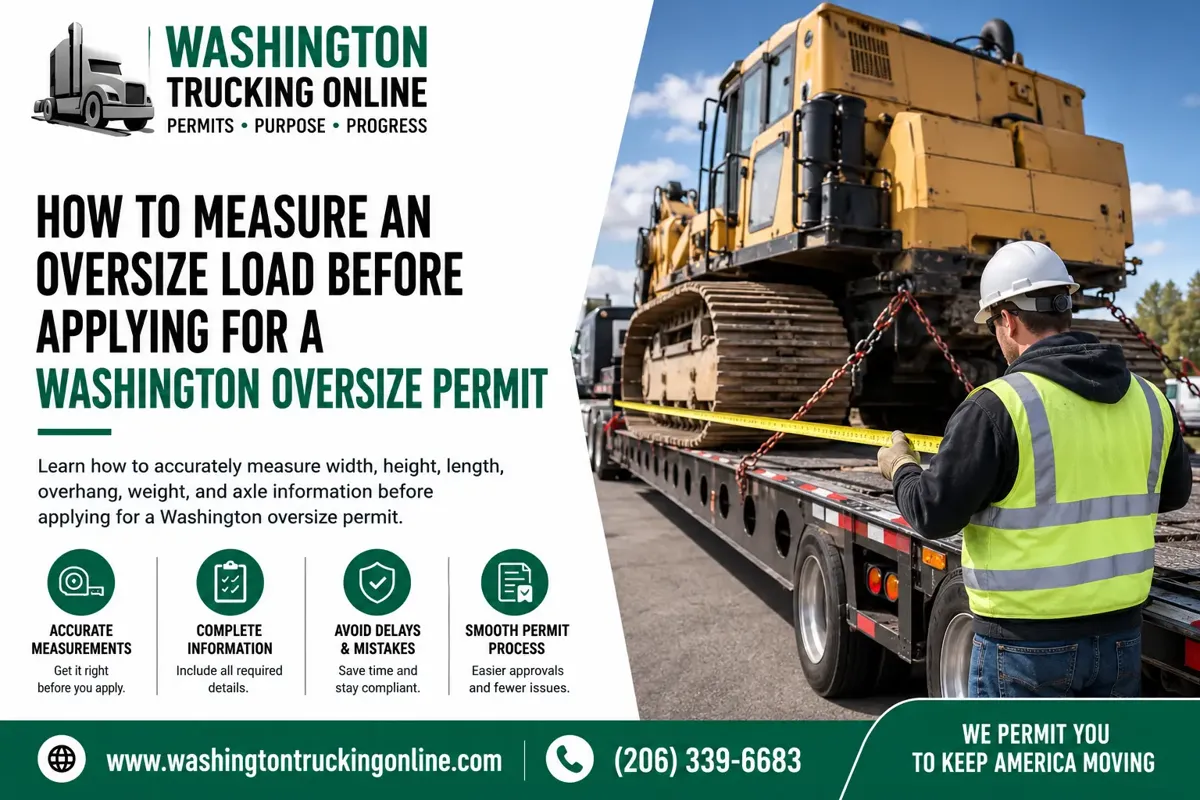
How To Measure An Oversize Load Before Applying For A Washington Permit
Table Of Contents
-
Introduction
-
Why Accurate Measurements Matter
-
Prepare The Vehicle And Load Before Measuring
-
Measure The Overall Width
-
Measure The Overall Height
-
Measure The Overall Length
-
Check Front And Rear Overhang
-
Measure The Loaded Vehicle, Not Just The Cargo
-
Record Weight And Axle Information
-
Double-Check Your Measurements
-
Common Measurement Mistakes To Avoid
-
Why Many Trucking Companies Choose Our Service
-
FAQ
Introduction
Before applying for a Washington oversize permit, trucking companies should have accurate measurements for the complete vehicle and load. The information submitted with the application should match the configuration that will actually travel.
Width, height, length, overhang, weight, and axle information can all affect permitting requirements. Measuring the load carefully before applying can help prevent incorrect information and unnecessary delays.
Why Accurate Measurements Matter
An oversize permit is based on the actual vehicle and load configuration. Measuring only the cargo may not provide an accurate picture of the completed combination.
Cargo placement, trailer type, attachments, and projections can all change the final dimensions. Accurate measurements also provide important information for determining appropriate routing and permit requirements.
Prepare The Vehicle And Load Before Measuring
Before measuring, configure the tractor, trailer, and cargo as they will be transported. The cargo should be properly positioned and secured, and the trailer should be in its normal operating position.
Use appropriate measuring equipment and check the load from multiple angles. The goal is to determine the dimensions of the actual transportation configuration rather than relying on estimates or older measurements.
Measure The Overall Width
Identify the widest point of the complete loaded vehicle. Include the cargo and any components that extend outward, such as attachments, platforms, outriggers, or other projections.
Washington's standard legal width is generally 8 feet 6 inches. Measure the actual loaded configuration rather than relying only on the manufacturer's stated equipment width.
Measure The Overall Height
Measure from the ground to the highest point of the loaded vehicle. Include the trailer, cargo, and any equipment positioned above the main load.
Washington's standard legal height is generally 14 feet. Make sure the vehicle is in its normal transportation configuration when taking the measurement, since cargo placement and trailer position can affect the final height.
Measure The Overall Length
Measure the complete combination, including the tractor, trailer, cargo, and applicable projections. Do not use the cargo's individual length as the overall vehicle length.
For long equipment and machinery, carefully check both the front and rear points of the complete configuration before entering the information on the permit application.
Check Front And Rear Overhang
If cargo extends beyond the front or rear of the trailer, measure the projection accurately. Long items such as beams, poles, machinery, and structural components may require particular attention.
Record the applicable front and rear overhang separately so the permit application accurately represents the loaded configuration.
Measure The Loaded Vehicle, Not Just The Cargo
One common mistake is measuring the cargo without considering the tractor and trailer. The complete combination should be evaluated before the application is submitted.
Check the tractor, trailer, cargo position, overall dimensions, and any projections. A load that is within legal dimensions by itself may become oversize once it is placed on a particular trailer.
Record Weight And Axle Information
Dimensions are only part of the information needed for a Washington permit. Trucking companies should also verify the gross vehicle weight, individual axle weights, number of axles, axle spacing, and load distribution.
Cargo placement can affect how weight is distributed across the axles. Make sure the weight information corresponds to the actual configuration that will be used for transportation.
Double-Check Your Measurements
After recording the dimensions, review them before starting the permit application. Recheck the widest point, highest point, overall length, and front and rear projections.
Having another person verify the measurements can also be helpful. A second check may identify an attachment or projection that was overlooked during the initial measurement.
Common Measurement Mistakes To Avoid
Estimating dimensions: Use actual measurements instead of approximate figures.
Measuring only the cargo: Consider the tractor, trailer, and cargo as one complete configuration.
Ignoring attachments: Equipment components can increase the overall width or height.
Forgetting overhang: Long cargo may extend beyond the front or rear of the trailer.
Measuring before loading: The final cargo position can change the dimensions.
Using old measurements: A different trailer, vehicle, or load configuration may require new measurements.
Providing inconsistent information: The application should accurately describe the vehicle and load that will actually travel.
Taking a few extra minutes to verify the information can help reduce avoidable application problems.
Why Many Trucking Companies Choose Our Service
Many trucking companies choose Washington Trucking Online because applying for an oversize permit requires accurate vehicle and load information, and even small mistakes can make the process more complicated. Our experienced permit specialists help trucking companies prepare their applications with the necessary details and avoid common application issues.
With fast processing, 24/7 customer support, weekend and holiday availability, a secure online application, competitive pricing, and experienced permit specialists, Washington Trucking Online provides a convenient way to handle Washington oversize permits and keep the permitting process organized.
Apply for your Washington oversize permit today.
FAQ
What should I measure before applying for a Washington oversize permit?
Measure the complete loaded vehicle, including overall width, height, length, applicable overhang, weight, axle configuration, and axle spacing.
Should I measure the cargo separately from the vehicle?
The cargo can be measured separately for reference, but the final permit information should represent the complete loaded vehicle and trailer configuration.
When should I measure the load?
Measurements should ideally be verified after the cargo has been loaded and positioned on the trailer.
Does cargo placement affect the measurements?
Yes. Cargo placement can affect overall height, length, overhang, weight distribution, and axle weights.
What happens if the measurements on my application are incorrect?
Incorrect information can result in application corrections, delays, or problems with the permitted movement. Measurements should be carefully verified before submission.
Do I need to measure overhang separately?
Yes. If cargo extends beyond the applicable front or rear reference points, the amount of overhang should be accurately determined.
Is measuring the cargo enough to determine whether I need an oversize permit?
No. The complete vehicle and load configuration should be considered, including the tractor, trailer, cargo, dimensions, weight, and axle configuration.
For more information, visit the Washington State Department of Transportation.