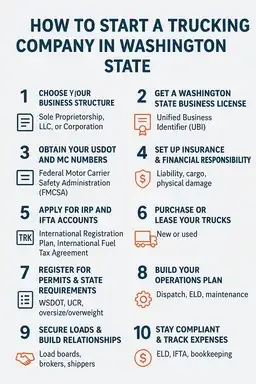
How to Start a Trucking Company in Washington State (2025 Guide)
Starting a trucking company in Washington can be profitable — the state is a major freight corridor for West Coast trade, agriculture, and port exports. However, it also requires careful planning, compliance with both federal and state regulations, and good financial management.
Step 1: Choose Your Business Structure
Decide what type of business entity to register:
-
Sole Proprietorship – simplest, but no liability protection
-
LLC (Limited Liability Company) – most common for small carriers (protects personal assets)
-
Corporation (S or C Corp) – best for larger fleets or investors
Register your business with the Washington Secretary of State:
https://www.sos.wa.gov/corps
Step 2: Get a Washington State Business License
Apply for a Unified Business Identifier (UBI) number and trucking endorsements through the Washington Department of Revenue’s Business Licensing Service.
https://dor.wa.gov/businesses
You’ll select:
-
“For-hire carrier” if hauling for others
-
“Private carrier” if hauling your own goods
You may also need city-level business licenses if you operate or park vehicles in a specific municipality.
Step 3: Obtain Your USDOT and MC Numbers
All commercial carriers crossing state lines or hauling regulated commodities must register with the Federal Motor Carrier Safety Administration (FMCSA):
-
USDOT Number – identifies your company and safety record
-
MC (Motor Carrier) Number – allows you to haul freight for hire
https://www.fmcsa.dot.gov/registration
If you plan to operate only within Washington, you may still need a USDOT number for intrastate carriers.
Step 4: Set Up Insurance & Financial Responsibility
FMCSA and Washington require proof of insurance before you can operate:
Minimum coverage:
-
$750,000 liability (general freight)
-
$1,000,000 for oil
-
$5,000,000 for hazardous materials
-
$100,000 cargo insurance (recommended or required for brokers)
Tip: Most new carriers pay higher premiums at first — work with a trucking-specialized insurance broker to bundle liability, cargo, and physical damage coverage.
Step 5: Apply for IRP and IFTA Accounts
If you operate across state lines, you’ll need:
-
IRP (International Registration Plan) – for apportioned license plates
-
IFTA (International Fuel Tax Agreement) – to simplify fuel tax reporting
These are handled through the Washington Department of Licensing (DOL) Prorate and Fuel Tax Office.
https://dol.wa.gov/
You’ll need to report miles and fuel usage quarterly under IFTA.
Step 6: Purchase or Lease Your Trucks
Choose whether to buy, lease, or lease-on with another carrier.
-
Buy: Full control, higher startup cost
-
Lease: Lower initial cost, limited flexibility
-
Lease-on: Operate under another carrier’s authority (good for first-year learning)
Make sure trucks meet Washington’s emissions and safety standards, especially in King, Pierce, and Snohomish counties.
Step 7: Register for Permits & State Requirements
Depending on your operation, you may need:
-
UCR (Unified Carrier Registration)
-
Oversize/Overweight permits (through WSDOT)
-
Washington State DOT permits if operating intrastate only
WSDOT commercial vehicle services: https://wsdot.wa.gov/travel/commercial-vehicles
Step 8: Build Your Operations Plan
Key elements for success:
-
Dispatch system (software or service)
-
ELD (Electronic Logging Device) for tracking hours of service
-
Fuel management (use IFTA-friendly fuel cards)
-
Driver qualification files (keep employment, drug test, medical cards)
-
Maintenance program (scheduled preventive maintenance)
Step 9: Secure Loads & Build Relationships
Start finding freight through:
-
Load boards (DAT, Truckstop, 123LoadBoard)
-
Freight brokers and shippers
-
Local industries (ports, warehouses, agriculture, manufacturing)
Pro Tip: Focus on one niche — e.g., refrigerated freight, flatbed, or regional LTL — to build a reputation faster.
Step 10: Stay Compliant & Track Expenses
Ongoing compliance includes:
-
Quarterly IFTA reports
-
Annual USDOT updates
-
Vehicle inspections and maintenance logs
-
Business taxes and state renewals
Use bookkeeping software (e.g., TruckingOffice, RigBooks, or QuickBooks for Truckers) to manage miles, fuel, and invoices.
Estimated Startup Costs (Single-Truck Operation)
| Expense | Estimated Cost |
|---|---|
| Truck & trailer | $60,000–$150,000 |
| Licensing, permits, and authority | $2,000–$4,000 |
| Insurance (first year) | $10,000–$20,000 |
| ELD & compliance equipment | $500–$1,500 |
| Working capital (fuel, repairs, tolls) | $5,000–$10,000 |
Total: ~$80,000–$180,000 (depending on truck type and financing)
Pro Tips for Success
✅ Keep maintenance and safety records — Washington enforces strict inspections.
✅ Join the Washington Trucking Associations (WTA) for advocacy, training, and resources.
✅ Build a fuel and route strategy to minimize tolls and congestion (especially near Seattle).
✅ Network with brokers, ports, and shippers to establish consistent lanes.