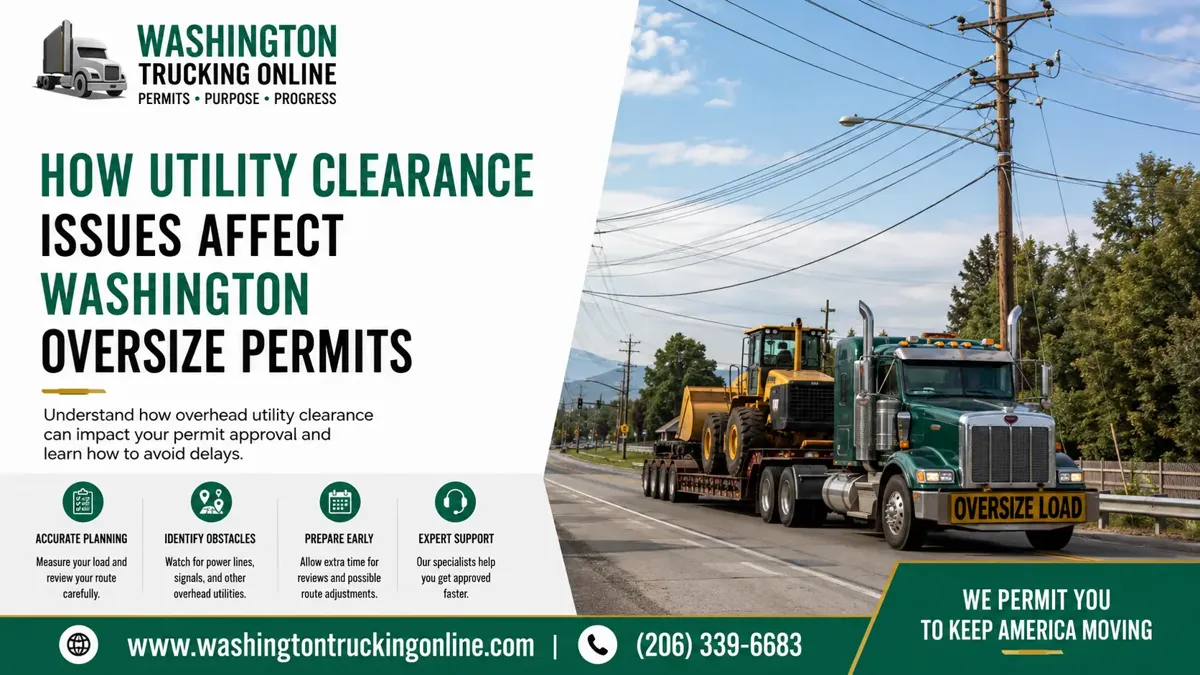
How Utility Clearance Issues Affect Washington Oversize Permits
Table Of Contents
-
Introduction
-
What Are Utility Clearance Issues?
-
Why Utility Clearance Is Important for a Washington Oversize Permit
-
Common Utility Obstacles That Can Affect Your Route
-
How Utility Clearance Issues Can Delay Your Washington Oversize Permit
-
How To Reduce Utility-Related Delays
-
Why Many Trucking Companies Choose Our Service
-
FAQ
Introduction
Applying for a Washington Oversize Permit involves much more than providing vehicle dimensions and selecting a travel route. Every oversize movement must be reviewed to ensure it can be completed safely while protecting public infrastructure and other motorists. One factor that is often overlooked during the application process is utility clearance. Overhead power lines, communication cables, traffic signals, railroad equipment, and temporary utility installations can all affect whether a proposed route is approved for travel.
If a shipment does not have sufficient overhead clearance along its intended route, additional reviews may be required before a Washington Oversize Permit can be issued. In some cases, carriers may need to select a different route or comply with special permit conditions. Understanding how utility clearance issues affect the permitting process allows trucking companies to prepare more accurate applications, reduce unnecessary delays, and keep deliveries on schedule.
What Are Utility Clearance Issues?
Utility clearance refers to the vertical distance between the roadway and overhead infrastructure. Although bridges and overpasses receive significant attention during route planning, utility structures can create just as many challenges for overheight loads.
Examples of overhead utilities include electrical transmission lines, local power distribution lines, telephone cables, fiber optic communication lines, traffic signals, railroad crossing equipment, decorative street lighting, and temporary construction utilities.
When applying for a Washington Oversize Permit, WSDOT evaluates the total loaded height of the vehicle together with the proposed travel route. If the load approaches or exceeds available overhead clearance, additional review may be required before travel can be authorized.
Because every shipment is different, carriers should always measure the completed load rather than relying on estimated equipment specifications. Even a small difference in height may determine whether a route is approved or whether another route must be selected.
Why Utility Clearance Is Important for a Washington Oversize Permit
Utility infrastructure provides critical services throughout Washington. Damaging electrical lines, communication systems, or traffic control equipment can create safety hazards, interrupt public services, delay transportation projects, and result in expensive repairs.
To help prevent these problems, utility clearance plays an important role in the Washington Oversize Permit review process. Permit reviewers evaluate whether the proposed route provides adequate overhead clearance for the dimensions listed in the application. If potential conflicts are identified, additional review may be necessary before approval is granted.
Proper planning benefits both the public and trucking companies. Discovering a clearance issue after an oversize load has entered the roadway can result in emergency rerouting, delivery delays, additional operating costs, or permit violations. Identifying potential obstacles before travel begins allows carriers to avoid many of these problems.
Roadway conditions may also change because of construction projects, maintenance work, or temporary utility installations. For this reason, previously approved routes should never be assumed to remain suitable for future shipments.
Common Utility Obstacles That Can Affect Your Route
Several types of overhead infrastructure may affect whether a Washington Oversize Permit can be approved for a specific route.
Common utility obstacles include:
-
Electrical transmission lines
-
Local power distribution lines
-
Telephone and fiber optic cables
-
Traffic signals and signal support arms
-
Railroad crossing equipment
-
Decorative street lighting
-
Temporary construction utilities
-
Municipal communication systems
These obstacles may appear anywhere along the route, including highways, city streets, industrial areas, and construction zones. Some may require only minor route adjustments, while others may require a completely different travel path.
Careful route planning before submitting a Washington Oversize Permit application helps identify potential conflicts early and reduces the likelihood of unexpected delays.
How Utility Clearance Issues Can Delay Your Oversize Permit
Utility clearance concerns do not automatically prevent a Washington Oversize Permit from being approved, but they can extend the review process.
If reviewers determine that a shipment may come too close to overhead infrastructure, several additional steps may become necessary. Depending on the circumstances, WSDOT may review alternate routes, request additional vehicle measurements, coordinate with utility providers, or require special travel conditions before authorizing movement.
Incomplete or inaccurate applications are another common source of delays. Incorrect height measurements or missing vehicle information make it difficult to determine whether sufficient clearance exists along the proposed route. As a result, reviewers may request corrections before continuing the permit review process.
Planning ahead and submitting complete, accurate information gives reviewers everything they need to evaluate the application efficiently while minimizing unnecessary delays.
How To Reduce Utility-Related Delays
Although some utility clearance reviews are unavoidable, trucking companies can take several steps to improve the permitting process.
Helpful practices include:
-
Measure the fully loaded vehicle accurately.
-
Verify every vehicle and load dimension before applying.
-
Review the proposed route for possible overhead obstacles.
-
Double-check all permit application information.
-
Allow extra processing time for unusually tall loads.
-
Respond quickly to requests for additional information.
-
Work with experienced permit specialists familiar with Washington requirements.
Accurate planning reduces the likelihood of revisions and helps reviewers evaluate applications more efficiently. Taking time to prepare complete documentation before submitting a Washington Oversize Permit application can save valuable time later in the process.
Why Many Trucking Companies Choose Our Service
At Washington Trucking Online, we make obtaining a Washington Oversize Permit simple, fast, and reliable. Our experienced permit specialists carefully review every application for accuracy to help reduce delays caused by common filing mistakes.
We provide 24/7 customer support, remain available on weekends and holidays, and offer fast permit processing, competitive pricing, and a secure online application process for your convenience. Whether you need a Washington Oversize Permit, Trip Permit, Fuel Permit, or other trucking permits, our knowledgeable team is committed to providing dependable service that helps keep your business moving.
Submit your permit application today!
FAQ
What is utility clearance?
Utility clearance is the vertical space between the roadway and overhead infrastructure, including power lines, communication cables, traffic signals, and similar structures.
Can utility clearance delay my Washington Oversize Permit?
Yes. If additional review or coordination is required because of overhead utilities, approval of your Washington Oversize Permit may take longer.
Does every Washington Oversize Permit require utility clearance review?
No. Additional review generally depends on the overall height of the vehicle and cargo together with the proposed travel route.
Can WSDOT require a different route for my Washington Oversize Permit?
Yes. If adequate overhead clearance is unavailable, WSDOT may require an alternate route or add special travel conditions to the permit.
How can I reduce delays when applying for a Washington Oversize Permit?
Accurately measuring your loaded vehicle, submitting complete application information, planning ahead, and working with an experienced permit service can help reduce delays.
For more information, visit the Washington State Department of Transportation Commercial Vehicle Services.