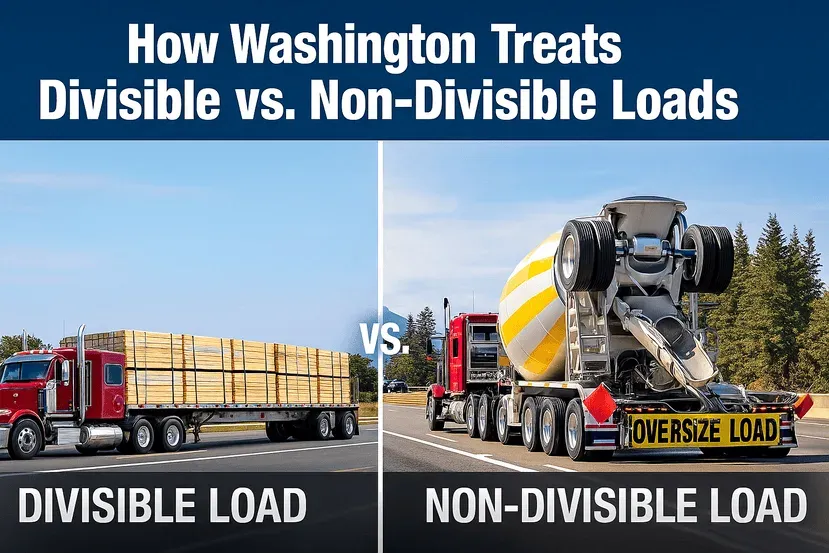
1. What Is a Divisible Load in Washington?
A divisible load is any cargo that can be safely divided into smaller parts in a reasonable amount of time, using standard equipment, without causing:
-
Damage to the cargo
-
Safety risks
-
An unreasonable increase in cost
Examples of divisible loads
-
Lumber
-
Palletized goods
-
Construction materials
-
Crushed rock or sand
-
Agricultural products
-
Steel coils
-
Pipe sections
-
Vehicles or equipment that can be removed from trailers
Washington does NOT issue oversize permits for any load considered divisible.
If the load exceeds legal weight or dimensions and can be reduced, the carrier must divide it.
2. Legal Dimensions for Divisible Loads
Divisible loads must stay within Washington’s standard limits:
-
Width: 8 ft 6 in
-
Height: 14 ft
-
Length:
-
53 ft semi-trailer
-
75 ft overall STAA combinations
-
-
Weight:
-
20,000 lbs per axle
-
34,000 lbs tandem
-
80,000 lbs GVW (federal formula applies)
-
Divisible loads cannot exceed these limits and still receive an oversize permit.
3. What Is a Non-Divisible Load in Washington?
A non-divisible load is cargo that cannot be separated into smaller units without:
-
Damaging the item
-
Making it unusable
-
Compromising safety
-
Requiring more than eight working hours to dismantle
-
Requiring specialized dismantling equipment
Federal rules (49 CFR § 658.5) guide Washington’s definition.
Examples of non-divisible loads
-
Wind turbine blades
-
Transformers
-
Large tanks
-
Industrial machinery
-
Excavators and heavy equipment
-
Bridge beams
-
Boats and yachts
-
Prefabricated buildings
-
Concrete beams and girders
Washington allows oversize/overweight permits ONLY for non-divisible loads.
4. When Washington Allows Exceptions
Washington may allow limited exceptions for certain bulk commodities under specific permit programs:
Examples
-
Log truck permits
-
Raw milk permits
-
Non-overweight “permit log” operations
These programs typically involve gross-weight allowances—not oversize dimensions.
Bulk goods that can be shifted or rearranged still count as divisible and do not qualify for oversize permits.
5. Multi-Piece Non-Divisible Loads
Washington permits allow a single non-divisible load plus additional small items, but only if:
-
The extra items do not require additional axle weight
-
They do not cause oversize dimensions
-
They don’t increase the permit classification
Example:
A carrier hauling a single excavator (non-divisible) may also transport its removable bucket or small tools, provided they do not change the permitted dimensions or weight.
6. Weight Rules for Non-Divisible Loads
Washington allows overweight permits for non-divisible loads based on:
-
Axle limits
-
Axle spacing
-
Bridge formula results
-
Route analysis
Common Washington overweight permits include:
-
Single-trip overweight permits
-
Continuous operation overweight permits (limited applicability)
-
Special log hauling overweight rules
-
Special hauling permits for cranes and construction machinery
7. Oversize Rules for Non-Divisible Loads
Oversize permits for non-divisible loads allow movement above the legal limits:
Potential allowances
-
Width: Over 8’6”
-
Height: Over 14’
-
Length: Over 53’ or 75’, depending on configuration
-
Overhang: Extended front or rear projections
For extreme sizes (superloads), WSDOT may require:
-
Detailed route surveys
-
Travel restrictions
-
Pilot/escort cars
-
Utility notifications
-
Traffic control plans
8. Consequences of Hauling Divisible Loads Without Reducing Them
If a load is found to be divisible but hauled under oversize permit:
-
Permit becomes invalid
-
Driver may be cited and fined
-
Load may be required to be reduced immediately
-
Carrier could be placed out of service
-
Repeat violations may trigger permit suspensions
Washington takes this seriously because divisible-load violations undermine safety and damage infrastructure.
9. Key Differences at a Glance
| Category | Divisible Loads | Non-Divisible Loads |
|---|---|---|
| Can you break it down? | Yes | No |
| Oversize permits allowed? | No | Yes |
| Overweight permits allowed? | Limited | Yes |
| Common examples | Pallets, lumber, gravel | Machinery, turbines, beams |
| Special exceptions? | Very few | Many |
10. Key Takeaways
-
Washington strictly follows federal rules on divisible vs. non-divisible loads.
-
Divisible loads cannot receive oversize permits.
-
Non-divisible loads are eligible for oversize/overweight permits.
-
There are limited exceptions for certain commodities.
-
Violating the rule can lead to citations, delays, and permit suspensions.