1. Legal Size & Weight Limits
Washington (WA)
-
Width: 8’6”
-
Height: 14’
-
Length: Varies by vehicle type; combinations commonly allowed up to 75’
-
Weight: Follows federal bridge formula; max 105,500 lbs with required permits and axle spacing
Oregon (OR)
-
Width: 8’6”
-
Height: 14’
-
Length: Typically more flexible; long combination vehicles (LCVs) up to 105’ on approved routes
-
Weight: Up to 105,500 lbs allowed with permits; Oregon provides more generous axle group rules
Idaho (ID)
-
Width: 8’6”
-
Height: 14’
-
Length: LCVs up to 115’ on designated routes
-
Weight: Can exceed 129,000 lbs on approved routes—Idaho is the most weight-flexible of the three
Summary:
Oregon and Idaho accommodate longer vehicle combinations; Idaho allows the heaviest loads.
2. Oversize Permit Types & Online Systems
Washington
-
Uses online permit portal - www.washingtontruckingonline.com
-
Offers Single-Trip, Annual, and Envelope permits
-
Routing must comply with strict bridge and mountain pass restrictions
Oregon
-
Uses the Oregon Trucking Online - www.oregontruckingonline.org
-
Offers Single-Trip, Annual, Continuous Operation, and specialized permits
-
Known for clear routing maps and detailed OS/OW route guidance
Idaho
-
Uses Idaho's Online Permitting System (ITD)
-
Offers Single-Trip, Annual, and Extra-Length permits
-
Includes special permits for high weights exceeding federal limits
Summary:
Oregon has the most streamlined and user-friendly system; Washington has the most constrained routing.
3. Pilot Car Requirements
Washington
-
More restrictive for escorts—often requires pilot cars earlier at lower dimensions
e.g., width over 11’ may trigger escort requirements on many routes.
Oregon
-
Escort thresholds differ by corridor; some routes allow wider loads without pilot cars
-
Uses detailed district escort charts
Idaho
-
Generally more permissive than WA and OR
-
Escort requirements increase mainly in high-traffic or mountainous areas
Summary:
Washington is the strictest with pilot car rules; Idaho the most flexible.
4. Travel Hour Restrictions
Washington
-
OS/OW travel often restricted during peak traffic hours, especially in Seattle/Tacoma
-
Holiday and weekend restrictions apply
Oregon
-
Restrictions depend on size and corridor
-
Agricultural and forest industry loads often have seasonal allowances
Idaho
-
Fewer restrictions overall
-
Many OS/OW loads allowed to travel during daylight hours year-round
Summary:
Washington has the tightest travel restrictions; Idaho the least restrictive.
5. Route Challenges & Geography
Washington
-
Mountain passes with seasonal chain requirements
-
Numerous low-clearance bridges
-
Heavily congested urban corridors
Oregon
-
Coastal and mountain terrain present seasonal challenges
-
However, Oregon provides better OS/OW route planning tools
Idaho
-
Long rural highways with fewer congestion points
-
Easier routing for tall and heavy loads
Summary:
Washington is the most challenging for route planning due to population density and geography.
6. Permit Pricing & Processing Speed
Washington
-
Annual and single-trip permits priced competitively but route approvals can take longer for specialized loads
Oregon
-
Oregon’s permit fees are moderate
-
Known for very quick processing and automated routing approval
Idaho
-
Permit fees are generally lower
-
Fast processing, especially for routine loads
Final Comparison Snapshot
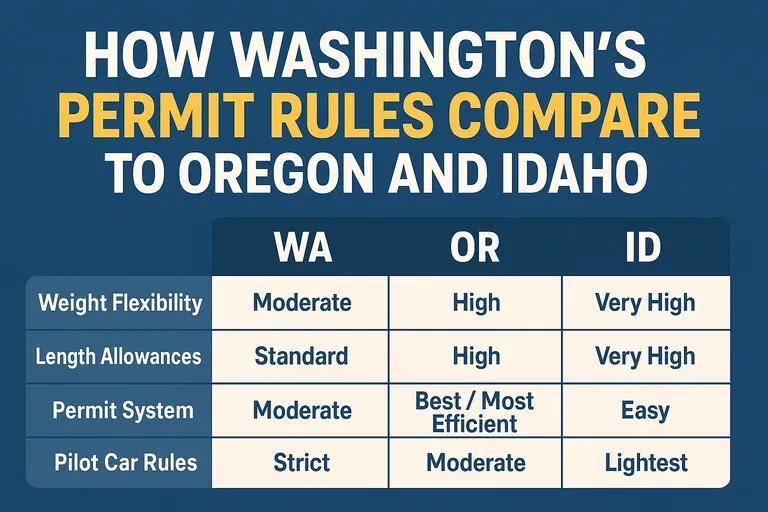
| Feature | Washington | Oregon | Idaho |
|---|---|---|---|
| Weight Flexibility | Moderate | High | Very High |
| Length Allowances | Standard | High | Very High |
| Permit System | Moderate | Best / Most Efficient | Easy |
| Pilot Car Rules | Strict | Moderate | Lightest |
| Travel Restrictions | Most restrictive | Moderate | Least |
| Routing Challenges | Highest | Medium | Low |