1. General Permit Administration
| State | Agency Responsible | Online Permit System | Notes |
|---|---|---|---|
| Washington (WA) | Washington State Department of Transportation (WSDOT) | WSDOT Electronic Permit System (EPS) | One of the most automated systems in the region. |
| Oregon (OR) | Oregon Department of Transportation (ODOT), Motor Carrier Transportation Division | Oregon Trucking Online (TOL) | Requires carriers to maintain an ODOT account for annual and single-trip permits. |
| Idaho (ID) | Idaho Transportation Department (ITD), Permit Office | ITD Online Permitting Portal | Allows trip-specific and annual oversize permits. |
Common Ground: All three states use online portals for oversize/overweight permit applications and allow payment by credit card or carrier account.
2. Oversize Load Dimension Limits
| Measurement | Washington | Oregon | Idaho |
|---|---|---|---|
| Maximum Width (without permit) | 8’6” | 8’6” | 8’6” |
| Maximum Height (without permit) | 14’ | 14’ | 14’ |
| Maximum Length (single vehicle) | 40’ | 45’ | 45’ |
| Maximum Length (combination) | 75’ | 75’ | 75’ |
Key Difference: Washington limits single-unit vehicles to 40 feet, while Oregon and Idaho allow up to 45 feet.
All three require permits for loads exceeding standard dimensions, but Oregon tends to issue more flexible annual oversize permits for recurring routes.
3. Overweight and Axle Regulations
| Rule | Washington | Oregon | Idaho |
|---|---|---|---|
| Max Gross Weight (without permit) | 80,000 lbs | 80,000 lbs | 80,000 lbs |
| Bridge Formula Used | Federal + State Additions | Federal Formula | Federal Formula |
| Single Trip Overweight Permits | Yes | Yes | Yes |
| Annual Overweight Permits | Limited | Yes (for specific commodities/routes) | Yes |
Washington applies additional state bridge restrictions more stringently than Oregon or Idaho, especially in coastal and western regions.
4. Escort and Pilot Car Requirements
| Load Type | Washington | Oregon | Idaho |
|---|---|---|---|
| Width 12’–14’ | 1 rear escort | 1 front or rear (depends on route) | 1 escort |
| Width >14’ | 2 escorts (front and rear) | 2 escorts | 2 escorts |
| Height >14’6” | May require route survey | Requires route survey | Requires route survey |
Key Point: Oregon and Idaho often require front escorts earlier (from 12’ wide), while Washington is more route-specific and may allow exceptions with route engineering approval.
5. Travel Time and Restrictions
| Factor | Washington | Oregon | Idaho |
|---|---|---|---|
| Weekend Travel | Restricted for oversize loads | Restricted after noon Sat | Allowed with some limits |
| Holiday Travel | No travel on major holidays | Restricted | Restricted |
| Night Travel | Allowed under 10’ wide | Case-by-case | Case-by-case |
Washington and Oregon both limit oversize movement during peak traffic and holidays, while Idaho is generally more flexible but still requires daytime movement for superloads.
6. Permit Fees and Validity
| Type | Washington | Oregon | Idaho |
|---|---|---|---|
| Single Trip Permit | ~$20–40 | ~$8–20 | ~$30–50 |
| Annual Permit (OS/OW) | ~$200–500 | ~$200–600 | ~$150–400 |
| Permit Validity (Single Trip) | 3 days | 10 days | 5 days |
Oregon permits last the longest (10 days), making it more cost-effective for carriers moving multiple loads through the state.
7. Enforcement and Compliance
-
Washington: Strict enforcement by Washington State Patrol (WSP) at weigh stations and on-road inspections.
-
Oregon: Enforcement by ODOT and Oregon State Police, with integrated data sharing through Oregon Trucking Online.
-
Idaho: Compliance monitored by ITD Commercial Vehicle Services and state patrol officers.
Tip: Always carry a printed or electronic copy of your valid permit — all three states verify permits electronically, but roadside officers may still request documentation.
8. Cross-Border Operations
Carriers hauling between these states must pay attention to:
-
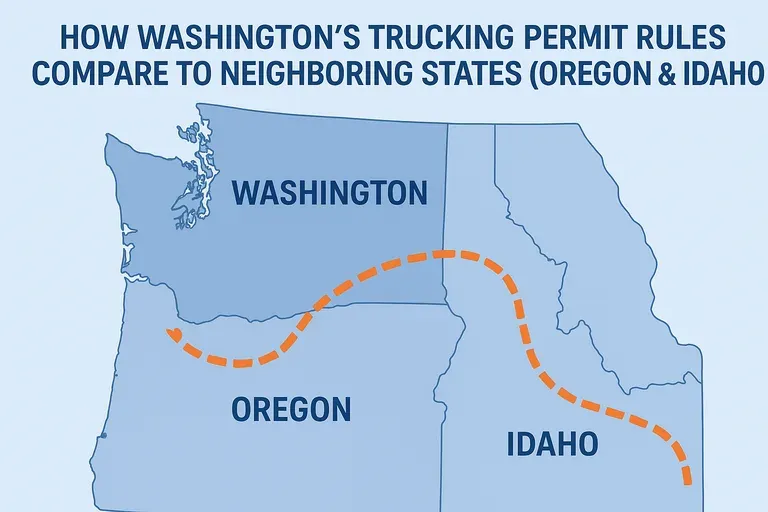
Route continuity: Some approved Washington routes do not directly align with Oregon or Idaho’s oversize corridors.
-
Permit overlap: You’ll need separate state permits; there’s no “regional” or “reciprocal” OS/OW permit.
-
Port of Entry checks: Especially critical when crossing from Oregon into Washington or vice versa.
Bottom Line
While Washington, Oregon, and Idaho share similar federal weight and size standards, the biggest differences lie in enforcement, routing flexibility, and permit validity.
-
Washington = strict bridge compliance and travel-hour rules
-
Oregon = carrier-friendly online system and flexible duration
-
Idaho = practical approach with simpler escort requirements
For seamless multi-state operations, carriers should plan permits together, align travel windows, and verify routes before departure to avoid costly interruptions at borders.