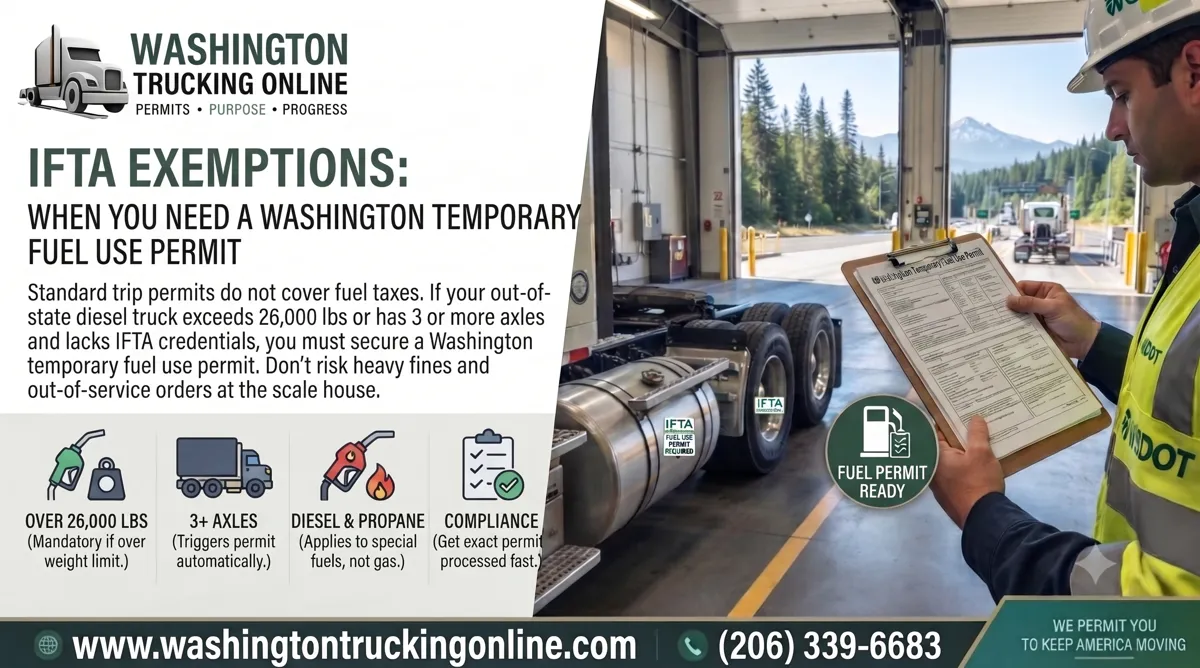
IFTA Exemptions: When You Need a Washington Temporary Fuel Use Permit
Table of Contents
-
Introduction
-
The Difference Between a Trip Permit and a Fuel Use Permit
-
Who Needs a Washington Temporary Fuel Use Permit
-
The 26,000-Pound and Three-Axle Rule
-
Consequences of Missing Your Fuel Use Permit
-
Why Many Trucking Companies Choose Our Service
-
Frequently Asked Questions
Introduction
Successfully navigating commercial routes into the Pacific Northwest requires absolute precision. Many out-of-state fleet operators and dispatchers know they need a Washington 3-day temporary trip permit to cross the state line. However, a common and expensive mistake is assuming that a standard trip permit covers all regulatory obligations. It does not.
The trip permit only grants temporary registration and weight authority. It does not cover fuel taxes. If your commercial vehicle is powered by diesel or propane and you do not participate in the International Fuel Tax Agreement (IFTA), you will likely need a temporary fuel use permit alongside your standard trip permit.
Failing to secure this specific document before entering Washington can lead to severe fines and out-of-service orders at the port of entry. This guide breaks down the exact weight limits, axle configurations, and IFTA exemptions that trigger the need for a Washington temporary fuel use permit. It will help your dispatch team ensure perfect compliance every single time your trucks head west.
The Difference Between a Trip Permit and a Fuel Use Permit
When a truck pulls into a Washington State Department of Transportation (WSDOT) scale house, enforcement officers check for two distinct types of temporary authority if the truck is not fully apportioned.
The temporary trip permit acts as your vehicle registration. It proves you have the legal right to operate a commercial vehicle of a certain weight on public highways for a 72-hour period. It is essentially a substitute for having Washington listed on your International Registration Plan cab card.
The temporary fuel use permit is entirely separate. Washington, like most states, heavily taxes commercial fuel to fund highway maintenance. If your truck is not registered under IFTA, the state has no way to track and tax the fuel you consume while driving within its borders. The temporary fuel use permit serves as an upfront tax payment, allowing you to operate legally without filing a quarterly IFTA return for Washington. Buying one permit does not automatically grant you the other, and officers will specifically look for both documents during an audit.
Who Needs a Washington Temporary Fuel Permit
Not every out-of-state truck needs a fuel use permit. The requirement hinges entirely on your vehicle weight, your axle count, your fuel type, and your current IFTA status.
If your trucking company already holds an active IFTA license and carries the correct decals, you do not need a temporary fuel use permit. Your fuel consumption in Washington will simply be calculated and paid during your regular quarterly IFTA tax filings.
However, you must purchase a Washington temporary fuel permit if you meet all of the following conditions:
-
Your vehicle is not operating under an active IFTA license.
-
Your vehicle is powered by special fuels, which primarily includes diesel and propane.
-
Your vehicle meets specific weight or axle thresholds defined by the state.
If you operate a gasoline-powered truck, you are generally exempt from the temporary fuel use permit requirement, as gasoline taxes are collected differently at the pump. For diesel and propane trucks, dispatchers must look closely at the weight and axles.
The 26,000-Pound and Three-Axle Rule
Washington enforces strict size and weight triggers for fuel tax liability. If you operate a diesel- or propane-powered commercial vehicle without IFTA credentials, you must purchase a temporary fuel use permit if your truck meets either of these two criteria:
Gross Vehicle Weight Over 26,000 Pounds: If you operate a two-axle commercial vehicle with a gross vehicle weight or registered gross weight exceeding 26,000 pounds, a fuel use permit is mandatory. This rule frequently catches operators of large box trucks, moving vans, and specialized hauling equipment off guard.
Three or More Axles: If your power unit has three or more axles, you must secure a temporary fuel use permit regardless of your gross vehicle weight. Even if you are running completely empty and your truck weighs less than 26,000 pounds, the physical presence of three axles on the power unit triggers the fuel permit requirement automatically.
If your vehicle setup involves a combination, such as a tractor and a trailer, and the combined weight exceeds 26,000 pounds, the rule also applies. Dispatchers must evaluate the entire vehicle configuration before dispatching a truck to the Washington border.
Consequences of Missing Your Fuel Permit
Arriving at a Washington port of entry without the required temporary fuel use permit is treated as a major tax and licensing violation. Enforcement officers at weigh stations like Plymouth, Bow Hill, or Cle Elum will immediately flag the discrepancy during a standard paperwork audit.
If an auditor catches a missing fuel use permit, the truck will be placed out of service immediately. Your driver will be forced to park the truck at the scale facility. They will not be permitted to leave until a brand new, valid temporary fuel use permit is purchased, processed, and properly printed on site.
The financial impact extends far beyond the cost of the permit itself. Your company will face heavy monetary citations from the state for operating without proper tax credentials. More importantly, your driver will be stuck sitting at the weigh station for hours, burning through their available hours of service. This inevitably leads to missed delivery windows, unhappy receivers, and severe financial penalties from your freight brokers. Avoiding these penalties requires securing all necessary permits before entering the state and ensuring your driver has the physical printouts ready.
Why Many Trucking Companies Choose Our Service
Managing multistage logistics leaves no room for administrative guesswork. Determining exactly which permits your trucks need can be complicated, especially when juggling different weights, axle counts, and IFTA statuses. At Washington Trucking Online, we eliminate the friction between your dispatch desk and the WSDOT scale house so you can focus on routing your freight profitably.
Our streamlined permitting platform guarantees absolute compliance through a rigorous validation process. We take the burden of precision off your shoulders by ensuring every detail is correct before submission.
Exact Data Alignment: We meticulously cross-verify your provided vehicle identification numbers, license plates, and operational data against state parameters before processing. This multipoint check ensures total accuracy and eliminates the risk of scale house rejections.
Instant Document Delivery: We process your trip and fuel requests rapidly. We send correctly formatted, print-ready PDFs directly to your inbox or directly to your driver, ensuring they have the exact physical documentation WSDOT demands without unnecessary delays.
Comprehensive Compliance: Whether you need standard 3-day trip passes, unapportioned fuel use permits, or complex oversize routing, we handle all your Washington regulatory needs under one roof. We act as an extension of your compliance team.
FAQ
Does a standard WSDOT trip permit cover my fuel tax obligations?
No. The standard trip permit only covers vehicle weight and registration authority. It does not cover your fuel use. You must purchase a separate temporary fuel use permit if you meet the weight and axle requirements.
Do I need a fuel use permit if I am running empty?
Yes. If your truck has three or more axles, or if it is registered over 26,000 pounds, you still need a fuel use permit even if the trailer is completely empty. The requirement is based on vehicle configuration and registered weight, not your actual payload at the time of crossing.
How long is a temporary fuel use permit valid?
A temporary fuel use permit is valid for exactly three consecutive calendar days, which equates to 72 hours. This time frame mirrors the standard temporary trip permit.
Can I buy a fuel use permit at the port of entry?
While some ports of entry may have facilities to process permits, relying on this approach is highly risky and can lead to major delays. State regulations require you to have the printed, signed permit in hand before you cross the state line. Purchasing in advance through a reliable service is the only way to ensure compliance.