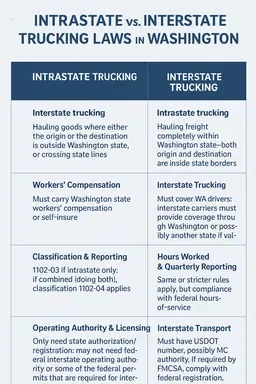
Definitions: Intrastate vs. Interstate in Washington
| Term | What It Means in WA |
|---|---|
| Interstate trucking | Hauling goods where either the origin or the destination is outside Washington state, or crossing state lines. For example, picking up freight in Washington and delivering it to another state |
| Intrastate trucking | Hauling freight completely within Washington state — both origin and destination are inside state borders. |
Rules & Regulations for Each
Here are key areas where Washington law distinguishes between intrastate and interstate trucking, or where different obligations apply:
| Regulatory / Compliance Area | Intrastate Trucking | Interstate Trucking |
|---|---|---|
| Workers’ Compensation & Industrial Insurance | Must carry Washington state workers’ compensation or self-insure if carrying on business within WA. All hours (driving, loading, waiting) must be reported under WA risk class 1102-03 (intrastate). | Likewise must cover WA drivers; interstate carriers must provide coverage either through Washington or possibly another state if valid & recognized. Risk class is 1102-02 for purely interstate operations. |
| Classification & Reporting | Intrastate operations are classified under 1102-03 if intrastate only; if combined (doing both), classification 1102-04 applies. Drivers’ hours must be tracked, capped, etc. | Pure interstate gets 1102-02; combined operations are 1102-04. Interstate classifications may also impact tax and licensing obligations |
| Hours Worked & Quarterly Reporting | Intrastate carriers must keep detailed records, including drivers’ logs, time records, loading/unloading/wait time; maximum hours per driver per quarter (e.g. 520 hours) etc. | Same or stricter rules apply, plus the requirement to comply with federal hours-of-service regulations (for interstate commerce) under FMCSA. If operating interstate, FMCSRs apply. Washington doesn’t relieve interstate carriers of these. |
| Operating Authority & Licensing | Intrastate carriers only need state authorization/registration; may not need federal interstate operating authority or some of the federal permits that are required for interstate commerce. Washington also has state-level registrations, insurance, insurance proof etc. | Must have USDOT number, possibly MC authority, if required by FMCSA, comply with federal registration, insurance minimums, etc. Interstate carriers are under both state and federal oversight. |
| Tax, Use & Exemption Issues | State taxes such as the Washington “use tax” may apply to vehicles/trailers unless a sufficient portion of use is interstate; exemptions may require demonstrating “substantial use” interstate (e.g. 25% or more) via mileage, revenue, or line-crossing methods. | For interstate operations, some exemptions or deductions exist for interstate commerce; interstate hauls may qualify vehicles for certain state use-tax exemptions. Washington law uses the substantial-use test. |
| Federal vs State Regulatory Overlaps | Intrastate operations are subject primarily to Washington State regulations (WAC, WA statutes). However, Washington has adopted many federal standards via state law (for example safety, driver qualification etc.). | Federal laws (FMCSR) apply directly. Interstate carriers must comply with both federal and state regulations. State regulation enforces on top of federal where permitted. |
Key Differences & Practical Implications
-
Complexity & Compliance Burden: Interstate carriers have more layers — federal + state, more permits, more insurance. Intrastate carriers may be simpler but still must maintain state-level compliance in detail.
-
Tax & Financial Implications: Whether the vehicle/trailer qualifies for state tax exemptions depends on how much interstate vs intrastate work is done. Misclassifying may lead to unexpected “use tax” or other state tax liabilities.
-
Insurance & Liability Exposure: Interstate operations generally trigger higher insurance standards and are more likely to be inspected or audited, because of vehicle crossing state jurisdictions and higher risk exposure.
-
Driver Requirements: Some driver credentials, medical certificates, log-keeping, and hours-of-service requirements differ. Interstate drivers must satisfy federal rules; intrastate drivers might have some exemptions, but in Washington many of the safety & hours rules are adopted via state law.
-
Risk Classification & Workers’ Comp: Employers must correctly classify drivers and report hours under Washington’s risk classification system (intrastate, interstate, or combined). Misreporting can result in under-insurance, audits, fines, or coverage gaps.
Washington-Specific Rules & Considerations
-
Washington defines and segments risk class 1102 into 1102-02 (interstate), 1102-03 (intrastate), and 1102-04 (combined). Employers must report using the correct classification.
-
Hours worked: Washington caps driver hours and requires reporting loading, waiting, travel time etc.
-
Tax exemption based on “substantial use” for interstate commerce: For example, a truck or trailer may be exempt from state use tax if used at least 25% in interstate commerce. The methods to calculate that (mileage, revenue, line crossing) are specified.
Risks / Common Pitfalls
-
Misclassifying hauls as intrastate when they should count as interstate (e.g. shipments that cross state line or eventually leave WA) — this can result in tax or regulatory penalties.
-
Failing to track and prove the percentage of interstate use to maintain tax exemptions.
-
Poor recordkeeping of hours, routes, or whether crosses state lines, which can lead to disputes in audits.
-
Overlaps between state vs federal requirements leading to confusion about which rules apply in mixed operations.
-
Insurance coverage gaps if assuming intrastate coverage suffices but getting pulled into interstate operations.