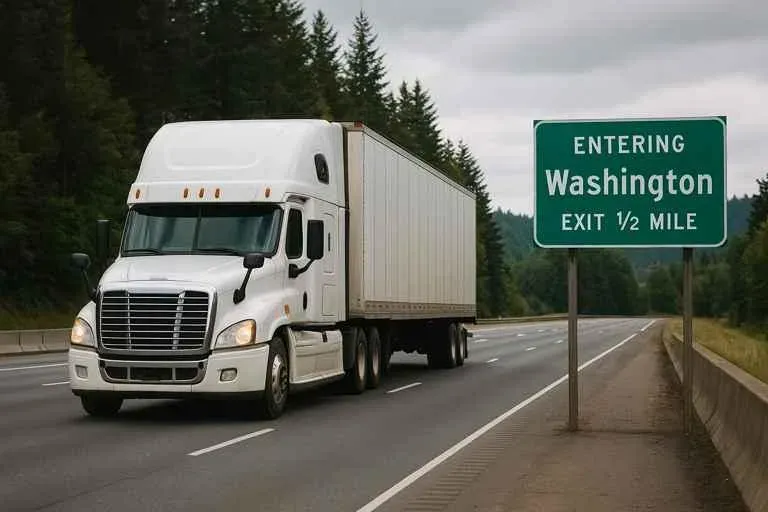
The International Registration Plan (IRP) is an agreement among U.S. states, the District of Columbia, and Canadian provinces that facilitates the equitable distribution of registration fees for commercial vehicles operating across multiple jurisdictions. For Washington-based carriers, proper IRP registration is a critical step to ensure legal interstate operations and avoid costly fines or delays.
1. What is the IRP?
The IRP allows commercial motor carriers to register their fleets in one “base jurisdiction” (state or province) while legally operating in all member jurisdictions.
Fees are apportioned based on the percentage of total miles traveled in each area during the reporting period.
For example, if a Washington-based truck travels 60% of its total miles in Washington and 40% in Oregon, the IRP registration fees will be divided proportionally between those states.
2. Who Must Register Under IRP
You must register under the IRP if your vehicle:
-
Travels in two or more IRP jurisdictions, and
-
Has a gross vehicle weight (GVW) over 26,000 pounds, or
-
Has three or more axles, regardless of weight, or
-
Is part of a fleet used for hire that crosses state or national borders.
Vehicles used only within Washington (intrastate) are not required to have IRP registration.
3. Washington’s IRP Administration
The Washington State Department of Licensing (DOL) manages the IRP program through its Prorate and Fuel Tax Office (PRFT).
Website: dol.wa.gov
Carriers must apply, renew, and manage their accounts through the Prorate and Fuel Tax online portal or by submitting paperwork directly to the DOL.
4. Step-by-Step IRP Registration Process
Step 1: Establish Your Base Jurisdiction
Your base jurisdiction must be Washington if:
-
Your fleet operates primarily from a Washington location;
-
Records of mileage are maintained in Washington; and
-
You accrue distance within the state.
Step 2: Gather Required Documents
Typical documentation includes:
-
Proof of vehicle ownership (title or lease)
-
USDOT number and Federal Employer Identification Number (FEIN)
-
Current safety inspection or lease agreement (if applicable)
-
Proof of insurance
-
Mileage records for the previous reporting year
-
Unified Carrier Registration (UCR) proof of compliance
Step 3: Submit Application
Complete the Schedule A/B forms (for fleet details and jurisdiction mileage) and Schedule C (vehicle list) via the DOL’s online IRP portal.
New carriers can create a Prorate Account at:
https://dol.wa.gov/business/trucking
Step 4: Pay Apportioned Fees
Fees are based on:
-
Vehicle type and weight;
-
Miles driven in each IRP jurisdiction;
-
Each jurisdiction’s per-mile or per-weight rate.
Payments can be made through the DOL’s online system or mailed with supporting documents.
Step 5: Receive Cab Cards and Plates
Once approved, Washington issues:
-
Apportioned plates — displaying the word “Apportioned”;
-
A cab card listing all approved IRP jurisdictions.
These must be carried in the vehicle at all times during operation.
5. Renewals and Recordkeeping
-
IRP registrations must be renewed annually, typically by December 31.
-
Maintain detailed mileage records for each jurisdiction — logs, GPS data, trip sheets, and fuel receipts.
-
The DOL may audit your records at any time to verify accuracy of mileage reporting.
6. Penalties for Non-Compliance
Operating without valid IRP credentials can result in:
-
Fines and impoundment of vehicles at roadside inspections
-
Trip permit requirements for each jurisdiction entered (which are costly and time-consuming)
-
Possible suspension of registration privileges or account audits
7. Temporary Trip Permits
If you’re not IRP-registered but occasionally cross state lines, you can obtain a 72-hour trip permit.
Trip permits are available online through www.washingtontruckingonline.com
8. IRP and IFTA Coordination
IRP registration is closely linked with IFTA (International Fuel Tax Agreement) reporting.
-
IRP covers registration fees, while IFTA covers fuel taxes for multiple jurisdictions.
-
Both programs use similar mileage data, so maintaining accurate trip records ensures compliance for both.
9. Common Mistakes to Avoid
-
Underreporting mileage in certain jurisdictions
-
Missing renewal deadlines
-
Failing to maintain accurate odometer readings or GPS logs
-
Operating with expired cab cards or plates
-
Not updating fleet information after adding/removing vehicles
10. Key Resources
-
Washington DOL IRP Portal: https://dol.wa.gov/business/trucking
-
IRP, Inc. Official Site: https://www.irponline.org
-
Washington State Patrol (WSP) Commercial Vehicle Division: for roadside inspections and enforcement.
-
Prorate and Fuel Tax Office Contact:
-
1125 Washington St SE, Olympia, WA
(360) 664-1858
Summary
The IRP simplifies multi-state trucking operations by consolidating registration into a single base jurisdiction. For Washington carriers, maintaining up-to-date records, timely renewals, and accurate mileage reporting ensures compliance and efficient fleet operations.