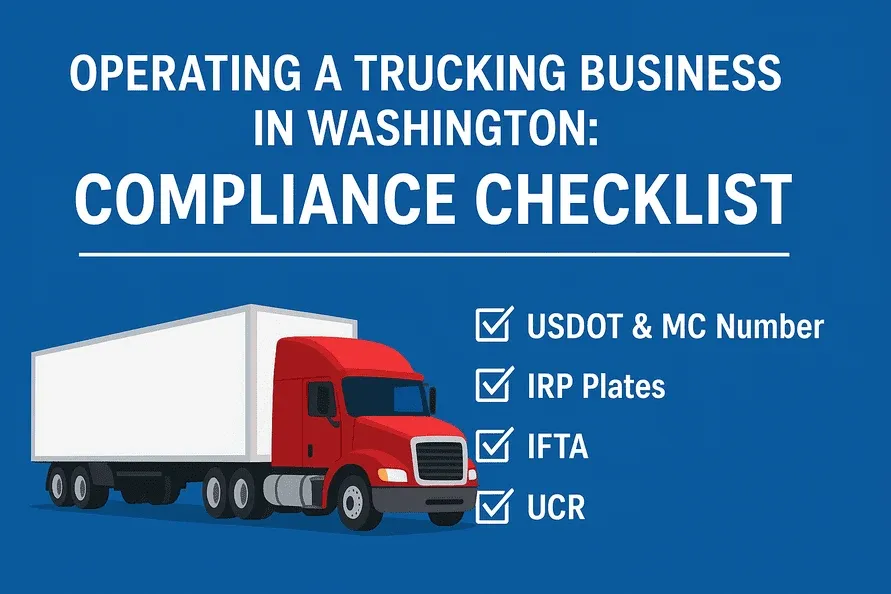
1. Obtain a USDOT and MC Number (If Operating Interstate)
If you plan to haul freight across state lines, you must:
-
Register for a USDOT number
-
Apply for MC Operating Authority through FMCSA
Intrastate carriers may also require a USDOT number depending on vehicle weight and activity.
2. Washington State Business Registration
Every trucking business must:
-
Register with the Washington Secretary of State
-
Obtain a Unified Business Identifier (UBI)
-
File with the Washington Department of Revenue if conducting taxable activity
3. IRP (International Registration Plan) Plates
Interstate carriers must register their vehicles under IRP and apportion plates based on mileage driven in each jurisdiction.
Washington manages IRP through the Department of Licensing (DOL).
4. IFTA Fuel Tax License
If your vehicle:
-
Has 3 or more axles, OR
-
Weighs over 26,000 lbs
…you must register for IFTA, file quarterly fuel tax reports, and maintain mileage records.
5. UCR (Unified Carrier Registration)
All interstate carriers must file UCR annually and keep the receipt on hand for inspections at https://www.fmcsa.me/.
6. Washington Intrastate Operating Requirements
For carriers operating only inside Washington:
-
Obtain the appropriate Intrastate Operating Permit
-
Follow Washington State Patrol (WSP) safety rules
-
Maintain DOT compliance even without MC authority
7. Oversize/Overweight Permits
If your truck exceeds Washington’s size/weight limits, you must purchase:
-
Single-trip OS/OW permits, or
-
Annual permits depending on equipment
Washington also requires specific routing for heavy haul loads.
8. Commercial Vehicle Tax & Fees
Truckers must comply with:
-
Gross Weight License (GWL) fees
-
Road Use and Registration Fees
-
Weight-based taxes depending on configuration
9. Washington Fuel Tax Requirements
Aside from IFTA, non-IFTA carriers must pay:
-
Washington state diesel tax
-
Use tax for off-road equipment
-
Mileage records for fuel verification
10. WSDOT Load Restrictions
Washington applies seasonal load limits on certain roads due to:
-
Freeze/thaw cycles
-
Pavement protection
-
Forest and rural road conditions
Always check WSDOT load restriction maps before planning a route.
11. Safety and Compliance Requirements
Washington trucking businesses must follow:
-
FMCSA safety fitness standards
-
Hours-of-Service (HOS) regulations
-
ELD (Electronic Logging Device) rules
-
Driver qualification files (DQFs)
-
Pre-employment and random drug/alcohol testing
12. Vehicle Inspections & Maintenance
Washington requires:
-
Annual DOT inspections
-
Frequent vehicle maintenance logs
-
Daily DVIR reports
Inspection paperwork must be kept for at least 12 months.
13. Washington New Entrant Audit
All new interstate carriers undergo a New Entrant Safety Audit by WSP or FMCSA.
Required documents include:
-
HOS logs
-
Vehicle maintenance files
-
Drug/alcohol testing records
-
Proof of insurance
-
Accident register
Failing the audit may lead to revocation of authority.
14. Insurance Requirements
Mandated minimums include:
-
$750,000 – $1,000,000 liability insurance
-
Cargo insurance for for-hire carriers
-
Additional policies for hazmat or specialized freight
Washington may require proof of insurance at ports and weigh stations.
15. Washington Port Compliance
If operating through the Port of Seattle or Tacoma, carriers must follow:
-
Terminal access requirements
-
Equipment inspection protocols
-
Clean Truck Program rules
-
Appointment systems for container pickup
Quick Summary: Washington Trucking Compliance Checklist
USDOT & MC Number (if interstate)
Register business & obtain UBI
IRP apportioned plates
IFTA account & quarterly filings
UCR annual registration
Intrastate authority (if in-state only)
OS/OW permits as needed
Pay Washington truck taxes & fees
Follow WSDOT load & route restrictions
Maintain FMCSA safety compliance
Complete new entrant audit
Maintain adequate insurance
Follow port trucking rules