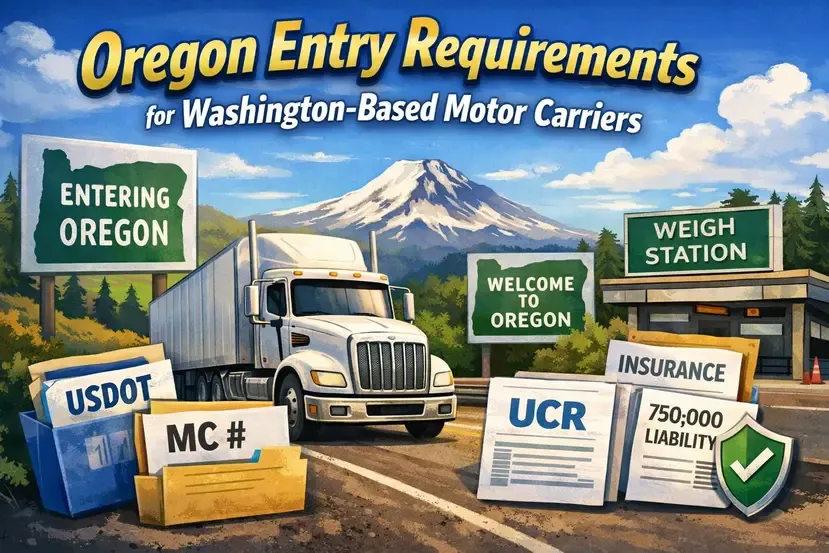
For Oregon Truck Permits Visit Here - https://www.oregontruckingonline.org/
1. Weight-Mile Tax & Oregon Credentials Before Entry
Out-of-state carriers (including Washington-based) must obtain Oregon credentials before entering the state if operating vehicles over 26,000 lb GVW or exceeding temporary pass limits. Credentials include enrollment in Oregon’s Weight-Mile Tax (WMT) program and valid vehicle registration or temporary pass.
-
Weight-Mile Tax: Oregon does not participate in IFTA fuel tax reporting; instead it uses WMT for heavier trucks.
-
Temporary Pass Limits: Temporary passes are limited (e.g., 10 per vehicle or 35 per account annually). If you exceed these, you must establish an Oregon Motor Carrier account and credentials before operating.
-
Exception (limited): A carrier may enter solely to obtain credentials at a designated office near the OR/WA border (e.g., Portland Bridge office), but this must be done before operating in Oregon.
-
Enforcement at Entry: Oregon weigh stations and port-of-entry personnel may check WMT compliance, USDOT number, vehicle registration, and insurance.
2. Motor Carrier Account
Out-of-state carriers that operate regularly in Oregon typically must set up an Oregon Motor Carrier Account with the Oregon DOT’s Commerce & Compliance Division (CCD).
To establish this account you generally need to:
-
Provide corporate documentation (e.g., articles of organization or certificate of standing).
-
Complete the Oregon Weight-Mile Tax Enrollment Application (form 9076) for out-of-state carriers.
-
Enroll and register vehicles in Oregon Trucking Online (TOL).
3. Insurance Requirements
All carriers (including Washington-based) must have proof of liability and, where applicable, cargo insurance filed with Oregon CCD:
-
Liability Insurance: Required before registering or operating intrastate. Minimum acceptable amount is $750,000 combined single limit.
-
Cargo Insurance: Required for for-hire payloads subject to loss or damage (minimum $10,000).
-
Proof of insurance must usually be filed with CCD before operating in Oregon.
Meeting Federal Motor Carrier Safety Administration (FMCSA) insurance/authority standards (49 CFR Part 387) also satisfies Oregon’s requirements for interstate carriers.
4. Permits for Oversize/Overweight Loads
For specialized loads that exceed legal size/weight limits:
-
Variance or oversize permits must be obtained before entry if coming from out of state.
-
Oregon’s permitting system (ORION) now handles oversize/overweight permits online.
Local county or city roads may require additional permits beyond state permits depending on the route.
5. Port-of-Entry Rules
At official Oregon weigh stations and ports of entry:
-
Trucks over certain weights (e.g., 20,000 lb GVW) must stop unless enrolled in preclearance (like Green Light).
-
Officers may inspect credentials — including WMT cab cards, insurance, USDOT numbers, and permits.
Failure to have required credentials before entry can result in fines, being turned back, or citations.
6. Federal Requirements Still Apply
Even though this is about Oregon, remember:
-
Interstate carriers still need a USDOT number, and if required, a Federal Operating Authority (MC number) from the FMCSA for for-hire operations.
-
Carriers must meet FMCSA safety and insurance standards, and many Oregon requirements dovetail with those federal rules.
Practical Compliance Steps for Washington-Based Carriers
-
Determine if Oregon operation triggers WMT/registration (vehicles >26,000 lb or crossing temporary pass limits).
-
Set up an Oregon Motor Carrier account & enroll vehicles via Oregon Trucking Online.
-
Have required insurance documents on file with Oregon CCD.
-
Obtain oversize/overweight permits before entry if necessary.
-
Carry required credentials and proofs while traveling in Oregon, and be prepared for port-of-entry checks.
https://www.oregon.gov/odot/mct/pages/oregon-motor-carrier-requirements.aspx