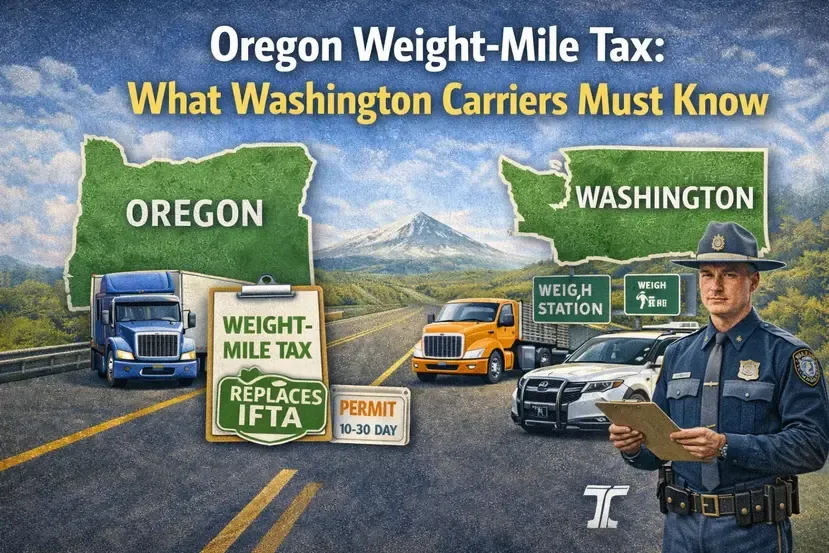
For Oregon Permits visit and apply here - https://www.oregontruckingonline.org/
What Is the Oregon Weight-Mile Tax?
The Oregon Weight-Mile Tax is a highway use tax charged on commercial vehicles over 26,000 lbs based on:
-
Vehicle weight
-
Axle configuration
-
Miles traveled within Oregon
Unlike most states, Oregon does not rely on IFTA fuel tax for heavy vehicles. Instead, qualifying trucks pay the Weight-Mile Tax for Oregon miles.
Why This Matters for Washington Carriers
Washington carriers are often caught off guard because:
-
Washington uses standard fuel taxes
-
Oregon uses weight-mile reporting instead of IFTA
-
Oregon enforcement is strict and audit-driven
If you enter Oregon without proper setup, you risk citations, fines, or being placed out of service.
Who Must Pay the Oregon Weight-Mile Tax?
Washington carriers must comply if they:
-
Operate a vehicle over 26,000 lbs
-
Travel any miles in Oregon
-
Are not exempt under Oregon law
This applies to:
-
For-hire carriers
-
Private fleets
-
Owner-operators
-
Interstate carriers passing through Oregon
Oregon Weight-Mile Tax vs IFTA (Critical Difference)
| Topic | Washington | Oregon |
|---|---|---|
| Primary highway tax | Fuel tax (IFTA) | Weight-Mile Tax |
| IFTA filing for OR miles | Not used | Replaced by WMT |
| Reporting basis | Gallons & miles | Weight × miles |
| Complexity | Moderate | High |
Washington carriers still file IFTA for all other states, just not for Oregon miles (if subject to WMT).
How Washington Carriers File the Tax
Washington carriers must:
-
Register with https://www.oregontruckingonline.org/
-
Choose reporting method:
-
Monthly
-
Quarterly
-
-
Track Oregon miles precisely
-
Report vehicle weight and axle configuration
-
Pay tax by the due date
Accurate trip sheets, ELD data, or GPS records are essential.
Temporary Permits for Washington Carriers - https://www.oregontruckingonline.org/
If you don’t have a permanent Oregon account, you may use:
-
10-day weight-mile permit
-
30-day weight-mile permit
These are common for:
-
Occasional Oregon trips
-
One-time deliveries
-
Short-term contracts
Enforcement & Penalties
Oregon enforces WMT through:
-
Weigh stations
-
Roadside inspections
-
Audits
Penalties may include:
-
Citations and fines
-
Back taxes
-
Interest and penalties
-
Out-of-service orders
Oregon is known for detailed audits, especially for out-of-state carriers.
Common Mistakes Washington Carriers Make
-
Assuming IFTA covers Oregon
-
Failing to obtain a weight-mile permit
-
Under-reporting Oregon miles
-
Using incorrect declared weight
-
Poor trip documentation
Key Takeaways for Washington Carriers
-
Oregon Weight-Mile Tax replaces IFTA for heavy vehicles
-
Applies to vehicles over 26,000 lbs
-
Washington carriers must register or buy permits
-
Accurate mileage and weight records are critical
-
Non-compliance can be expensive and disruptive
https://www.oregon.gov/odot/mct/pages/weight-mile-tax-program-enrollment.aspx