1. Temporary Trip Permit (for Out-of-State Trucks)
What it is:
A short-term permit that lets an out-of-state commercial vehicle legally operate on Washington highways without full state registration (IRP). It’s intended for one-time trips, new vehicles awaiting registration, or carriers not based in Washington.
Key Facts:
-
Valid for about 3 consecutive days (72 hours).
-
Required for carriers not registered under the International Registration Plan (IRP) but still running in Washington.
-
Must be purchased before operating.
-
You must keep the permit in the vehicle during the trip.
If you expect to stay longer or make repeated trips, full IRP registration is typically required instead of repeated trip permits.
2. Temporary Fuel Use Permit
Purpose:
If you operate a vehicle that doesn’t participate in the International Fuel Tax Agreement (IFTA) and enters Washington, a fuel permit lets you legally use fuel in the state and properly account for fuel taxes.
When it’s required:
-
For diesel or propane trucks with:
-
2 axles and >26,000 lbs GVW, or
-
3+ axles regardless of weight.
-
Details:
-
Good for 3 consecutive days.
-
Must be obtained before entering Washington.
3. Oversize / Overweight Permits
Out-of-state carriers must secure these before entering Washington whenever their vehicle or load exceeds the state’s legal limits:
-
Width over 8′6″
-
Height over 14′
-
Length or axle/weight beyond state standard limits
Types include:
-
Single trip oversize/overweight permits
-
Superload permits for extremely large/heavy loads
These are usually issued by Washington State Department of Transportation (WSDOT) or authorized agents, and can often be self-issued online using Washington’s permit system.
4. State Registration Requirements for Regular Carriers
If you regularly operate in Washington, temporary permits aren’t enough — you may need:
-
IRP registration (apportioned plates) for ongoing interstate operations
-
IFTA credentials if you operate fuel-taxable vehicles across multiple states
-
A USDOT number for interstate commerce and safety monitoring (per Washington law)
Without these, you must use temporary permits or risk fines and enforcement actions.
5. Penalties for Non-Compliance
Operating without required permits in Washington can result in:
-
Civil fines and penalties
-
Vehicle detainment or impoundment by state patrol
-
Delivery delays until compliance is established
Summary Table
| Situation / Carrier Type | Required Permit |
|---|---|
| Out-of-state truck without IRP | Temporary Trip Permit |
| Vehicle not in IFTA | Temporary Fuel Use Permit |
| Oversize or overweight load | Oversize / Overweight Permit |
| Regular interstate operations | IRP / IFTA Registration + USDOT Number |
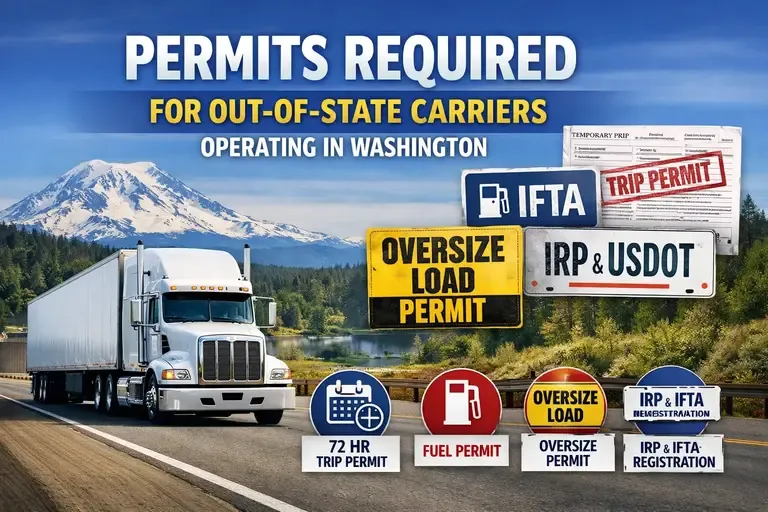
Permits Required for Out-of-State Carriers Operating in Washington