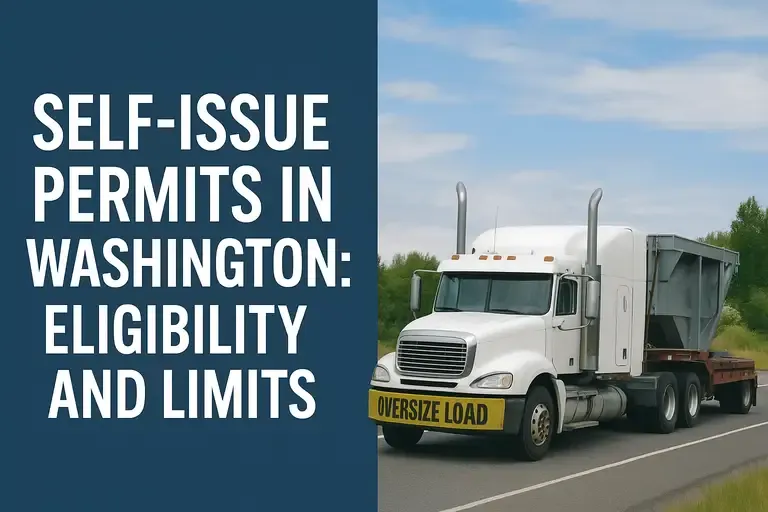
What Is a Self-Issue Permit?
-
WSDOT allows carriers to self-issue oversize/overweight (OSOW) permits using its online system called www.washingtontruckingonline.com.
-
This system is available 24/7, so companies can issue permits on their own schedule.
Eligibility: Who Can Self-Issue
Here are the main criteria and requirements for a carrier to become a self-issuing company:
-
No Special Authorization Needed
-
For many standard OSOW permits (below certain thresholds), there’s no special extra approval beyond registering as a self-issuer.
-
However, some permit types are not eligible for self-issuing.
-
Limits & Restrictions for Self-Issued Permits
WSDOT places maximum limits on the dimensions and weight for self-issued permits. Here are the key limits:
-
Width: up to 16 feet
-
Height: up to 16 feet
-
Trailer / Load Length: up to 125 feet
-
Gross Weight: up to 200,000 pounds for a single trip, non-divisible load (tractor/trailer combos)
-
Eligible Vehicle Combinations: limited to tractor/trailer (can include “jeeps” and “boosters” for weight distribution)
-
Axle Spacing Report: needed for weight permits — carriers must supply an axle spacing report number.
-
Double Trailers: Self-issue permits are not valid for double trailers under overweight/self-issue.
Permit Types That Can Be Self-Issued
Here is the number of permit types that self-issuing companies can create via www.washingtontruckingonline.com
-
Single-trip oversize/overweight (non-divisible) permits.
-
Monthly and annual permits for certain types:
-
Single trailer (divisible or non-divisible) up to a certain length.
-
Double trailer permits (for divisible loads) — but note: double trailers are not eligible for overweight self-issue, only dimension, per other rules.
-
Non-divisible dimensional permits (width/height/length) up to certain envelopes.
-
Manufactured home transport (monthly/annual) with dimensional limits.
-
Empty apple bins & hay bales (special monthly/annual permit).
-
Fixed-load 3- or 4-axle vehicles (e.g., cranes), with a required axle spacing report.
-
Log tolerance permit (for unprocessed logs hauled by certain combos).
-
Permit Types Not Eligible for Self-Issue
Certain permits require WSDOT’s direct review or are disallowed via self-issue:
-
Superloads: Loads exceeding 16 ft wide, 16 ft high, 125 ft load length, or 200,000 lb must go through WSDOT (not self-issue).
-
Night travel permits that exceed certain dimensions: e.g., over 12 ft wide, 14 ft 6 in high, or 105 ft overall length need approval.
-
8-tire axle weight permits above certain limits (e.g., 8-tire with very high axle weight) are not self-issuable.
-
Farm implement permits (if exceeding certain thresholds) may not be eligible.
-
Manufactured housing permits that exceed the state’s predefined dimension allowances (per the “manufactured home map”) require WSDOT’s direct handling.
Costs & Fees
-
For self-issuing, there is no extra surcharge compared to getting a permit through WSDOT: self-issue cost = same as if done by a WSDOT office.
-
The weight permit fee uses the standard WSDOT overweight fee schedule.
-
Example: dimensional single-trip permit (self-issued) is $10 per trip (for certain dimension-only permits).
Responsibilities & Liabilities for Self-Issuers
-
Route Restrictions: Even though you self-issue the permit, you must check for and obey any road or bridge restrictions shown on the permit.
-
Over-Height Clearance: Carriers are fully responsible for verifying vertical clearances (bridges, overpasses). WSDOT does not guarantee height clearances for every route.
-
Local Jurisdictions: Self-issued permits only cover state routes. If traveling on city or county roads, the carrier must get approval from the relevant local authority.
-
Accurate Data Required: When self-issuing, the carrier must provide correct information (vehicle, axle spacing, route, etc.). Errors can lead to non-compliance or even safety risks.
-
No Permit Modification: According to WSDOT self-issuer training, once a self-issued permit is issued, it cannot be modified.
System & Process Notes
-
WSDOT is upgrading its self-issue system: they received a federal grant to modernize the eSNOOPI system with better routing, automated checks, and a more user-friendly interface.
-
The new system includes tools like the Bridge Vertical Clearance Trip Planner to help carriers avoid height issues.
-
There is self-issuer training available (self-study PDF) to help companies learn how to properly issue permits.
Pros and Cons of Self-Issuing
Pros:
-
Speed & Convenience: Permit issuance 24/7, without waiting for a WSDOT office or agent.
-
Control: Carriers can manage their own permit issuance, especially for routine or frequent moves.
-
Cost Efficiency: No extra fee for self-issuing; same cost as through WSDOT.
Cons / Risks:
-
Route Risk: If the carrier fails to check route restrictions or clearance, they may pick a risky route.
-
Human Error: Self-issuing requires inputting technical data (axle spacing, route details) — higher chance of mistakes.
-
Responsibility: The carrier bears responsibility for verifying overhead clearance, restrictions, and local road approval.
-
Non-modifiable: Once issued, the permit can't be changed, which could be problematic if details were entered incorrectly.
Summary
-
Self-issuing permits via www.washingtontruckingonline.com is a powerful and efficient option for many oversize/overweight moves.
-
But there are defined limits: 16 ft wide, 16 ft high, 125 ft length, and up to 200,000 lb (single trip), with required axle spacing reports.
-
Not all permit types are eligible — superloads, very heavy axle permits, some night-permit requests, and certain housing or farm implement permits require WSDOT’s direct review.
-
As a self-issuance carrier, you're responsible for route planning, checking for restrictions, and ensuring you comply with all regulations.