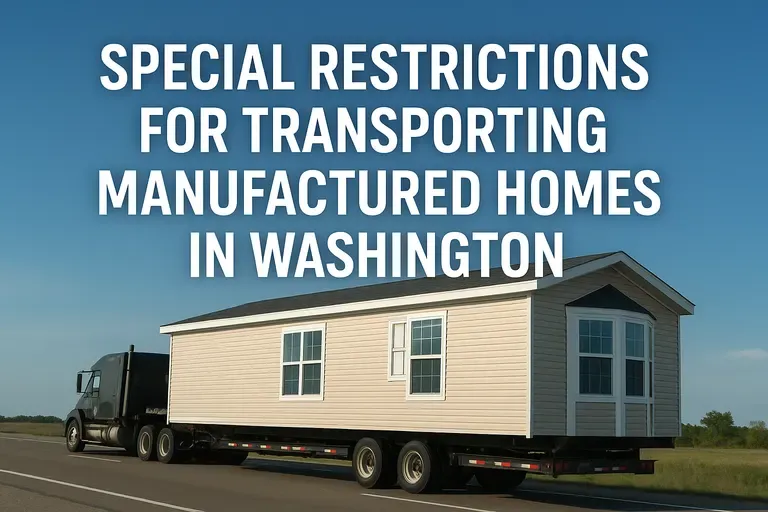
1. Manufactured Homes Are Automatically Oversize Loads
Manufactured homes always exceed standard legal dimensions in Washington.
This means every move requires a Washington Oversize/Overweight (OS/OW) permit, regardless of size or route.
Typical manufactured home dimensions:
-
Width: 12–18 feet
-
Height: up to 15 feet
-
Length: 60–80 feet or more
-
Combination length can exceed 100 feet
Because of this, special restrictions apply.
2. Maximum Legal Dimensions for Manufactured Homes
Washington limits manufactured home movements to:
Maximum Width
-
Most homes: 14–16 feet wide
-
Homes wider than 16 feet require additional review and often classification as Superloads
Maximum Height
-
Up to 15 feet, 6 inches, depending on route
-
Any load risking contact with bridges/overpasses requires a route survey
Maximum Length
-
Overall vehicle + home combination length typically cannot exceed
95–110 feet, depending on setup
Homes exceeding these limits require special approval and routing analysis.
3. Route Restrictions & Pre-Approved Corridors
Washington uses specific pre-approved corridors for manufactured home transport.
Some highways restrict:
-
Turns
-
Interchanges
-
Certain grades
-
Construction zones
-
Night travel
If a home exceeds standard dimensions, WSDOT may require:
-
Custom routing
-
A pilot car survey
-
Temporary traffic control
-
Utility company coordination (for tall loads)
4. Pilot / Escort Vehicle Requirements
Manufactured homes almost always require accompanying escort vehicles, especially for wide or long loads.
General rules (varies by width & length):
Width 12–14 feet
1 escort vehicle required
Usually trailing the load
Width 14–16 feet
2 escort vehicles
One in front, one behind
Width 16 feet+
3 escort vehicles may be required
Plus police escorts in some areas
Pilot cars must meet strict Washington regulations:
-
Height poles for tall homes
-
2-way communication
-
Advance warning signage
-
Lights & flags
5. Travel Time Restrictions
Manufactured homes are not allowed to travel at all hours.
Typical restrictions:
-
Daylight-only travel
-
No Sunday or holiday travel
-
Curfews in urban areas (Seattle, Tacoma, Spokane)
-
Weather-related restrictions (fog, snow, wind)
High winds are a major concern. WSDOT may shut down routes for wide loads during wind advisories.
6. Wind & Weather Restrictions
Due to large surface area, manufactured homes are vulnerable to wind.
Many escorts and carriers follow:
-
No travel when winds exceed 20–25 mph
-
Mandatory pull-off during sudden gusts
-
WSDOT-issued wind advisories on passes and coastal zones
Weather-related compliance is crucial for safety and preventing overturn incidents.
7. Special Towing & Equipment Requirements
Manufactured home haulers must use:
-
Approved towing hitches
-
Safety chains
-
Mirrors extending far enough to see down both sides
-
Red/amber lights at each corner
-
Oversize load signs
-
Flags on edges and corners
Homes must be structurally secure before transport:
-
Windows protected
-
Doors locked
-
Roofing secured
-
Exterior panels tightened
8. Weigh Station & Inspection Requirements
Manufactured homes must:
-
Stop at all open weigh stations
-
Submit permits, routing instructions, and inspections
-
Pass safety checks (tire condition, securement, lights, brake function)
Failure to stop can result in:
-
Heavy fines
-
State escort requirements
-
Out-of-service order
9. Permit Requirements
A Washington manufactured home permit typically requires:
-
Exact home dimensions
-
Axle and tire specs
-
Origin and destination
-
Trailer VIN and configuration
-
Escort vehicle details
-
Proposed route
Homes over certain widths/heights require additional engineering review.
10. Tips to Avoid Delays and Penalties
-
Order permits before entering Washington
-
Check construction zones along the route
-
Monitor wind forecasts
-
Coordinate early with escort services
-
Keep a printed or digital copy of the permit
-
Follow the exact permitted route — no deviations
Manufactured homes are strictly regulated due to safety concerns, so compliance is essential.