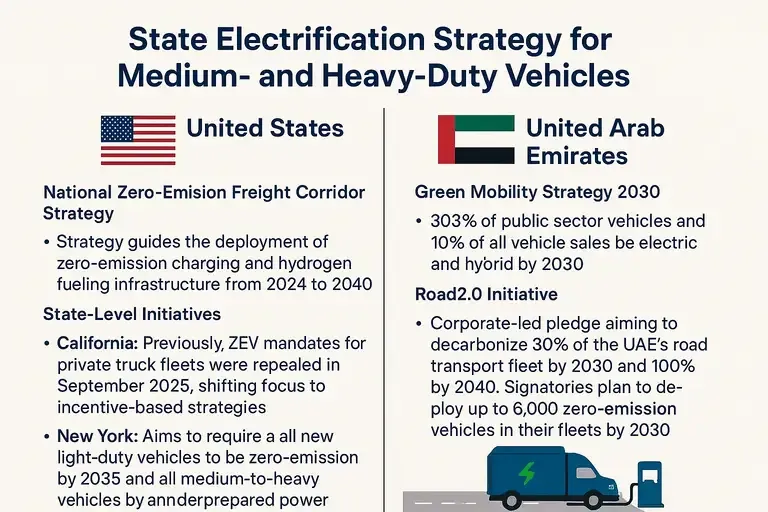
United States: Federal and State-Level Strategies
National Zero-Emission Freight Corridor Strategy
The U.S. Department of Energy (DOE), in collaboration with the Department of Transportation (DOT) and the Environmental Protection Agency (EPA), released a strategy to guide the deployment of zero-emission MHDV charging and hydrogen fueling infrastructure from 2024 to 2040.
State-Level Initiatives
-
California: Previously, California implemented strict zero-emission vehicle (ZEV) mandates for private truck fleets. However, in September 2025, the state repealed its ZEV purchasing mandate for private fleets, shifting focus to incentive-based strategies.
-
New York: Aims to require all new light-duty vehicles to be zero-emission by 2035, and all medium-to-heavy vehicles by 2045. Challenges include inadequate EV charging infrastructure and an underprepared power grid.
-
Vermont: Paused the adoption of California’s strict EV sales mandates due to concerns over insufficient charging infrastructure and underdeveloped technology for heavy-duty EVs.
United Arab Emirates: National and Corporate Strategies
National Initiatives
-
Green Mobility Strategy 2030: Dubai's initiative mandates that 30% of public sector vehicles and 10% of all vehicle sales be electric and hybrid by 2030.
-
Road2.0 Initiative: A corporate-led pledge aiming to decarbonize 30% of the UAE's road transport fleet by 2030 and 100% by 2040. Signatories plan to deploy up to 6,000 zero-emission vehicles in their fleets by 2030.
Industrial Decarbonization Roadmap
Unveiled at COP28 in December 2023, this roadmap aims to reduce carbon dioxide emissions in the industrial sector by 2.9 gigatonnes by 2050, aligning with the UAE’s Net Zero by 2050 Strategy.
Global Trends and Challenges
-
Infrastructure Development: A significant challenge in MHDV electrification is the development of adequate charging and fueling infrastructure. Both the U.S. and UAE are investing in expanding these facilities to support the transition.
-
Policy Shifts: While some regions have implemented strict mandates, others are shifting towards incentive-based strategies to encourage adoption, acknowledging the challenges in infrastructure and technology readiness.
-
Corporate Engagement: Corporate pledges, like the Road2.0 Initiative in the UAE, play a crucial role in driving the transition by committing to fleet electrification and influencing the broader ecosystem.
These strategies reflect a global commitment to reducing emissions and promoting sustainable transportation. While challenges remain, the combination of government policies, corporate initiatives, and infrastructure development is paving the way for the electrification of medium- and heavy-duty vehicles.