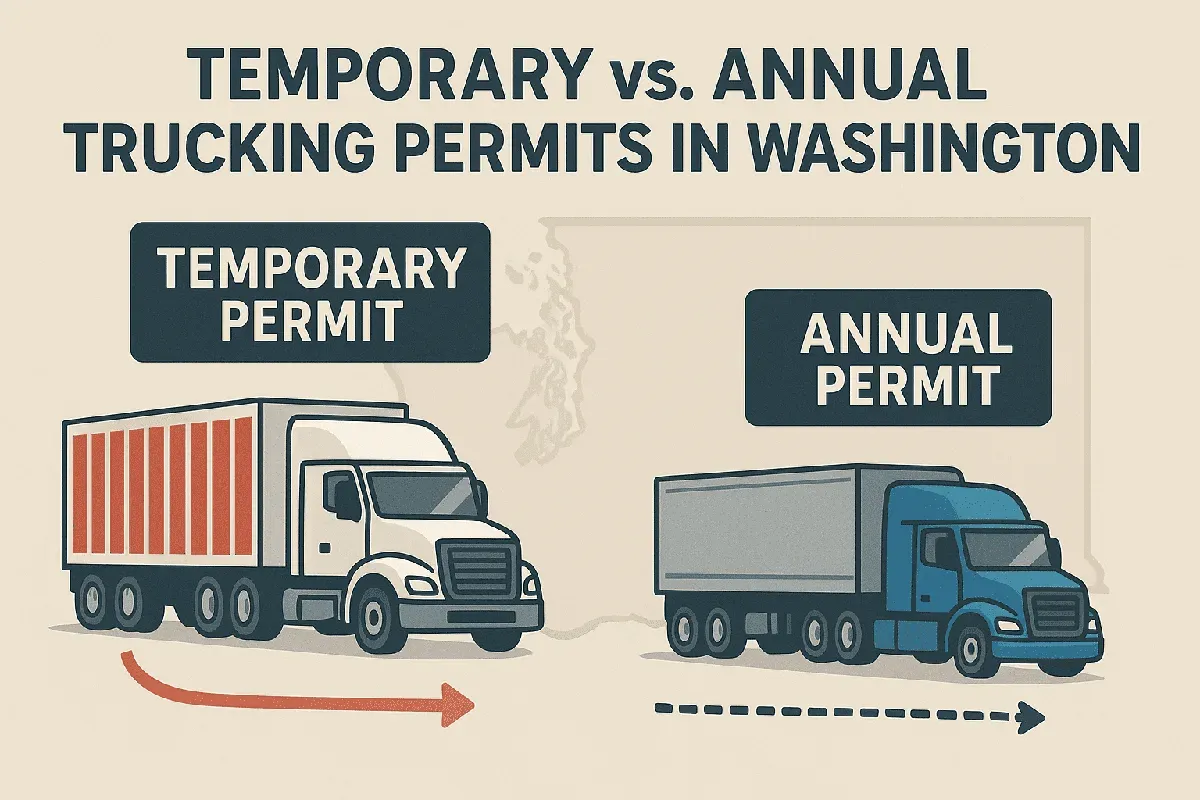
Temporary Trucking Permits
Purpose:
Temporary permits are ideal for short-term or one-time operations, such as hauling a specific oversized load or entering the state for a limited job.
Validity:
-
Usually valid for a single trip or a specific duration, typically up to 3–10 days, depending on the permit type.
-
The permit applies only to the designated vehicle, route, and load listed at the time of application.
Common Uses:
-
Hauling an oversized piece of machinery for a single delivery.
-
Crossing into Washington for an out-of-state project.
-
Operating a truck while waiting for registration or permanent credentials.
Advantages:
-
Quick to obtain through WSDOT’s www.washingtontruckingonline.com
-
Lower initial cost for short-term needs.
-
Flexibility for irregular or occasional operations.
Limitations:
-
Must be renewed for each trip or load.
-
No long-term cost benefit for frequent haulers.
-
Route-specific — any deviation may require reissuance.
2. Annual Trucking Permits
Purpose:
Annual permits are designed for carriers who regularly haul similar loads or operate specific routes that exceed standard legal limits.
Validity:
-
Valid for one year from the date of issuance.
-
Covers ongoing operations for specific vehicle types or activities (e.g., overweight, oversize, or specialized hauling).
Common Uses:
-
Regular delivery routes using the same type of heavy equipment.
-
Logging, construction, or agricultural operations with consistent load profiles.
-
Fleets operating year-round within Washington.
Advantages:
-
Cost-effective for frequent or recurring trips.
-
Reduces administrative time and delays from repeated permit applications.
-
Allows predictable operations with pre-approved routes.
Limitations:
-
More stringent application requirements (load specs, axle spacing, insurance, etc.).
-
Limited to specific vehicle and route conditions approved by WSDOT.
-
Must be renewed annually before expiration to avoid penalties.
3. Key Differences at a Glance
| Feature | Temporary Permit | Annual Permit |
|---|---|---|
| Duration | 3–10 days or per trip | 1 year |
| Purpose | One-time or short-term hauls | Regular or ongoing hauls |
| Cost | Lower upfront, higher over time | Higher upfront, lower long-term |
| Approval Time | Fast (often same day) | Longer (requires review) |
| Route Flexibility | Route-specific | Pre-approved routes |
| Best For | Occasional operators | Frequent or routine carriers |
4. Choosing the Right Permit
Carriers should evaluate:
-
Frequency of travel within Washington
-
Load type and dimensions
-
Route consistency
-
Budget and compliance needs
If you only occasionally enter Washington or move special equipment, a temporary permit makes sense. For ongoing business operations within the state, an annual permit saves time, money, and administrative effort.