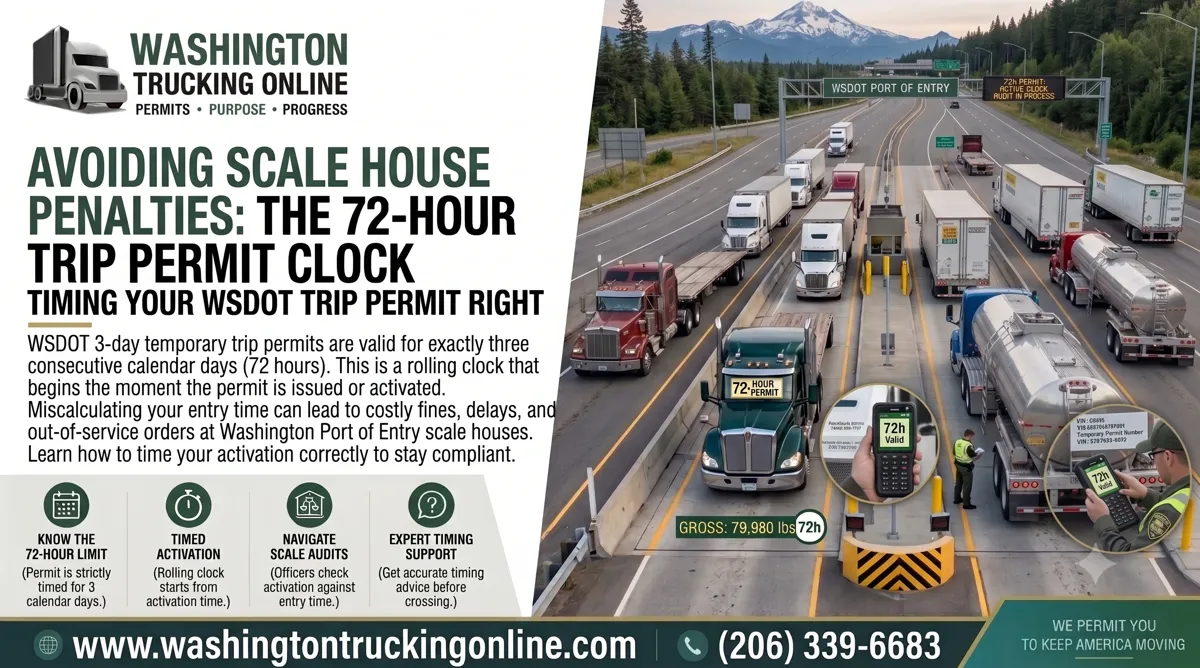
The 72-Hour Clock: How to Correctly Date and Time Your WSDOT Trip Permit
Table of Contents
-
Introduction
-
What is the 72-Hour Rolling Clock?
-
Step-by-Step: How to Time Your Permit Activation
-
Two Critical Errors That Invalidate Your Documentation
-
The Consequences of a Timing Violation at the Scale
-
Why Choose Our Service for Washington Temporary Permits
-
Frequently Asked Questions
Introduction
Driving commercial routes into the Pacific Northwest means staying on top of strict state-specific transport rules. As established in our primary guide on avoiding scale house penalties, out-of-state commercial motor vehicles missing Washington on their International Registration Plan (IRP) cab card must obtain a 3-day temporary trip permit before crossing the state line.
However, simply purchasing the permit isn't enough. The Washington State Department of Transportation (WSDOT) enforces strict rules regarding how these permits are dated and timed. A single administrative error or scheduling miscalculation can turn a valid permit into an expensive registration violation. This guide details exactly how the 72-hour permit clock functions and how to coordinate your activation times perfectly.
What is the 72-Hour Rolling Clock?
A standard temporary trip permit is valid for exactly three consecutive calendar days. It is critical to understand that this operates on a strict, rolling 72-hour clock based on the exact start time entered during purchase; it does not simply run until midnight of the third day.
For example, if your permit is activated with a start time of Tuesday at 6:00 AM, it remains legally valid until Friday at 5:59 AM. Rolling across the state line or pulling into a Washington port of entry at 7:00 AM on Friday means your temporary registration has expired, leaving you vulnerable to under-registration penalties.
Step-by-Step: How to Time Your Permit Activation
To maximize your 72-hour window and protect your delivery schedule from delays, follow this exact sequence during your trip planning:
-
Evaluate Route and External Delays: Before finalizing your permit purchase, check current pass conditions on major corridors like I-90 (Snoqualmie Pass) and factor in driver hours of service (HOS) remaining.
-
Determine Target Border Crossing Time: Calculate when your truck tires will actually touch Washington pavement. This should be your target permit start time. Do not set the activation clock to your dispatch time if you still have an 8-hour transit through neighboring states.
-
Pre-Date the Permit During Purchase: You can buy your trip permit in advance and select a specific future date and time for it to take effect. This ensures your documentation is secured without wasting valuable transit hours.
-
Print and Sign Before Entry: The driver must print, sign, and date the physical permit document before entering the state.
Two Critical Errors That Invalidate Your Documentation
WSDOT scale house officers routinely audit temporary paperwork, and they enforce a zero tolerance for administrative discrepancies. Avoid these two common pitfalls:
-
Manual Adjustments and Corrections: If your driver is delayed at a shipper and your pre-selected activation time is no longer ideal, never use a pen to cross out, alter, or change the text on the printed permit. Any manual alterations instantly void the document during a state inspection.
-
Over-Relying on Temporary Transit: WSDOT rules restrict a single vehicle identifier (VIN) to a maximum of three temporary trip permits within any rolling 30-day window. Attempting to chain permits consecutively to bypass permanent registration will trigger an enforcement flag.
The Consequences of a Timing Violation at the Scale
Entering Washington public highways with an expired or incorrectly timed permit carries the same penalties as operating an entirely unregistered vehicle.
If an enforcement officer catches a timing mismatch during a scale house audit, they will issue heavy monetary citations for improper licensing. Additionally, the vehicle can be placed out of service on the spot. Your driver will be forced to park at the scale facility until a brand-new, valid permit is purchased, processed, and printed, disrupting your freight timeline and damaging broker relationships.
Why Choose Our Service for Washington Temporary Permits
Managing multi-state logistics and compliance requires absolute precision. At Washington Trucking Online, we take the administrative burden off your dispatch team so you can focus on keeping your fleet moving.
Our streamlined permitting platform delivers:
-
Instant Digital Delivery: We process your trip and fuel requests rapidly, sending valid documentation straight to your inbox.
-
Exact Data Alignment: We cross-verify your vehicle identification numbers (VINs), plates, and requested start times with state parameters to eliminate scale house friction.
-
Complete Pacific Northwest Support: From 3-day trip passes and temporary unapportioned fuel use permits to specialized oversize routing, we serve as your single point of compliance contact.
FAQ
Can I adjust the start time of my WSDOT permit once it has been processed?
No. Once a temporary trip permit is generated by the state system, the activation window cannot be edited or modified. If your transit window changes significantly, a new permit must be secured to remain compliant.
What happens if my truck breaks down in Washington and the 72 hours run out?
If a mechanical breakdown keeps your vehicle in the state past the expiration hour, you must purchase an additional temporary trip permit to legally resume travel on public highways once the vehicle is repaired.
Does a temporary trip permit cover my fuel tax obligations too?
No. The standard trip permit only covers vehicle weight and registration authority. If your truck is over 26,000 lbs or has three or more axles, and you do not carry IFTA credentials, you must purchase a separate temporary fuel use permit alongside your trip permit.