1. Overview
Washington State shares a border of over 500 miles with British Columbia (B.C.), making it one of the busiest cross-border trucking corridors in the Pacific Northwest.
Thousands of trucks travel daily between Seattle, Bellingham, and Vancouver, carrying essential goods that power both regional and national economies.
Trucking plays a vital role in connecting supply chains across industries — from agriculture and technology to energy and retail — and ensures the smooth flow of trade between the U.S. and Canada, two of the world’s largest trading partners.
2. Key Border Crossings
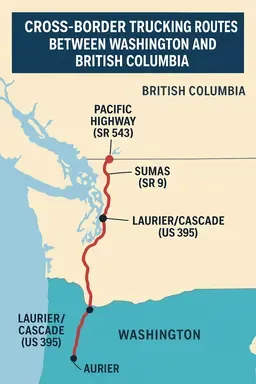
Washington’s major commercial border crossings include:
-
Blaine / Pacific Highway (SR 543) – The busiest truck crossing between Washington and B.C.
-
Sumas / Abbotsford (SR 9) – Used primarily for agricultural products and lumber.
-
Laurier / Cascade (US 395) – Serves eastern Washington industries and the interior of B.C.
Each crossing is equipped with U.S. Customs and Border Protection (CBP) and Canada Border Services Agency (CBSA) facilities to handle freight documentation, inspections, and driver verification.
3. Economic Significance
-
Canada is Washington State’s #1 trading partner, with over $30 billion in annual trade flowing through these corridors.
-
Cross-border trucking supports:
-
Agriculture: Transporting fruits, vegetables, and seafood from Washington farms to Canadian markets.
-
Manufacturing & Technology: Moving aerospace parts, electronics, and machinery between Boeing suppliers in Washington and B.C.’s tech hubs.
-
Retail & Consumer Goods: Delivering cross-border shipments for Amazon, Costco, and other major distributors.
-
-
The trucking industry is directly tied to tens of thousands of jobs in both states and provinces.
4. Operational Dynamics
-
Most freight operates on a “just-in-time” basis, meaning trucking companies must coordinate precise delivery schedules across the border.
-
Delays caused by customs, documentation errors, or inspection backlogs can ripple through entire supply chains.
-
Trusted Trader programs like FAST (Free and Secure Trade) help streamline processing for pre-approved carriers.
5. Regulatory and Logistical Challenges
-
Customs Documentation: Drivers must manage dual regulatory systems — U.S. CBP and Canada’s CBSA — including manifests, bills of lading, and safety certificates.
-
Hours of Service (HOS): Truckers need to comply with both FMCSA (U.S.) and Transport Canada regulations.
-
Environmental Regulations: Washington and B.C. share strong emission reduction goals, affecting truck engine standards and idling limits.
-
Infrastructure Bottlenecks: Long queues at Blaine during peak hours can cause multi-hour delays, reducing driver productivity.
6. Security and Modernization Initiatives
To improve efficiency and security:
-
FAST and C-TPAT programs pre-clear low-risk carriers for faster processing.
-
Intelligent Transportation Systems (ITS) monitor truck volumes and wait times.
-
Digital customs submissions are reducing paper-based delays.
-
Future investments aim to expand highway capacity and inspection lanes at major crossings.
7. Environmental Cooperation
Washington and British Columbia share a commitment to green freight initiatives:
-
Electric and hydrogen trucks are being tested for short-haul cross-border operations.
-
Both governments encourage alternative fuel corridors along I-5 and Highway 99.
-
Programs like the Cascadia Innovation Corridor promote sustainable logistics between Seattle and Vancouver.
8. Future Outlook
As trade continues to grow, cross-border trucking will remain a cornerstone of the Cascadia regional economy.
Efforts to modernize border infrastructure, streamline customs processes, and adopt cleaner technologies will:
-
Improve freight efficiency.
-
Reduce congestion.
-
Support sustainable economic growth for both Washington and British Columbia.
9. Key Takeaway
Cross-border trucking between Washington and British Columbia is not just about transportation — it’s about economic interdependence, innovation, and regional cooperation.
By enhancing infrastructure, embracing green technology, and improving customs coordination, both sides can ensure that this vital trade corridor remains strong, efficient, and sustainable for decades to come.