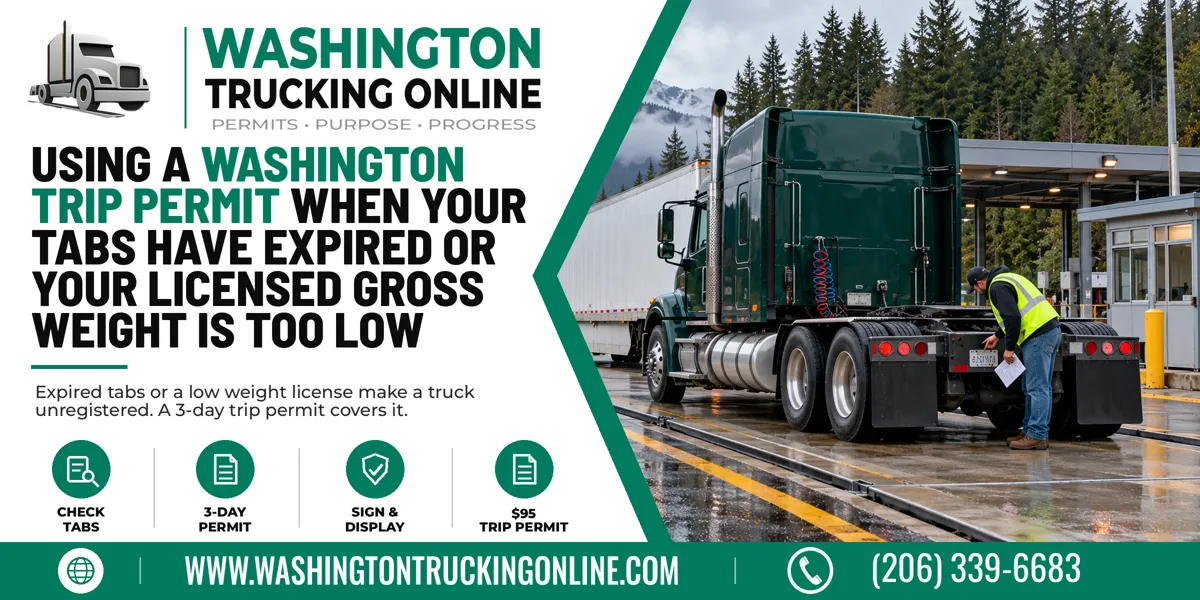
Using a Washington Trip Permit When Your Tabs Have Expired or Your Licensed Gross Weight Is Too Low
Table Of Contents
-
Introduction
-
The Short Answer
-
What Washington Law Says
-
Expired Tabs: When a Trip Permit Helps
-
Licensed Gross Weight Too Low for the Load
-
The 80,000 and 40,000 Pound Limits
-
Rules Every Trip Permit Must Follow
-
When a Trip Permit Is Not the Answer
-
Common Mistakes to Avoid
-
Why Many Trucking Companies Choose Our Service
-
FAQ
Introduction
Most carriers think of trip permits as something for out-of-state trucks. But Washington-plated trucks run into trouble too. Tabs expire while a truck is out on a run, or a carrier books a heavier load than the truck is licensed to carry.
In both cases, Washington law treats the truck as unregistered for that trip. The good news is that a Washington Trip Permit can cover it for a short time. This guide explains when the permit works, the weight limits that apply, and the rules you have to follow.
The Short Answer
Yes. Under RCW 46.16A.320(1)(a), a vehicle owner may operate an unregistered vehicle on public highways under a trip permit. For trip permit purposes, the law says a vehicle is considered unregistered if:
-
The license tabs have expired, or
-
The current gross weight license is insufficient for the load being carried.
So a Washington Trip Permit can legally cover a truck with expired tabs or a truck licensed for less weight than it is hauling, within the limits of the law.
What Washington Law Says
RCW 46.16A.320(1)(a) lists four situations where a vehicle counts as unregistered:
-
Reciprocity requires Washington registration. Under reciprocal relations with another jurisdiction, the owner would be required to register the vehicle in Washington.
-
No registration when it's required.
-
Expired license tabs.
-
Insufficient gross weight license for the load being carried.
The third and fourth cases are the ones that catch Washington carriers off guard, because the truck has plates and looks registered.
Expired Tabs: When a Trip Permit Helps
Tabs can lapse for simple reasons. The renewal notice goes to an old address, a payment is missed, or the truck is on the road when the month ends.
Once tabs expire, the truck counts as unregistered for trip permit purposes. A Washington Trip Permit lets it keep moving legally while you renew. Common uses include:
-
Finishing a run that started before the tabs expired.
-
Driving the truck back to the yard to deal with the renewal.
-
Covering a short gap while renewal paperwork is processed.
A trip permit is a short-term fix. The real solution is renewing the registration.
Licensed Gross Weight Too Low for the Load
Washington trucks are licensed for a specific gross weight. Carriers sometimes license lower to save on fees, then take a heavier load later.
If the current gross weight license is not enough for the load, the law treats the truck as unregistered for that trip. A Washington Trip Permit solves this for a short time. RCW 46.16A.320(3)(a) says each trip permit authorizes operation of a single vehicle at the maximum legal weight limit for the vehicle.
This helps when:
-
A one-time heavy load comes up.
-
A seasonal haul is heavier than your usual freight.
-
A truck is moved into heavier work before its license is updated.
The 80,000 and 40,000 Pound Limits
The law sets a cap on licensed gross weight. Under RCW 46.16A.320(1)(a)(iv), the licensed gross weight may not exceed:
-
80,000 pounds for a combination of vehicles, and
-
40,000 pounds for a single unit vehicle with three or more axles.
A trip permit is not an oversize or overweight permit. If a load is over legal weight limits, it needs a separate oversize or overweight permit as well.
Rules Every Trip Permit Must Follow
RCW 46.16A.320(3)(a) sets clear rules:
-
Three days. Each permit is valid for three consecutive days beginning with the day of first use.
-
Three per 30 days. No more than three trip permits may be used for any one vehicle in any thirty consecutive day period.
-
Identify the vehicle. The permit must identify the vehicle it was issued for.
-
Complete it fully. The permit must be completed in its entirety.
-
Sign before driving. The operator must sign it before operating on public highways.
-
No corrections. Altering or correcting data invalidates the permit.
-
Display it. The permit must be displayed on the vehicle as required by the Department of Licensing.
Prorate operators must also keep the customer copy of each permit for four years under RCW 46.16A.320(4).
When a Trip Permit Is Not the Answer
A Washington Trip Permit has limits:
-
It's not a long-term replacement for registration. Three permits per 30 days won't cover a truck for long.
-
No refunds. Under RCW 46.16A.320(5), exchanges, credits, or refunds may not be given after purchase.
-
Out-of-service carriers can't use them. Under RCW 46.16A.320(2)(b), trip permits may not be used for commercial motor vehicles of a carrier whose USDOT number has been placed out of service by the Washington State Patrol.
-
Other laws still apply. Vehicles on trip permits are subject to all laws affecting similar vehicles.
Common Mistakes to Avoid
-
Ignoring expired tabs. The truck counts as unregistered once they lapse.
-
Hauling over your licensed weight. A heavier load needs a trip permit or a license update.
-
Using a fourth permit in 30 days. The law allows three.
-
Fixing errors by hand. Any correction invalidates the permit.
-
Forgetting to sign. The operator must sign before driving.
A violation of the trip permit rules is a gross misdemeanor under RCW 46.16A.320(6).
Why Many Trucking Companies Choose Our Service
Washington Trucking Online gets your Washington Trip Permit ready fast when tabs expire or a load is heavier than your license allows. We check your truck details and dates, so your permit is right the first time.
-
Trip permit: $95
-
Oversize permit: $98
-
Fuel permit: $95
We provide support 24/7 and also work weekends and holidays.
or
FAQ
-
Can I use a Washington Trip Permit if my tabs have expired?
Yes. RCW 46.16A.320 treats a vehicle with expired tabs as unregistered, and a trip permit lets it operate legally for three days.
-
What if my load is heavier than my licensed gross weight?
The truck is considered unregistered for that load, and a trip permit can cover it at the maximum legal weight limit for the vehicle.
-
How long is a Washington Trip Permit valid?
Three consecutive days, beginning with the day of first use.
-
How many trip permits can I use?
No more than three for any one vehicle in any 30 consecutive days.
-
Does a trip permit let me exceed 80,000 pounds?
No. Loads over legal weight limits need a separate overweight permit.
For more information, visit the Washington State Legislature, RCW 46.16A.320.