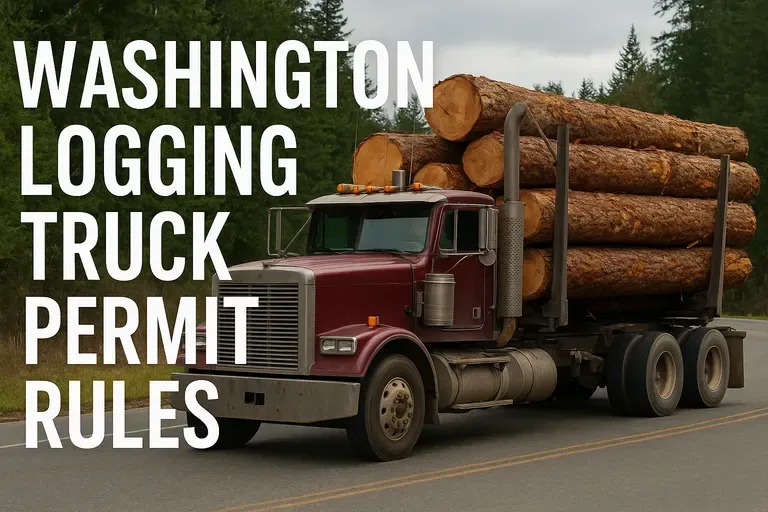
1. When Logging Trucks Need a Permit in Washington
Logging trucks generally require permits when:
-
Gross vehicle weight (GVW) exceeds legal limits
-
Axle weights exceed standard thresholds
-
The load overhangs beyond legal dimensions
-
Traveling on restricted routes or bridges
-
Operating during seasonal weight restrictions
Washington does allow a special logging overweight permit for certain operations, but you must meet strict conditions.
2. Washington’s Special Overweight Permits for Log Trucks
Washington offers a “Special Logging Permit” (under WAC 468-38) for trucks hauling raw logs. This permit:
-
Allows increased gross weights above the standard 105,500 lbs, depending on axle configuration.
-
Applies to non-divisible loads only (logs are considered non-divisible).
-
Usually requires carriers to follow approved logging routes.
Key Points:
-
Axle spacing must comply with WA bridge tables.
-
Loads must be secured per WAC 204-24.
-
Only applies to vehicles hauling raw forest products, not processed lumber.
3. Weight & Axle Requirements
Washington’s logging permits rely on specific axle formulas, including:
-
Maximum single axle: 22,000 lbs
-
Tandem axle: 43,000 lbs (with permit allowances for logging trucks)
-
Tridem axle: Up to 65,000 lbs with permits
-
Gross weight: Varies with axle count and spacing; must follow the WA Bridge Formula.
Logging trucks cannot exceed tire load ratings.
4. Dimension Rules for Logging Trucks
Logging trucks occasionally require permits when:
-
Rear overhang exceeds 15 ft
-
Overall height exceeds 14 ft
-
Width exceeds 8 ft 6 in
-
Length exceeds 41 ft for single units or 75 ft for combinations (with exceptions for pole or log-hauling trailers)
Most log trucks can operate legally without a dimension permit if their overhang is properly flagged and within allowable limits.
5. Load Securement Requirements
Washington requires:
-
At least two wrappers (tie-downs) for most log stacks
-
Additional wrappers depending on length, curvature, and stability of the logs
-
Center of gravity rules to prevent shifting
-
Compliance with FMCSA 393.116 for log securement
Violations are heavily enforced during WSP inspections.
6. Routing Restrictions
Logging trucks may face:
-
Seasonal closures on forest roads
-
Bridge and culvert limits on state or county routes
-
Restrictions during spring thaw in certain counties
-
Mandatory detours around weight-limited structures
Carriers must check WSDOT’s 511 travel advisory system and bridge weight maps before travel.
7. Seasonal Weight Restrictions
During freeze-thaw seasons, Washington often applies:
-
Reduced axle weight limits
-
Temporary prohibitions on heavy haul loads
-
County-managed weight restrictions on rural roads
Logging carriers operating in Eastern and Northern Washington are especially affected.
8. Permits for Off-Road and Forest Service Roads
If operating on:
-
US Forest Service roads → separate rules may apply
-
Private timber company lands → landowner-specific regulations
-
County-managed logging routes → coordinate with local public works departments
-
Tribal lands → tribal permits may be required
9. Escort/Pilot Car Requirements
Logging trucks rarely need pilot cars, but if the load becomes oversized (for example, long poles or overlength logs), Washington’s standard escort rules apply.
Typical triggers include:
-
Over 20 ft of rear overhang
-
Height exceeding 14 ft 6 in
-
Width over 11 ft (depending on route)
10. Enforcement & Penalties
Washington State Patrol enforces logging truck compliance through:
-
Roadside inspections
-
Weight checks at scales
-
Safety blitzes during peak logging season
Penalties can include:
-
Fines for overweight violations
-
Permit revocation
-
Out-of-service orders
-
Civil liability for infrastructure damage