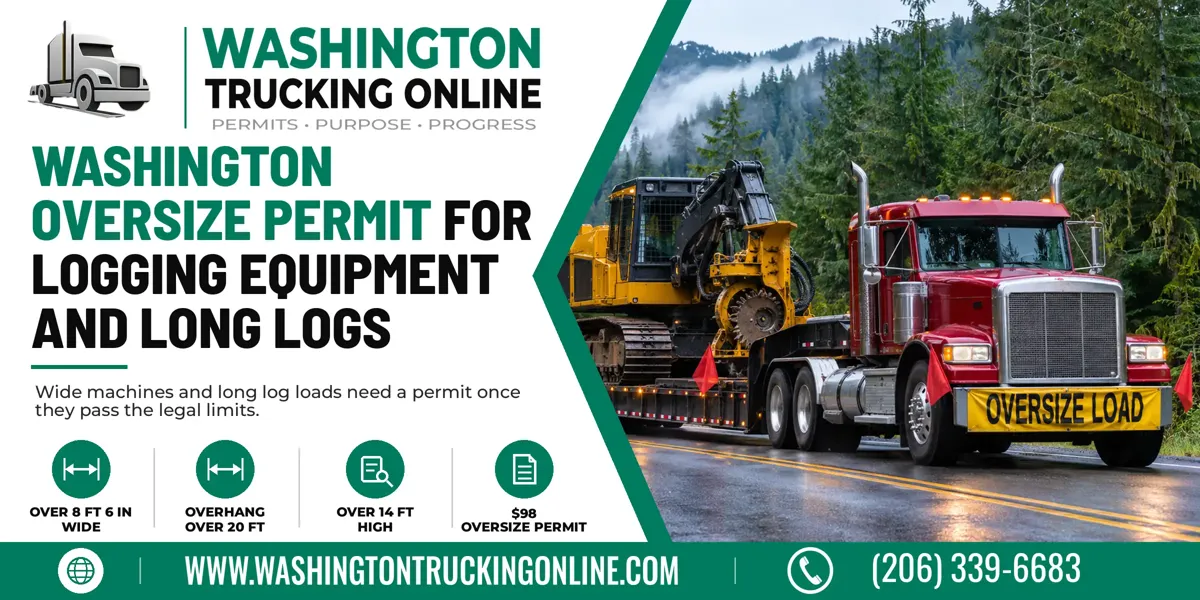
Washington Oversize Permit for Logging Equipment and Long Logs
Table Of Contents
-
Introduction
-
When Logging Loads Need a Permit
-
Washington's Legal Size and Weight Limits
-
Logging Equipment That Goes Oversize
-
Long Logs and Pole Trailers
-
Pilot Car Requirements
-
Signs, Flags and Lights
-
Travel Time Rules
-
How to Get a Washington Oversize Permit for Logging Loads
-
Common Mistakes to Avoid
-
Why Many Trucking Companies Choose Our Service
-
FAQ
Introduction
Logging is part of daily life in Washington. Crews work in the forests of the Olympic Peninsula, the Cascades and the northeast corner of the state, and the logs travel to mills in Aberdeen, Longview, Shelton and Spokane. Moving that wood, and the heavy machines that cut and load it, often means hauling loads that are too wide, too long or too heavy for normal limits.
This guide explains when logging equipment and long logs need a Washington Oversize Permit, which loads usually go over the limits, and what the permit requires on the road.
When Logging Loads Need a Permit
A load needs a Washington Oversize Permit when the vehicle and load together go over Washington's legal size or weight limits. Size limits are in RCW 46.44.010 to 46.44.030, and permits are issued by the Washington State Department of Transportation (WSDOT) under WAC 468-38.
WSDOT describes the single-trip permit as a 3-day, route-specific permit for non-divisible loads only. A single machine, such as a feller buncher, is non-divisible. A load of logs that could be split onto two trucks usually is not.
Washington's Legal Size and Weight Limits
These are the general limits most carriers plan around:
| Measurement | Legal Limit |
|---|---|
| Width | 8 feet 6 inches |
| Height | 14 feet |
| Semitrailer length | 53 feet |
| Gross weight | Up to 105,500 pounds with enough axles and spacing |
A load over any one of these limits generally needs a Washington Oversize Permit. Axle weights and spacing still apply, so a heavy machine can be overweight on one axle even when the gross weight looks fine.
Logging Equipment That Goes Oversize
Most modern logging machines are wide, tall or heavy. Common oversize logging loads include:
-
Feller bunchers and harvesters
-
Skidders and forwarders with wide tires or chains
-
Log loaders and shovel loggers
-
Yarders and towers used on steep ground
-
Processors and delimbers
-
Excavators and dozers used to build logging roads
Many of these machines are over 8 feet 6 inches wide on the trailer, and some go over 14 feet high. Removing buckets, booms or attachments can sometimes bring the load back under the limits. When it can't, a permit is required.
Long Logs and Pole Trailers
Log trucks usually haul with a pole trailer, which lets the logs carry part of the length between the truck and the trailer. Washington's length rules in RCW 46.44.030 treat these combinations differently from a standard tractor and semitrailer.
-
Standard log loads that stay within the legal length and weight rules don't need a special permit.
-
Long logs, poles and piling that go past those limits need a Washington Oversize Permit.
-
Overhang counts. A front overhang over 20 feet needs a front pilot car on two-lane highways, and a rear overhang over one-third of the trailer length needs a rear pilot car.
Check the full length, including overhang, before you apply.
Pilot Car Requirements
Logging loads often travel on narrow two-lane roads, where pilot cars matter most. Under Washington's rules:
-
Over 11 feet wide on a two-lane highway: two pilot cars, one in front and one at the rear
-
Over 14 feet wide on a multilane highway: one rear pilot car
-
Over 105 feet long on a two-lane highway: one rear pilot car
-
Over 14 feet 6 inches high: one front pilot car with a height pole on all highways
Pilot car operators must be certified through training Washington accepts, and cards are renewed every three years.
Signs, Flags and Lights
Oversize logging loads must be clearly marked:
-
"OVERSIZE LOAD" signs on the front and rear
-
Red or orange flags at the widest points and at the end of long overhangs
-
Warning lights when required by the permit
Clear marking is important on forest roads and mountain highways, where curves and hills can hide a long load until the last moment.
Travel Time Rules
Your Washington Oversize Permit sets when the load may move. Under WAC 468-38-175, WSDOT may restrict permitted loads on major holidays, including Thanksgiving Day, the day after Thanksgiving and Christmas. Some routes have commuter curfews near Seattle and Tacoma.
Weather also matters. Mountain passes such as Snoqualmie and Stevens can have winter restrictions, and loads may not move when visibility drops too low.
How to Get a Washington Oversize Permit for Logging Loads
-
Measure the Load. Get the width, height, length, overhang and weight on the trailer.
-
Check if Parts Can Be Removed. Buckets, booms or attachments may bring the load under the limits.
-
Plan the Route. Check bridges, mountain passes and curfew areas.
-
Gather Truck and Trailer Details. Include VINs, plates, axle spacing and weights.
-
Submit the Permit Application. Include the load description and route.
-
Book Pilot Cars If Needed. Use certified operators.
-
Mark the Load. Add signs, flags and lights before the move.
Common Mistakes to Avoid
-
Forgetting overhang. Long logs can trigger pilot car rules even when the width is legal.
-
Measuring without the trailer. Height is measured from the road.
-
Hauling a divisible load on a permit. Split extra logs onto another truck.
-
Ignoring bridge restrictions. Some bridges carry legal weights but not permitted weights.
-
Not carrying the permit. It must stay on the power unit.
Why Many Trucking Companies Choose Our Service
Washington Trucking Online helps logging contractors and carriers get the right Washington Oversize Permit for logging equipment and long logs, with the correct measurements, route and pilot car rules, so the load reaches the job or the mill on time.
-
Oversize permit: $98
-
Trip permit: $95
-
Fuel permit: $95
We provide support 24/7 and also work weekends and holidays.
or
FAQ
Does logging equipment need a Washington Oversize Permit?
Yes, when the load goes over Washington's legal size or weight limits.
Do long logs need a permit in Washington?
Only when the load goes past the legal length, overhang or weight limits.
When does a logging load need pilot cars?
On two-lane highways, loads over 11 feet wide need two pilot cars. Long overhangs and loads over 105 feet also need pilot cars.
How long is a single-trip permit valid?
WSDOT describes it as a 3-day, route-specific permit.
How much does your oversize permit service cost?
Our Washington Oversize Permit service is $98.
For more information, visit the Washington State Department of Transportation.