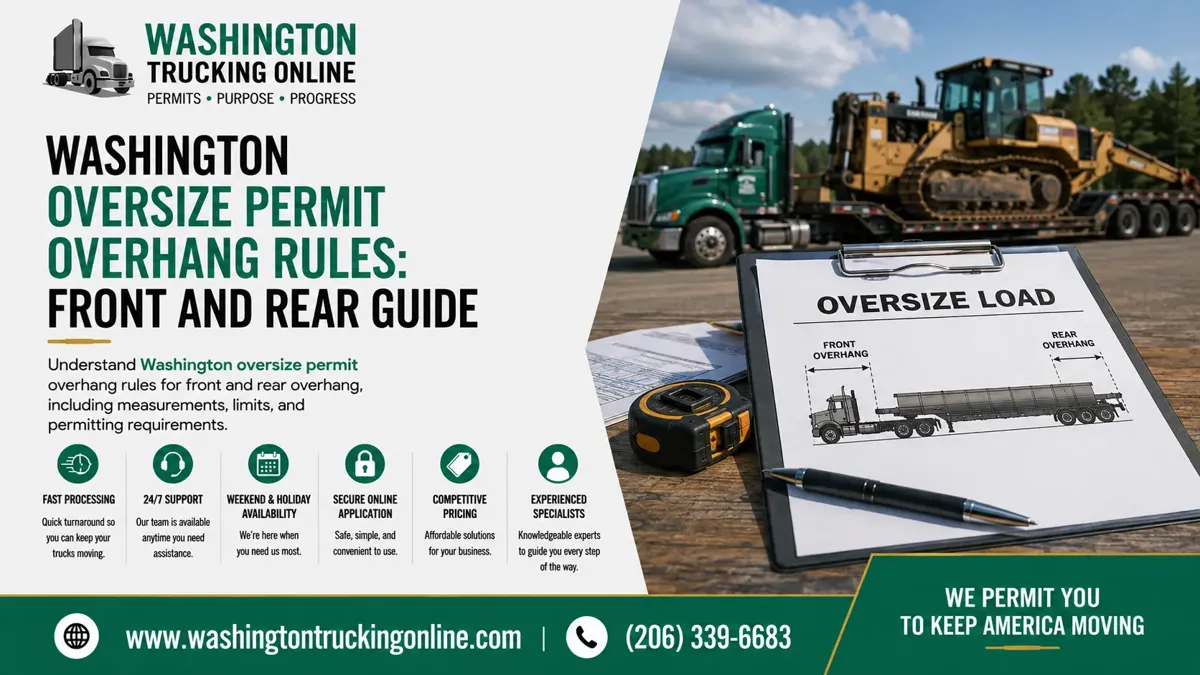
Washington Oversize Permit Overhang Rules: Front And Rear Overhang Explained
Table of Contents
-
Introduction
-
What Is Overhang On An Oversize Load?
-
Washington Front Overhang Rules
-
Washington Rear Overhang Rules
-
When Does an Overhang Require A Permit?
-
How Overhang Is Measured
-
Why Overhang Matters For Route Planning
-
Common Overhang Mistakes To Avoid
-
Why Many Trucking Companies Choose Our Service
-
FAQ
Introduction
When transporting large or specialized equipment in Washington State, the overall dimensions of the load are not the only measurements that matter. How far the load extends beyond the front or rear of the vehicle can also determine whether an oversize permit is required.
Washington allows limited front and rear overhang within the standard legal dimensions. When a load extends beyond those limits, trucking companies may need an oversize permit before operating on Washington state highways. Understanding how overhang is measured can help carriers prepare accurate permit applications and avoid problems during transportation.
What Is Overhang On An Oversize Load?
"Overhang" refers to the portion of a load that extends beyond the normal reference points of the vehicle or trailer.
For Washington oversize permitting, front and rear overhangs are treated differently. The standard legal allowance is 3 feet of front overhang and 15 feet of rear overhang. If the load exceeds these limits, an overdimension permit may be necessary, provided the load qualifies for permitting.
Overhang is especially common when transporting equipment, machinery, structural components, poles, beams, and other long, non-divisible loads.
Washington Front Overhang Rules
Washington generally allows up to 3 feet of front overhang within the standard legal dimensions.
"Front overhang" describes the portion of the load extending forward beyond the applicable front reference point of the vehicle. If the cargo extends farther than the legal allowance, the additional projection can make the movement overdimensional.
Trucking companies should measure the actual loaded configuration rather than estimating the amount of projection. A small measurement difference can affect whether the movement remains within legal dimensions or requires permitting.
When an oversize permit is required, the permitted dimensions and any applicable conditions must be followed during the trip.
Washington Rear Overhang Rules
Washington allows up to 15 feet of rear overhang under its standard legal dimensions. WSDOT identifies rear overhang as part of the state's legal dimension requirements, and certain permit programs also specify how rear overhang is measured.
Rear overhang is particularly important when hauling long equipment or machinery on trailers where the cargo extends substantially beyond the rear axle area.
Carriers should measure the load carefully and make sure the measurement matches the configuration described in the permit application. The trailer, load, axle arrangement, and measurement points should all be considered together.
When Does an Overhang Require A Permit?
A Washington oversize permit is generally required when the vehicle or load exceeds the state's legal dimensions and the load qualifies for permitting.
For standard dimensions, WSDOT lists:
-
3 feet of front overhang
-
15 feet of rear overhang
-
8 feet 6 inches of legal width
-
14 feet of legal height
-
53 feet for a tractor-trailer
-
75 feet overall for a truck and trailer combination
WSDOT states that oversize permits are issued for loads that cannot reasonably be divided.
A carrier should therefore determine the complete loaded dimensions before deciding whether an oversize permit is necessary.
How Overhang Is Measured
Accurate measurement is one of the most important parts of preparing an oversize permit application.
Before submitting permit information, trucking companies should:
-
Measure the complete loaded vehicle.
-
Determine how far the cargo extends beyond the applicable front reference point.
-
Measure the rear projection accurately.
-
Confirm the trailer and axle configuration.
-
Record the total dimensions consistently.
-
Compare the measurements with Washington's legal limits.
-
Provide accurate information when applying for the permit.
Do not rely on approximate measurements taken before the cargo is positioned on the trailer. The final loaded configuration is what matters for determining the dimensions of the movement.
Why Overhang Matters For Route Planning
Overhang is not simply an administrative measurement. A long projection can affect how a vehicle moves through intersections, turns, narrow roadways, and other areas along the approved route.
WSDOT requires carriers to verify route restrictions and overhead clearances before moving an oversize load. A permit does not eliminate the carrier's responsibility to check the route.
Carriers should also review the specific restrictions listed on their permit. Oversize movements can be subject to route-specific conditions, travel restrictions, and other requirements.
Common Overhang Mistakes To Avoid
Several mistakes can create unnecessary problems when transporting an overhanging load in Washington.
Using estimated measurements: Guessing the amount of overhang can result in inaccurate permit information.
Measuring from the wrong reference point: Front and rear overhang measurements must be based on the appropriate measurement points for the vehicle configuration.
Ignoring the trailer configuration: The same cargo can produce different dimensions depending on how it is positioned and transported.
Assuming a permit covers every route: Washington permits are generally tied to approved state highway movements, and local jurisdictions may have their own requirements.
Failing to check restrictions: Carriers remain responsible for checking route restrictions and clearance issues before moving.
Accurate measurements and careful route planning can help prevent delays and compliance problems.
Why Many Trucking Companies Choose Our Service
Many trucking companies choose Washington Trucking Online because the permitting process can be easier when experienced permit specialists handle the details. Our service provides fast processing, 24/7 customer support, weekend and holiday availability, a secure online application process, competitive pricing, and experienced permit specialists who understand Washington permitting requirements.
Whether you are transporting heavy equipment, machinery, structural components, or another non-divisible load with significant overhang, having the correct information prepared before the movement can make the permitting process much smoother.
Apply online today for your Washington oversize permit.
FAQ
How much front overhang is legal in Washington?
Washington allows up to 3 feet of front overhang within its standard legal dimensions. Loads exceeding the applicable limit may require an oversize permit.
How much rear overhang is legal in Washington?
The standard legal rear overhang allowance is 15 feet. Certain permit programs also specify how rear overhang is measured, so carriers should review the requirements applicable to their vehicle and load.
Does rear overhang automatically require an oversize permit?
Not necessarily. Rear overhang within the applicable legal allowance does not by itself make the load overdimensional. Overhang beyond the legal limit may require permitting if the load qualifies.
Can a divisible load receive an oversize permit for excessive overhang?
Washington states that oversize permits are issued for loads that cannot reasonably be divided. If the load can reasonably be reduced, it must generally be reduced rather than permitted as an oversize load.
Does an oversize permit guarantee that the route is safe for the load?
No. Carriers are responsible for checking route restrictions and overhead clearances before moving. WSDOT specifically places responsibility for verifying route restrictions and clearance issues on the carrier.
Can local roads have different requirements?
Yes. Washington permits cover state routes, while city streets and county roads can have separate requirements. Carriers should contact the appropriate local jurisdiction when their route includes roads outside the state highway system.
For more information, visit the Washington State Department of Transportation.