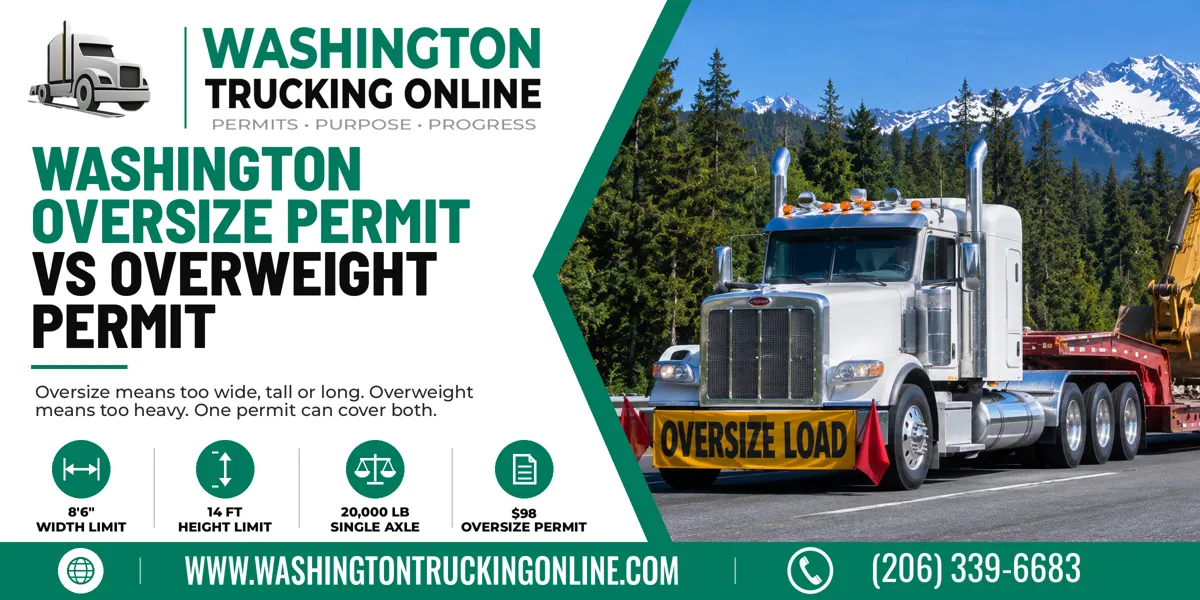
Washington Oversize Permit vs Overweight Permit: What's the Difference and Which Do You Need?
Table Of Contents
-
Introduction
-
The Short Answer
-
What Makes a Load Oversize in Washington
-
What Makes a Load Overweight in Washington
-
Side-by-Side Comparison
-
What If Your Load Is Both?
-
The Non-Divisible Load Rule
-
Real-World Examples
-
How to Choose the Right Permit
-
Why Many Trucking Companies Choose Our Service
-
FAQ
Introduction
Carriers often use "oversize" and "overweight" as if they mean the same thing. They don't. One is about the size of the vehicle and load, and the other is about how heavy it is. Mixing them up can lead to the wrong permit, a stop at the scale, and a fine.
This guide explains the difference between a Washington Oversize Permit and an overweight permit, shows the legal limits that trigger each one, and helps you pick the right permit before your truck rolls.
The Short Answer
-
You need a Washington Oversize Permit when the vehicle or load is wider, taller, or longer than Washington's legal limits.
-
You need an overweight permit when the vehicle is heavier than the legal axle or gross weight limits.
-
If the load is both oversize and overweight, one special permit from the Washington State Department of Transportation (WSDOT) can cover both.
All of these are special permits issued under RCW 46.44.090.
What Makes a Load Oversize in Washington
A load is oversize when it goes past any of the legal size limits:
-
Width: over 8 feet 6 inches (RCW 46.44.010)
-
Height: over 14 feet (RCW 46.44.020)
-
Length: over the legal length limits for the vehicle or combination, such as a semitrailer longer than 53 feet (RCW 46.44.030)
-
Overhang: a load hanging too far past the front or rear of the vehicle
Weight doesn't matter for this test. A light load can still need a Washington Oversize Permit just because it is too wide or too tall, like a 6,000-pound steel frame that is 11 feet wide.
What Makes a Load Overweight in Washington
A load is overweight when the vehicle is heavier than Washington allows. The main limits are:
-
Single axle: 20,000 pounds (RCW 46.44.041)
-
Tandem axle: 34,000 pounds
-
Gross weight: set by the number of axles and the distance between them, up to 105,500 pounds for vehicles with enough axles and spacing
A load can be overweight while being perfectly legal in size. A compact transformer or a heavy coil of steel may fit within 8 feet 6 inches but weigh far more than the axles can legally carry.
Side-by-Side Comparison
| Oversize Permit | Overweight Permit | |
|---|---|---|
| Triggered by | Width, height, length, overhang | Axle weight or gross weight |
| Key limits | 8'6" wide, 14' high | 20,000 lb single, 34,000 lb tandem |
| Common loads | Wide machinery, buildings, tall tanks | Transformers, heavy equipment, steel |
| Extra conditions | Signs, flags, lights, pilot cars | Route and bridge review |
What If Your Load Is Both?
Many heavy-haul loads are both too big and too heavy. A large excavator on a lowboy is a common example: it's wide and heavy at the same time.
In that case, you don't buy two separate permits. WSDOT issues one special permit that lists the approved dimensions and weights together. The permit will include the route, the travel conditions, and any bridge restrictions for the heavy part of the move.
Overweight moves often get extra review because WSDOT has to check that every bridge on the route can carry the weight.
The Non-Divisible Load Rule
Both kinds of permits are meant for loads that can't reasonably be broken down into smaller loads. A single bulldozer or a factory-built beam is non-divisible. A trailer full of gravel or lumber is divisible, so it should be loaded within legal limits instead of being permitted.
If you can split the load and haul it legally, WSDOT generally won't issue a special permit to haul it over the limits.
Real-World Examples
-
A 12-foot-wide modular office at 30,000 pounds. Oversize only. Needs a Washington Oversize Permit.
-
A 15-foot-tall storage tank. Oversize by height. Needs a Washington Oversize Permit.
-
A 70,000-pound transformer, 8 feet wide. Overweight only. Needs an overweight permit.
-
A 90,000-pound excavator, 11 feet wide. Both. One special permit covers both.
-
A tractor-trailer hauling 80,000 pounds of lumber. If the axles and dimensions are legal, no special permit is needed.
How to Choose the Right Permit
-
Measure the Load. Check the width, height, length, and any overhang with the load on the trailer.
-
Weigh the Truck. Get the gross weight and the weight on each axle group.
-
Compare to the Limits. Over on size means oversize. Over on weight means overweight.
-
Check if It's Divisible. Only non-divisible loads qualify for a special permit.
-
Order One Permit for Both. If the load is over on size and weight, request one permit that covers both.
-
Plan the Route. Large and heavy loads may face route, time, and bridge restrictions.
Why Many Trucking Companies Choose Our Service
Washington Trucking Online checks your load's size and weight, tells you exactly which permit you need, and orders your Washington Oversize Permit fast, whether the load is oversize, overweight, or both.
-
Oversize permit: $98
-
Trip permit: $95
-
Fuel permit: $95
We provide 24/7 support and work weekends and holidays.
or
FAQ
What is the difference between an oversize and an overweight permit in Washington?
An oversize permit covers loads that are too wide, tall, or long. An overweight permit covers loads that are too heavy.
How wide can a load be without a Washington Oversize Permit?
Up to 8 feet 6 inches. Anything wider needs a permit.
How tall can a load be without a permit?
Up to 14 feet. Anything taller needs a permit.
Do I need two permits if my load is too big and too heavy?
No. One WSDOT special permit can cover both size and weight.
Can I get a permit for a divisible load?
Generally no. Special permits are for loads that can't reasonably be broken down.
How much does your Washington Oversize Permit service cost?
Our Washington Oversize Permit service is $98.
For more information, visit WSDOT.