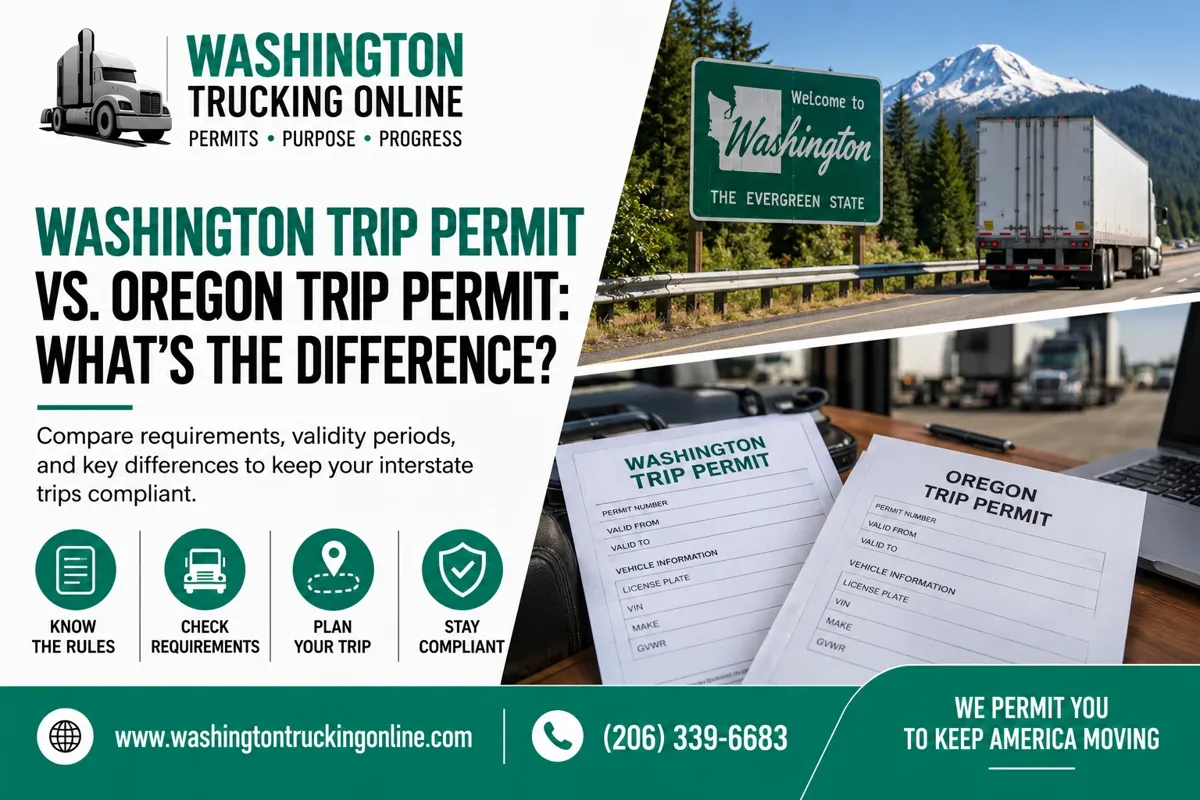
Washington Trip Permit vs. Oregon Trip Permit: What's The Difference?
Table Of Contents
-
Introduction
-
What Is A Washington Trip Permit?
-
What Is An Oregon Trip Permit?
-
How The Validity Periods Differ
-
How Vehicle Requirements Differ
-
What Happens When A Truck Travels In Both States?
-
How To Avoid Permit Mistakes
-
Why Many Trucking Companies Choose Our Service
-
FAQ
Introduction
Trucking companies traveling between Washington and Oregon may need temporary vehicle credentials when a truck does not have the registration required for a particular state. Although both states offer trip permits, a Washington Trip Permit and an Oregon Trip Permit are not identical.
Each state has its own rules regarding eligibility, vehicle requirements, permit duration, and how temporary authorization is used. A carrier traveling through both states should therefore review the requirements for each state instead of assuming that one permit automatically covers the entire trip.
Understanding these differences can help trucking companies plan interstate movements, provide drivers with the correct documents, and avoid preventable problems during inspections or state-line crossings.
What Is A Washington Trip Permit?
A Washington Trip Permit provides temporary Washington vehicle licensing for an eligible vehicle. It is generally used when the vehicle does not have the Washington registration needed for the planned operation.
For commercial vehicles, Washington trip permits can provide temporary authorization for a limited period. The permit is issued for the specific vehicle and must be properly completed and available for the vehicle's operation.
The permit is temporary, so trucking companies should pay close attention to its effective period. Washington also has limits on how frequently certain trip permits may be obtained for the same vehicle.
Because the permit is specific to Washington, a carrier should not assume that obtaining one satisfies Oregon requirements later in the same trip.
What Is An Oregon Trip Permit?
An Oregon Trip Permit provides temporary operating authority for qualifying vehicles in Oregon. Oregon offers multiple trip permit types depending on the vehicle and purpose of the operation.
For example, the Heavy Motor Vehicle Trip Permit is available for certain unregistered heavy vehicles and is generally valid for 10 consecutive days.
Oregon also has separate temporary credentials for other situations, so the carrier needs to identify the permit type that applies to the vehicle.
This is an important distinction when comparing Washington and Oregon. The term “trip permit” may be used in both states, but the specific permit requirements are not the same.
How The Validity Periods Differ
One of the easiest differences to identify is the length of time the permits are valid.
A Washington Trip Permit is generally valid for three consecutive days. An Oregon Heavy Motor Vehicle Trip Permit is generally valid for 10 consecutive days.
That difference can affect how a carrier plans a multi-state trip.
For example, a truck might enter Washington on Monday, travel into Oregon on Tuesday, and remain in Oregon through the end of the week. The Washington permit does not continue beyond its own validity period simply because the truck is still traveling under an Oregon credential.
Dispatch should track the validity of each permit separately and make sure the driver does not rely on an expired document.
How Vehicle Requirements Differ
Washington and Oregon also have different requirements regarding which vehicles qualify for temporary trip permits.
Washington's commercial trip permit system is designed for specific temporary vehicle licensing situations. Oregon has several trip permit categories based on the vehicle's registration status, weight, and type of operation.
This means the carrier should look at more than the state name on the permit. The company should confirm the exact vehicle, license plate, permit type, and operating circumstances before departure.
A truck that qualifies for a temporary permit in Washington may not qualify for the same type of temporary credential in Oregon.
Trucking companies should review each state's requirements separately when preparing a cross-border trip.
What Happens When A Truck Travels In Both States?
When a truck travels from Washington into Oregon, the carrier should determine what temporary credentials are needed for each part of the trip.
For example, the truck may need a Washington Trip Permit for its Washington operation and an Oregon Trip Permit for temporary operation in Oregon, depending on the vehicle's registration and circumstances.
The driver should have access to the appropriate current documentation for each state.
Dispatch should also keep the two permits organized separately. Clearly identifying which document applies to Washington and which applies to Oregon can help prevent a driver from presenting the wrong paperwork.
For carriers that regularly travel between the two states, using a state-by-state permit checklist can make this process much easier.
How To Avoid Permit Mistakes
The easiest way to prevent problems is to verify all temporary credentials before the truck leaves.
Dispatch should confirm:
-
Vehicle identification
-
License plate
-
Permit type
-
Effective dates
-
Vehicle registration status
-
State where the permit applies
-
Required driver documentation
Drivers should also review their documents before crossing a state line.
If a vehicle, license plate, registration status, or planned operation changes, the carrier should review the permit requirements again. Companies should not assume that an existing document remains correct after a significant change.
Keeping Washington and Oregon permit records separate can also reduce the chance of sending the wrong document to a driver.
Why Many Trucking Companies Choose Our Service
Many trucking companies choose Washington Trucking Online and Oregon Trucking Online when they need help managing temporary commercial vehicle credentials across state lines. Our services provide experienced permit specialists, fast processing, secure online applications, and convenient customer support.
Working with experienced permit specialists can help carriers identify the appropriate state-specific credential and reduce document mix-ups when a trip involves both Washington and Oregon.
Our goal is to make the permitting process more convenient so trucking companies can spend less time dealing with paperwork and more time keeping their operations moving.
FAQ
Is A Washington Trip Permit The Same As An Oregon Trip Permit?
No. Washington and Oregon have different temporary permitting systems, eligibility requirements, vehicle rules, and validity periods.
How Long Is A Washington Trip Permit Generally Valid?
A Washington Trip Permit is generally valid for three consecutive days.
How Long Is An Oregon Heavy Motor Vehicle Trip Permit Generally Valid?
An Oregon Heavy Motor Vehicle Trip Permit is generally valid for 10 consecutive days.
Can One Permit Automatically Cover Both Washington And Oregon?
No. Carriers should review the applicable requirements for each state and determine which credentials are needed.
Does An Oregon Trip Permit Replace Other Oregon Requirements?
Not necessarily. Depending on the vehicle and operation, additional Oregon registration or tax requirements may apply.
What Should Dispatch Check Before A Washington-To-Oregon Trip?
Dispatch should verify the vehicle, license plate, permit type, validity dates, registration status, and applicable requirements for each state.
Why Should Drivers Keep The Permits Separate?
Keeping documents organized by state reduces the chance of presenting the wrong permit during an inspection or state-line crossing.
What If The Truck's Information Changes After The Permit Is Issued?
The carrier should review the applicable permit requirements and determine whether updated documentation is needed before continuing the trip.
For more information, visit the Washington State Department of Licensing and the Oregon Department of Transportation.