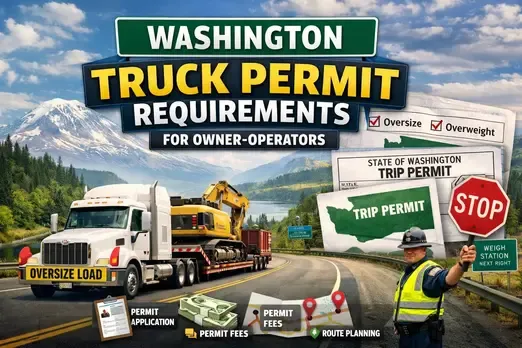
1. When You Need a Permit
As an owner-operator, you must obtain a permit in Washington whenever your truck and/or load exceed legal size or weight limits under state law. That includes:
-
Width over 8 ft 6 in
-
Height over 14 ft
-
Length above standard legal length
-
Weight above legal axle or gross limits
If any part of the load can reasonably be reduced or removed to get within legal limits, the state typically won’t issue the permit.
Put simply: if your rig + cargo are bigger or heavier than legal, get a permit first.
2. Types of Permits You Might Need
Oversize / Overweight Permits
-
Required when your vehicle + load exceed legal size or weight limits.
-
Issued through https://www.washingtontruckingonline.com/
-
You can self-issue if you register in the program and meet the criteria.
Owner-operator tip: If you haul non-divisible loads (e.g., equipment you can’t break down), you’ll likely need these permits.
Temporary Trip Permits
-
For trucks not registered or for short-term trips.
-
Good for up to 3 consecutive days.
-
Ideal when entering WA with a truck not registered in the state.
-
Cost around ~$36 (varies by service).
Temporary Fuel Permits (IFTA)
-
If you’re not registered under IFTA (International Fuel Tax Agreement) but are operating in WA with a diesel/propane commercial vehicle.
-
Also good for 3 days.
3. Self-Issuing Permits (Owner-Operator Friendly)
You can self-issue permits online at https://www.washingtontruckingonline.com/ if you
are authorized under your company or USDOT number
Self-issuing lets you generate permits 24/7 — no need to call a permit agent for routine oversize/overweight trips.
This is especially useful for owner-ops who move oversize loads regularly.
4. Permit Application Essentials
As an owner-operator, to successfully issue or apply for permits you’ll need:
Truck / trailer registration info
Load dimensions & weight information
Axle spacing report (usually required for overweight permits)
Proposed route (you are responsible for checking it)
You’re also responsible for checking bridge restrictions and overhead clearances along your route.
5. Fee Basics
Washington charges based on:
-
dimensional oversize
-
weight exceeding legal limits
-
trip mileage
Temporary permits and oversize permits have set or sliding fees based on these factors.
6. Enforcement & Compliance
-
Operating without a permit when required can lead to fines or being turned around at inspection stations.
-
You must have permits in hand before entering the state or starting a permitted run.
Owner-Operator Practical Checklist
Before you hit the road in Washington:
-
Measure your truck + load.
-
Check legal limits (width, height, length, weight).
-
Decide permit type (oversize/overweight, trip, fuel).
-
Print and carry permits.
-
Plan your route (avoid restricted bridges/low clearance).