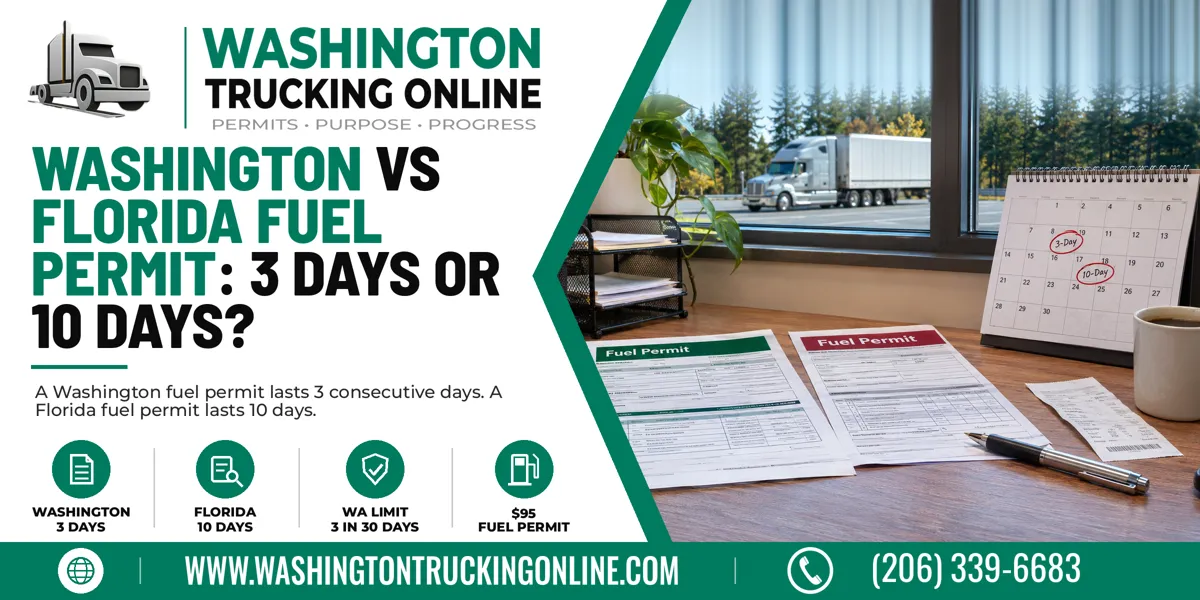
Washington vs Florida Fuel Permit: 3 Days or 10 Days?
Table Of Contents
-
Introduction
-
The Short Answer
-
Which Trucks Need a Fuel Permit in Each State
-
How Long Each Permit Lasts
-
How Often You Can Use Each Permit
-
Side-by-Side Comparison
-
What Each Permit Does and Doesn't Cover
-
Penalties in Washington and Florida
-
When IFTA Makes More Sense in Both States
-
Common Mistakes When Running Both States
-
Why Many Trucking Companies Choose Our Service
-
FAQ
Introduction
Washington and Florida sit at opposite corners of the country, but carriers without IFTA credentials face the same question in both states: what do I need to cover fuel tax for one trip?
Both states answer with a temporary fuel permit. The difference is how long that permit lasts and what happens when a trip runs long. This guide compares the Washington Fuel Permit and the Florida Fuel Permit point by point, so you can plan each trip without running on an expired permit.
The Short Answer
A Washington Fuel Permit is valid for 3 consecutive days, and a carrier can buy no more than 3 permits in any 30 days. A Florida Fuel Permit expires 10 days after the date of issuance.
In short, Washington gives you a short window and a hard limit on how often you can use it, while Florida gives you more time per permit.
Which Trucks Need a Fuel Permit in Each State
Both states use the same qualified motor vehicle test:
-
Two axles and a gross or registered weight over 26,000 pounds,
-
Three or more axles, regardless of weight, or
-
A combination weighing over 26,000 pounds.
-
Washington: diesel and propane trucks that meet the test need IFTA or a Washington Fuel Permit. Gasoline trucks generally don't need it, since gasoline tax is usually paid at the pump.
-
Florida: a qualified motor vehicle without IFTA credentials needs a Florida Fuel Permit. Florida-based trucks that run only inside Florida are exempt.
What it means: if your truck needs a permit in one state, it almost always needs one in the other too.
How Long Each Permit Lasts
-
Washington: the permit is good for 3 consecutive days, beginning and ending on the dates shown on it. Day one is the start date on the permit, so buying a day early uses up one of your three days.
-
Florida: the permit expires 10 days after issuance. The 10 days start on the date the permit is issued, not the day the truck enters Florida.
What it means: a Washington permit leaves very little room for a late shipper or a breakdown. A Florida permit can cover a trip with a weekend layover.
How Often You Can Use Each Permit
-
Washington: a carrier may buy a maximum of 3 permits in any 30 days. A trip longer than three days needs more than one permit, which uses up the limit even faster.
-
Florida: the temporary permit is meant for carriers without IFTA credentials making occasional trips into the state.
What it means: regular Washington runs push carriers toward IFTA much sooner than Florida runs do.
Side-by-Side Comparison
| Feature | Washington | Florida |
|---|---|---|
| How long it lasts | 3 consecutive days | 10 days from issuance |
| Usage limit | 3 permits in any 30 days | For occasional trips |
| Who needs it | Qualified diesel or propane vehicles without IFTA | Qualified motor vehicles without IFTA |
| Our price | $95 | $120 |
| Penalty | Gross misdemeanor | Third-degree felony, each day separate |
What Each Permit Does and Doesn't Cover
-
Washington: The permit fee, set under RCW 46.17.400, is paid in lieu of the special fuel tax on fuel used on Washington highways. Under RCW 82.38.100, permits can't be issued to a carrier that owes fuel taxes, penalties, or interest to the state.
-
Florida: Florida's motor fuel use tax under section 207.003 applies to each gallon of motor fuel used to propel a qualified motor vehicle in Florida, including fuel bought in another state. The permit covers that tax for the trip.
What it means: in both states, the fuel permit covers fuel tax only. Registration needs its own trip permit or IRP plates.
Penalties in Washington and Florida
-
Washington: violating the fuel permit law is a gross misdemeanor under RCW 82.38.100. Altering the dates, license number, or VIN invalidates the permit.
-
Florida: driving without a required Florida Fuel Permit or decals can be a third-degree felony, and each day is a separate offense.
When IFTA Makes More Sense in Both States
-
You Run in Either State Often. Frequent trips mean frequent permits.
-
You Hit Washington's Limit. More than 3 permits in 30 days isn't allowed.
-
Your Trips Run Long. Long Washington trips can need two or more permits.
-
You Cover Many States. IFTA handles fuel tax in all member states at once.
-
You Want Fewer Last-Minute Orders. IFTA decals stay on the truck all year.
Common Mistakes When Running Both States
-
Treating 3 days like 10. A Washington permit runs out fast.
-
Buying the permit too early. In both states, the clock starts on the permit's date.
-
Forgetting Washington's 3-in-30 limit. A fourth permit isn't allowed.
-
Changing the dates by hand. In Washington, that invalidates the permit.
-
Skipping the trip permit. Fuel permits don't cover registration.
Why Many Trucking Companies Choose Our Service
Washington Trucking Online helps carriers order the right Washington Fuel Permit on the right start date and keep track of the 3-in-30 limit, so every trip into Washington stays covered.
-
Fuel permit: $95
-
Trip permit: $95
-
Oversize permit: $98
We provide support 24/7 and also work weekends and holidays.
or
FAQ
How long is a Washington Fuel Permit valid?
It is valid for 3 consecutive days, as shown on the permit.
How long is a Florida Fuel Permit valid?
It expires 10 days after the date of issuance.
Can I buy as many Washington Fuel Permits as I need?
No. A carrier can buy no more than 3 in any 30 days.
Do IFTA carriers need either permit?
Generally no. Carriers with valid IFTA credentials report fuel tax through IFTA.
How much does your Washington Fuel Permit service cost?
Our Washington Fuel Permit service is $95.
For more information, visit the Washington State Department of Transportation and the Florida Department of Highway Safety and Motor Vehicles.