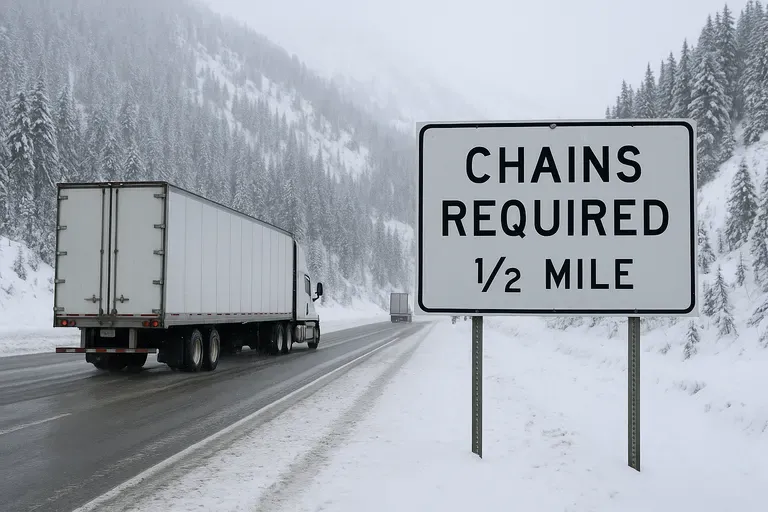
Washington’s Chain Law Requirements for Commercial Trucks
1. Purpose
Washington’s chain laws are designed to ensure safe travel during snow and ice conditions, especially on mountain passes like Snoqualmie, Stevens, White, and Blewett Passes. The law applies primarily to vehicles over 10,000 lbs GVW.
2. When Chains Are Required
-
Chain requirements are activated by WSDOT (Washington State Department of Transportation) during winter weather.
-
Signs and electronic message boards will indicate when and where chains must be installed.
-
Even all-wheel drive and four-wheel drive vehicles must comply when signs are posted.
-
Failure to chain up when required may result in a $500 fine.
3. Truck Chain Requirements
| Vehicle Type | Minimum Chain Requirements |
|---|---|
| Single-drive axle truck | 3 chains – two on the main drive axle and one on a trailer axle |
| Tandem-drive axle truck | 5 chains – four on the main drive axles and one on a trailer axle |
| Fully chained configuration | 6 chains – all drive wheels and one on a trailer axle |
| Combination vehicles (tractor-trailers) | At least one chain on one tire of every drive axle and one on one tire of one trailer axle |
-
“Approved traction devices” (like cable chains or automatic chain systems) are accepted if they meet WSDOT standards.
4. Designated Chain-Up Areas
WSDOT provides designated chain-up and removal areas before and after mountain passes.
Examples include:
-
I-90 – Snoqualmie Pass
-
US 2 – Stevens Pass
-
US 12 – White Pass
-
US 97 – Blewett Pass
These areas are marked and maintained for safety and efficiency.
5. Key Rules
-
Drivers must carry chains from November 1 through April 1 on specific routes, even if not in use.
-
You may not proceed past a “Chains Required” sign without the required chains installed.
-
Chains must be installed on drive axles — not steering axles.
-
Always check the WSDOT mountain pass reports before travel.
6. Penalties
-
Failure to carry chains: $138 fine
-
Failure to install when required: $500 fine
-
If the vehicle blocks traffic because of not chaining up — additional civil liability may apply.
7. Safety Recommendations
-
Always inspect chains before use for damage or wear.
-
Practice installation before the winter season.
-
Carry reflective gear and gloves for safety when chaining roadside.
-
Keep an emergency kit with flares, blankets, and traction aids.