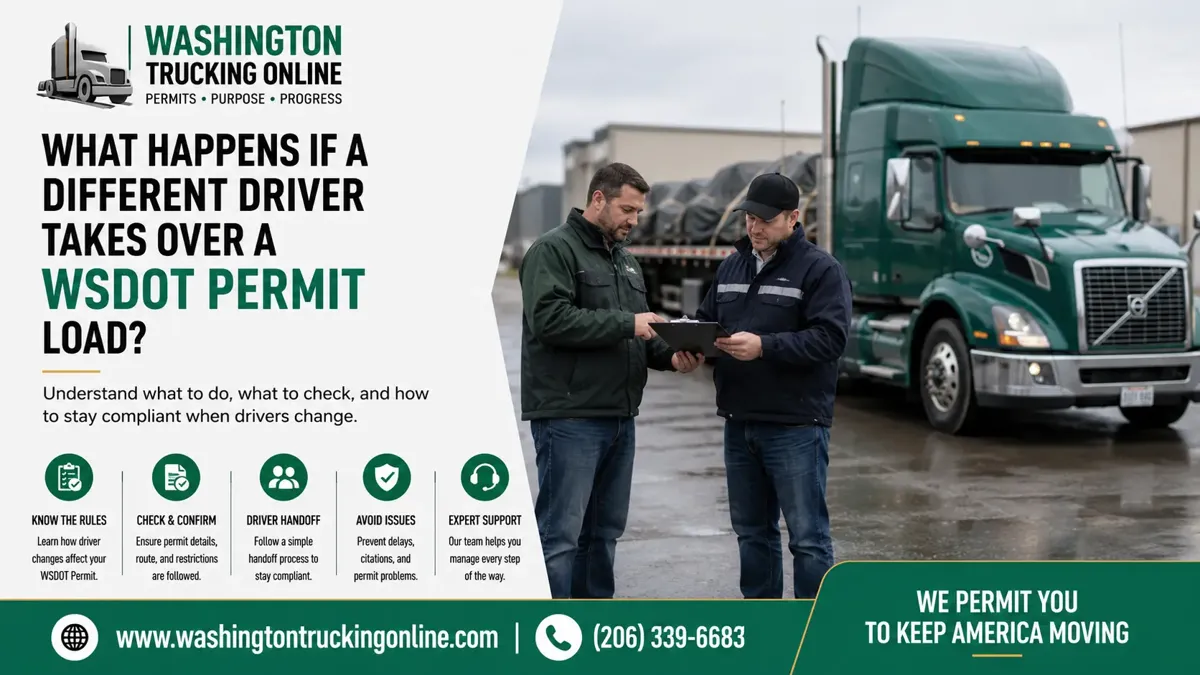
What Happens If A Different Driver Takes Over A WSDOT Permitted Load?
Table Of Contents
-
Introduction
-
Does A WSDOT Permit Belong To The Driver?
-
What Happens When A Different Driver Takes Over?
-
What Should The New Driver Check?
-
What If The Driver Change Happens During The Trip?
-
What If The Truck Also Changes?
-
How To Prevent Problems During A Driver Change
-
Common Mistakes To Avoid
-
Why Many Trucking Companies Choose Our Service
-
FAQ
Introduction
A driver change can happen during almost any commercial trip. A driver may reach the end of a scheduled shift, become unavailable, or need to be replaced because of an unexpected situation.
When the truck is carrying an oversized or overweight load under a WSDOT Permit, the carrier should make sure the replacement driver understands the permit conditions before continuing.
A driver change does not automatically mean that a new permit is needed. However, the new driver should have access to the permit, understand the approved route, and follow all applicable travel restrictions and conditions.
The most important distinction is whether only the driver changes or the truck and equipment also change.
Does A WSDOT Permit Belong To The Driver?
A WSDOT Permit is associated with a specific permitted movement rather than simply being permission for an individual driver.
The permit contains information and conditions related to the vehicle, load, route, travel period, and other requirements. The driver operating the permitted vehicle needs to follow those conditions.
Therefore, when a different driver takes over the same truck and load, the carrier should make sure the replacement driver receives the permit and understands its requirements.
The new driver should not rely only on verbal instructions from the previous driver. Reviewing the actual permit helps ensure that important restrictions are not overlooked.
What Happens When A Different Driver Takes Over?
If the same truck, trailer, and load remain in place, the carrier should provide the replacement driver with the current WSDOT Permit and relevant trip information.
Before continuing, the new driver should understand:
-
The approved route
-
Permit travel dates
-
Travel-time restrictions
-
Load dimensions and weight
-
Escort requirements
-
Required signs and equipment
-
Special conditions listed on the permit
This is particularly important for oversized and overweight loads because the permitted movement may have conditions that do not apply to ordinary commercial vehicles.
A driver handoff should therefore be treated as an important part of the trip rather than simply an exchange of keys.
What Should The New Driver Check?
Before taking responsibility for the load, the replacement driver should review the WSDOT Permit and confirm that the truck and load still match the permitted movement.
The driver should check:
Permit Information:
Make sure the correct permit is available and readable.
Vehicle And Load:
Confirm that the truck, trailer, load, and configuration remain unchanged.
Route:
Review the approved route before continuing.
Travel Restrictions:
Check any restrictions involving travel hours, days, or other conditions.
Escort Requirements:
Confirm that required escort arrangements remain in place.
Current Trip Location:
Make sure the driver knows where the truck is and which portion of the approved route remains.
These checks can help prevent the new driver from unintentionally violating a condition that the previous driver already understood.
What If The Driver Change Happens During The Trip?
Sometimes a driver change cannot be planned in advance.
A driver may become sick, experience an emergency, or reach a required stopping point while the load is still in transit.
When possible, the handoff should take place at a safe location. The replacement driver should receive the permit and a clear explanation of the remaining route and travel conditions.
If the driver change causes a significant delay, the carrier should also check whether the remaining trip still fits within the permit's travel dates and restrictions.
A delay does not automatically provide permission to continue outside the conditions stated on the permit.
What If The Truck Also Changes?
Changing the driver is different from changing the truck.
If the same permitted truck continues carrying the same load, the primary issue is making sure the new driver understands the permit.
However, if the carrier also replaces the power unit, trailer, or other equipment, the situation can become more complicated.
A different vehicle may have different dimensions, axle spacing, weight distribution, or other characteristics. The carrier should therefore determine whether the existing WSDOT Permit still applies.
Do not assume that a permit automatically follows the load to another truck simply because the original driver is no longer available.
If equipment changes, review the applicable permit requirements before continuing.
How To Prevent Problems During A Driver Change
Trucking companies can reduce problems by creating a standard permit handoff procedure.
Before the replacement driver continues, the carrier should:
-
Provide the current WSDOT Permit.
-
Review the approved route.
-
Explain special permit conditions.
-
Confirm travel restrictions.
-
Verify escort requirements.
-
Review the load dimensions and weight.
-
Confirm that the equipment has not changed.
-
Identify the truck's current location.
-
Review the remaining travel schedule.
For companies operating multiple permitted loads, a written driver handoff checklist can make the process easier and more consistent.
The goal is to make sure every driver taking over the load knows exactly what permit applies and what requirements must be followed.
Common Mistakes To Avoid
Assuming The New Driver Does Not Need The Permit:
The applicable permit should remain available in the vehicle.
Failing To Explain Permit Conditions:
The replacement driver should personally review important restrictions.
Confusing A Driver Change With A Vehicle Change:
Replacing a driver is not the same as replacing the permitted equipment.
Changing Equipment Without Checking The Permit:
A different truck or trailer may require additional permit action.
Ignoring Travel Restrictions:
A driver change does not automatically change the permit's travel conditions.
Taking A Different Route:
The new driver should continue following the approved route.
Relying Only On Verbal Instructions:
The driver should review the actual permit instead of depending entirely on information from the previous driver.
Why Many Trucking Companies Choose Our Service
Many trucking companies choose Washington Trucking Online because managing WSDOT permit requirements can become more complicated when drivers, equipment, and schedules change.
Our experienced permit specialists help trucking companies with WSDOT Permit needs and provide support when questions arise about permit information, vehicle changes, route requirements, and trip planning.
With fast processing, 24/7 customer support, weekend and holiday availability, secure online applications, competitive pricing, and experienced permit specialists, Washington Trucking Online helps trucking companies manage their permit needs efficiently.
Whether a company is preparing a new permitted movement or dealing with an unexpected driver change, organized permit documentation can help reduce unnecessary delays and compliance problems.
FAQ
Can a different driver take over a WSDOT permitted load?
Yes, a different driver can take over the same permitted vehicle and load, but the replacement driver should have the permit and understand its conditions before continuing.
Does changing the driver require a new WSDOT Permit?
Not necessarily. A driver change is different from changing the permitted vehicle or equipment.
What should the new driver review?
The driver should review the permit, route, travel dates, restrictions, load information, and escort requirements.
What if the power unit also changes?
A power unit change can require different permit action. The carrier should verify that the existing permit applies before moving the load with replacement equipment.
What if the driver change causes a delay?
Check whether the remaining trip still fits within the permit's travel dates and restrictions before continuing.
Can the new driver take a different route?
The driver should follow the route authorized by the permit and should not assume another route is acceptable.
How can carriers prevent driver handoff problems?
Use a standard handoff checklist covering the permit, route, restrictions, load information, equipment, and remaining trip schedule.
For more information, visit the Washington State Department of Transportation.