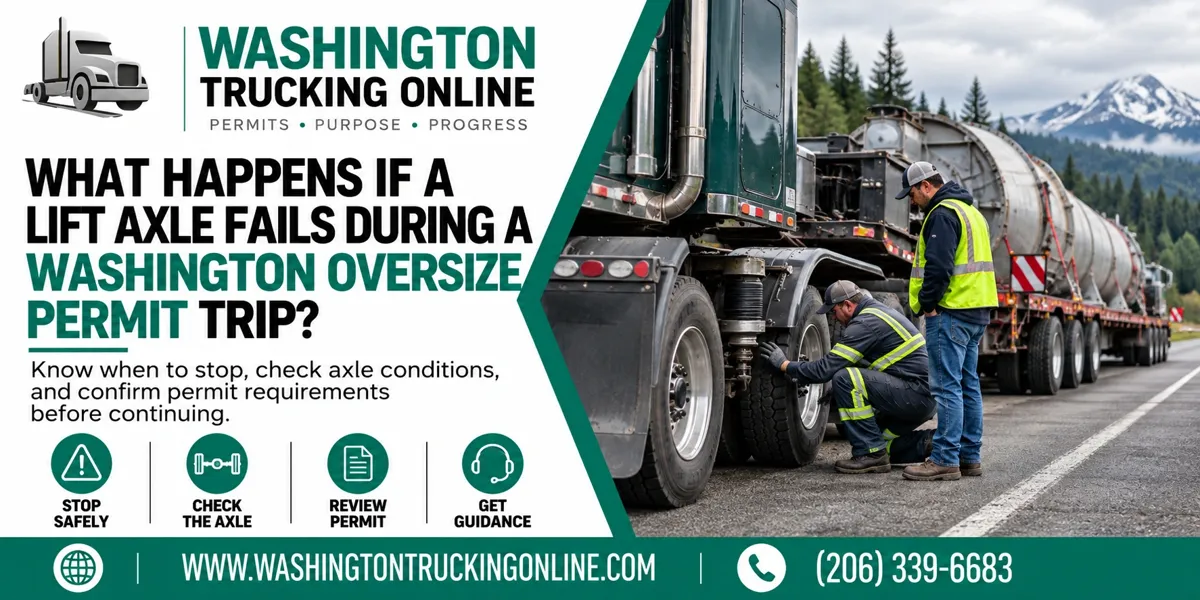
What Happens If a Lift Axle Fails During a Washington Oversize Permit Trip?
Table Of Contents
-
Introduction
-
Why A Lift Axle Failure Matters
-
What To Do Immediately After The Failure
-
Check The Permit And Actual Vehicle Configuration
-
Can The Truck Continue The Trip?
-
Contact The Appropriate Support Team
-
Prepare For The Next Movement
-
Common Mistakes To Avoid
-
Why Many Trucking Companies Choose Our Service
-
FAQ
Introduction
A lift axle helps distribute a heavy load across a vehicle combination, but a mechanical failure during an oversize move can change how the truck carries its weight. A failed axle, air suspension problem, damaged tire, or control-system issue can affect the vehicle’s condition and the way its load is supported.
If a failure occurs during a Washington Oversize Permit trip, do not assume the original permit automatically covers continuing with the vehicle in a different condition. Prioritize safety, stop when it is safe to do so, and verify the vehicle configuration, axle weights, and permit requirements before resuming travel.
Why A Lift Axle Failure Matters
Washington overweight permits rely on vehicle and load information, including axle weights and spacing. A lift axle that no longer operates as intended may change how weight is distributed across the axle groups. Depending on the vehicle design and failure, the affected axle may remain on the ground, fail to carry its expected share, or become unsafe to use.
That matters because the permitted configuration may no longer match the actual operating condition. Even if the cargo dimensions have not changed, the combination’s weight distribution and safe handling may be different. A route-specific permit also does not remove the driver’s responsibility to operate safely and observe its conditions.
What To Do Immediately After The Failure
First, protect the driver and other road users. If steering, braking, tire condition, suspension, or load stability appears affected, stop in a safe location as soon as conditions allow. Use hazard lights and follow the company’s roadside safety procedures.
Do not crawl under the vehicle beside moving traffic or attempt an unsafe roadside repair. Contact dispatch and arrange qualified roadside assistance or a mechanic. If the truck cannot be moved safely, request appropriate recovery or towing support.
Record where the problem occurred, the symptoms, the time, and any steps taken. Photos may help document visible damage when they can be taken safely. These records can help maintenance staff and permit personnel understand what changed.
Check The Permit And Actual Vehicle Configuration
Before the truck moves again, compare the permit details with the actual combination. Review the axle spacing report or other configuration information used for the overweight permit, the number and placement of axles, tire details, stated axle weights, gross weight, and the permitted route.
Washington requires axle spacing information for overweight permits, and the axle spacing report is assigned to a specific configuration. If an axle failure changes the configuration or expected weight distribution, do not assume the existing figures remain appropriate. Have the vehicle inspected and obtain guidance on whether a revised permit, updated information, or another step is necessary.
Do not change the permit or recalculate weights from guesswork. Have qualified personnel establish the actual condition and ask the appropriate authority how it affects the planned movement.
Can The Truck Continue The Trip?
That depends on the mechanical condition, actual axle loading, applicable legal limits, the permit’s conditions, and whether the vehicle can be operated safely. A lift axle failure does not lead to the same answer in every situation.
If the axle problem makes the truck unsafe, the trip should not continue until the vehicle is repaired or safely recovered. If the vehicle appears drivable, that alone does not confirm the combination remains within the approved weight limits or permit conditions. The carrier should verify the altered configuration and obtain any required direction before moving the load.
Do not raise, lower, disconnect, or lock out equipment simply to make the truck match assumptions on paper. Follow the manufacturer’s safety procedures and the mechanic’s advice.
Contact The Appropriate Support Team
Notify dispatch, the fleet maintenance contact, and the permit office or issuer as appropriate. Describe the failure, the vehicle and axle group affected, the location, and the proposed next step. Ask whether the current Washington Oversize Permit remains suitable for the actual configuration and whether any permit correction or additional approval is needed.
Keep a record of the guidance provided and the person or office contacted. If the trip must be delayed, rerouted, repaired roadside, or moved by another vehicle, verify any new route and configuration before continuing. Do not assume that a repair appointment or dispatch instruction overrides permit restrictions.
Prepare For The Next Movement
After repairs, have a qualified technician confirm that the axle and related systems work properly. Check tires, suspension, air lines or hydraulic components, warning indicators, and load stability as applicable to the equipment.
Reconfirm the load’s weight distribution and vehicle configuration, and make sure the required permit information reflects the approved movement. Review route restrictions and any escort or travel conditions before departure. Keep repair invoices, inspection notes, revised documents, and dispatch records together with the original permit.
A careful restart check can help prevent a second roadside interruption and give the carrier a clear record of why the truck stopped and what was done before it resumed the trip.
Common Mistakes To Avoid
Continuing Without Checking Safety: Do not assume the vehicle is safe because it can still roll. A suspension or axle failure may affect handling and load support.
Assuming The Permit Still Matches: Verify the actual configuration and weight information before resuming an overweight movement.
Attempting An Improvised Repair: Do not perform unsafe roadside work or disable equipment to keep the schedule.
Ignoring Route And Permit Conditions: A delay or repair may change the plan, but the permit’s route restrictions still matter.
Failing To Keep Records: Document the failure, repair, communications, and any permit guidance for the carrier’s files.
Why Many Trucking Companies Choose Our Service
Planning a permitted move involves checking vehicle details, axle information, route conditions, and the documents required before dispatch. When equipment problems interrupt a trip, carriers may also need help understanding which permit details should be reviewed before continuing.
Washington Trucking Online helps trucking companies with permit application information and practical guidance for planning Washington movements. Our service can help carriers organize the details needed for an application and identify questions that should be resolved before travel.
FAQ
Does a lift axle failure automatically cancel a Washington Oversize Permit?
Not necessarily, but the failure may change the vehicle’s configuration or weight distribution. Verify the actual condition and ask the appropriate permit authority whether the existing permit remains applicable.
Can the driver continue if the truck still moves?
Not based on that fact alone. The vehicle must be safe, and the combination must comply with applicable weight limits and permit conditions.
Should the carrier update the axle spacing report?
If the configuration changes, verify whether the existing report and permit details still apply. Do not alter or substitute configuration information without appropriate guidance.
What information should dispatch collect?
Record the location, symptoms, affected axle, vehicle configuration, visible damage, repair advice, and any communication with the permit office.
What should happen before the truck resumes the trip?
Have the equipment inspected or repaired, confirm safe operation, verify axle loading and permit conditions, and document any instructions or required updates.
For more information, visit the Washington State Department of Transportation.