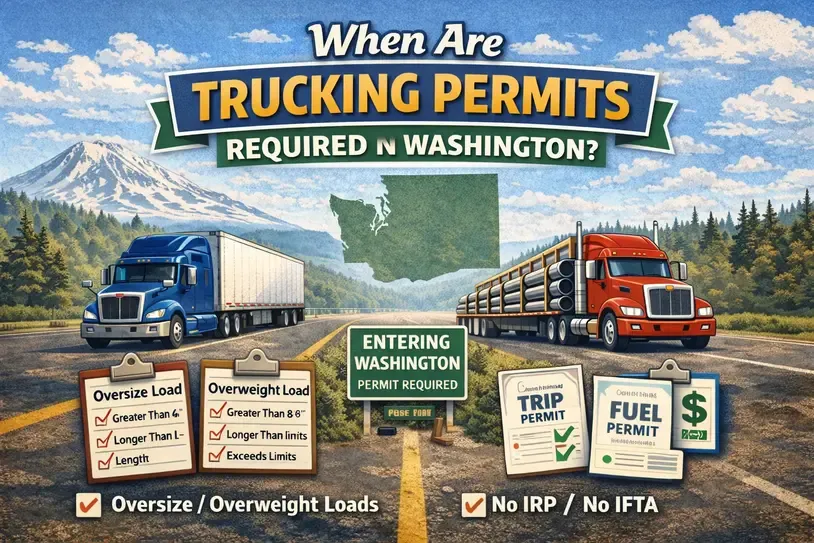
1. Oversize & Overweight Loads
You need a special commercial vehicle permit anytime your truck or its load exceeds the state’s legal dimensions or weight:
Width: Greater than 8 feet 6 inches
Height: Greater than 14 feet
Length: More than the legal length limits (e.g., over 53 feet for trailers or over 75 feet overall)
Weight: Exceeding legal axle or gross vehicle weight limits
If your load cannot be reasonably divided into smaller parts, a permit is required before moving.
2. Entering the State with an Oversize/Overweight Load
All oversize or overweight vehicles must have a Washington permit before entering the state or traveling within it. Permits are issued through:
-
Washington State Department of Transportation (WSDOT)
-
Authorized permit agents
-
Self-issue online system (eSNOOPI Pro) for eligible loads
Permits are not available at highway ports of entry, so plan ahead.
3. Temporary Trip Permits
If you’re coming into Washington without permanent registration (e.g., no IRP plates or proper state weight licensing), you may need:
-
A trip permit — allows operation for up to 3 consecutive days for a commercial vehicle that lacks appropriate weight licensing.
-
A fuel permit — required if you don’t pay fuel tax through IFTA and you operate a diesel or propane vehicle over 26,000 lbs ($33, 3-day).
These temporary permits ensure legal operations when you’re not fully registered for Washington.
4. Special Cases: Superloads
Superloads—very large or extremely heavy non-divisible loads—require advanced permit approval and extra documentation:
-
Exceeding 16 feet width
-
Exceeding 16 feet height
-
More than 125 feet total length
-
Over 200,000 pounds gross weight
-
Written applications must be submitted well before movement.
5. Route Compliance & Additional Rules
Even with a permit, carriers must:
-
Verify route restrictions, overhead clearances, and bridge limits
-
Comply with any travel time or seasonal restrictions
-
Follow local rules if moving on city or county roads (local permits may be required).
Simple Rule of Thumb
You must obtain a Washington trucking permit whenever your truck or load exceeds standard legal limits for size or weight, or if you lack proper registration or licensing to operate at your intended weight or configuration.
https://wsdot.wa.gov/travel/commercial-vehicles/commercial-vehicle-permits