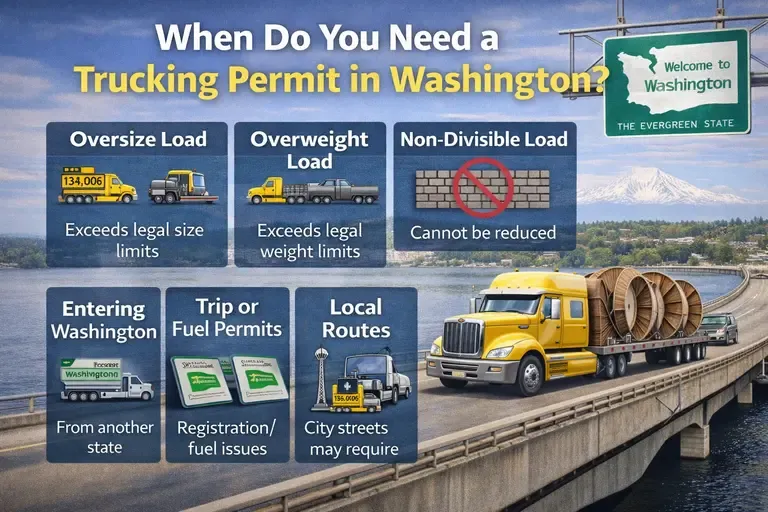
1. When Your Truck or Load Exceeds Legal Size Limits
You must obtain a permit before moving if your vehicle or its load goes beyond Washington’s maximum legal dimensions on state highways, including:
-
Width: Greater than 8 feet 6 inches
-
Height: Greater than 14 feet
-
Length: Over standard legal limits (e.g., long trailers or combinations)
-
Overhang: Beyond allowed front/rear overhang limits
Permits cover oversize movements that cannot be reasonably reduced by breaking down the load.
2. When the Weight Exceeds Legal Limits
A permit is also required if your truck or combination:
-
Exceeds legal gross vehicle weight (GVW)
-
Exceeds legal axle or tandem weight limits
Heavy trucks often need an overweight permit based on state weight tables and axle spacing data before moving on Washington highways.
3. For “Non‑Divisible” Loads
Washington issues permits for non‑divisible loads, meaning:
-
Loads that cannot be reasonably separated or reduced to fit within legal size/weight limits.
If the load can be broken down, a permit is usually not granted.
4. When Entering Washington From Another State
If you are an out‑of‑state carrier entering Washington with oversize or overweight equipment:
-
You must secure a Washington permit before entering the state.
-
This includes carriers passing through or delivering to locations within Washington.
Permit issuance does not happen at highway ports; you need your permit in advance.
5. Temporary Permits for Registration or Fuel Issues
Even if your load doesn’t exceed size or weight limits, you might need a permit in these scenarios:
-
Trip Permits: Required for temporary operation if your vehicle lacks Washington weight licensing.
-
Fuel Permits: Required if you operate a commercial vehicle without IFTA fuel tax compliance (e.g., diesel trucks over 26,000 lbs).
6. Local/Cities May Need Additional Permits
If you transport oversize/overweight loads on local streets or city jurisdictions (e.g., Seattle), separate local permits may be required in addition to state permits.
Quick Rule of Thumb
You generally need a Washington trucking permit if any of the following apply:
Your truck or load exceeds legal size or weight limits
The load is non‑divisible
You are entering from another state with oversize/overweight equipment
You need temporary trip or fuel permits due to licensing status
Your route includes city streets with separate permit rules
Permits can often be obtained online through https://www.washingtontruckingonline.com/ ; plan ahead, because permits are not issued at highway ports.