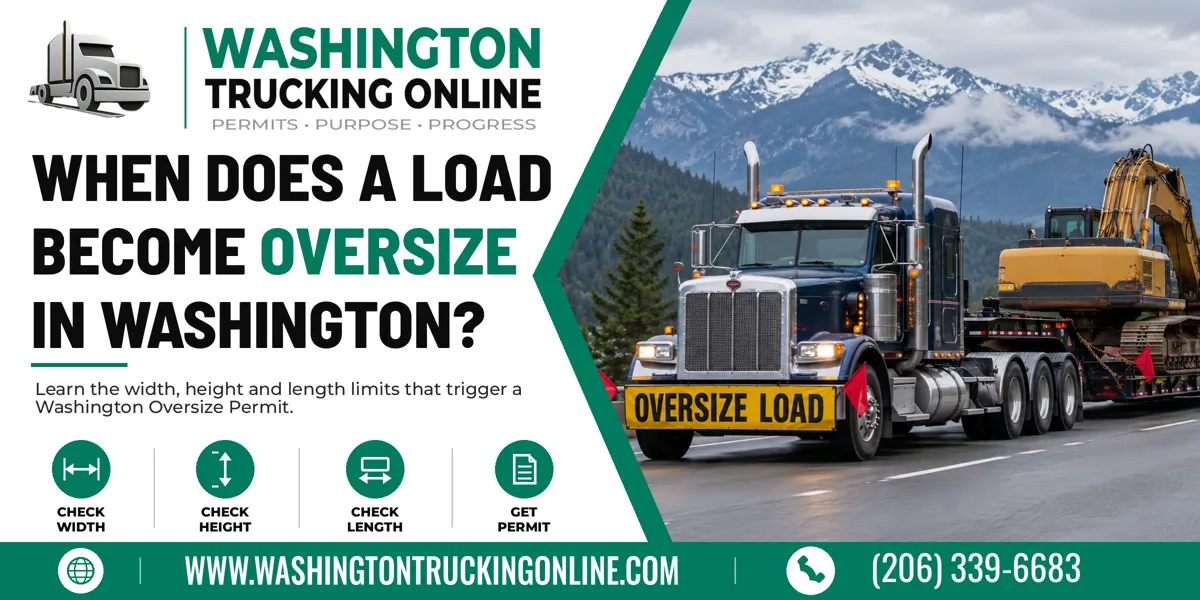
When Does a Load Become Oversize in Washington? Width, Height, and Length Triggers Explained
Table Of Contents
-
Introduction
-
Washington's Legal Size Limits at a Glance
-
The Width Trigger
-
The Height Trigger
-
The Length and Overhang Triggers
-
What About Weight?
-
How to Check Whether Your Load Needs a Permit
-
Common Mistakes to Avoid
-
Why Many Trucking Companies Choose Our Service
-
FAQ
Introduction
Every carrier hauling in Washington eventually faces the same question: is this load legal as-is, or do I need a Washington Oversize Permit? The answer depends on a few clear measurements. Once your vehicle or load passes any one of them, it is considered oversize and needs a permit before it moves on public highways.
Washington's size limits are set in RCW 46.44, and the Washington State Department of Transportation (WSDOT) issues permits for loads that exceed them on state highways. This guide walks through the width, height, length, and overhang triggers, touches on weight, and explains how to check your load before you roll.
Washington's Legal Size Limits at a Glance
Here are the general legal limits for commercial vehicles in Washington:
-
Width: 8 feet 6 inches (8.5 feet)
-
Height: 14 feet, measured from the ground
-
Single-unit vehicle length: 40 feet
-
Semitrailer length (tractor-semitrailer combination): 53 feet
-
Truck and trailer combination: 75 feet overall
-
Front overhang: 3 feet beyond the front bumper or front wheels
-
Rear overhang: 15 feet beyond the center of the last axle
If your load exceeds any single one of these, you will generally need a Washington Oversize Permit. Rules can change, so confirm current limits with WSDOT before each move.
The Width Trigger
Under RCW 46.44.010, the total outside width of a vehicle or its load must not exceed 8.5 feet. Width is the most common reason loads become oversize, since construction equipment, prefab structures, and agricultural machinery often run wider than a standard trailer.
A few things to keep in mind:
-
The load counts, not just the trailer. A legal-width trailer carrying a 10-foot-wide excavator is an oversize load.
-
Mirrors are excluded. Rear-view mirrors may extend beyond the body.
-
Certain safety devices are excluded. Some non-cargo devices may extend up to 3 inches beyond the width limit.
Wider loads may also trigger extra conditions, such as escort vehicles, signs, flags, or travel-time limits. Very wide loads, over 16 feet according to WSDOT, are treated as superloads and need special review.
The Height Trigger
RCW 46.44.020 sets the maximum height at 14 feet from the road surface, loaded or unloaded. Tall loads like transformers, tanks, and machinery on lowboys can reach that limit quickly.
Height is especially risky because of bridges, overpasses, signals, and utility lines. A permit authorizes the move, but it does not guarantee clearance along every part of the route. Survey the route and watch for posted low clearances. Loads over 16 feet high are generally considered superloads by WSDOT.
The Length and Overhang Triggers
Length rules in Washington (RCW 46.44.030) depend on the vehicle configuration:
-
Single-unit vehicles: 40 feet overall.
-
Tractor-semitrailer: the semitrailer may not exceed 53 feet.
-
Doubles: the two trailers combined may not exceed 61 feet.
-
Truck and trailer: 75 feet overall.
Overhang is a separate trigger under RCW 46.44.034. A load extending more than 3 feet past the front bumper or wheels, or more than 15 feet past the center of the last axle, needs a permit even if the trailer itself is legal length. This often catches long loads like steel beams, poles, and pipe.
What About Weight?
Weight is handled separately from size, but many oversize loads are also overweight. Washington generally limits a single axle to 20,000 pounds, and gross weight is set by the lowest of the tire, axle, and wheelbase table limits, topping out at 105,500 pounds for long multi-axle combinations. If your load is over in both size and weight, your permit needs to cover both. Confirm axle and gross weight limits with WSDOT for your exact configuration.
How to Check Whether Your Load Needs a Permit
-
Measure the Loaded Vehicle. Measure width, height, and overall length with the load secured, not just the empty trailer.
-
Measure Overhang. Check the front overhang and rear overhang from the center of the last axle.
-
Compare Against Legal Limits. If any measurement exceeds the limit, you need a Washington Oversize Permit.
-
Check Weight. Confirm axle and gross weights against Washington's limits.
-
Plan Your Route. Note low clearances, bridge restrictions, and any city or county roads that may need local approval.
-
Order Your Permit Before You Move. Carry the permit in the cab and follow every condition listed on it.
Common Mistakes to Avoid
-
Measuring the trailer instead of the load. Limits apply to the vehicle and its load.
-
Forgetting about overhang. A legal-length trailer can still carry an oversize load.
-
Guessing on height. A few inches can mean a bridge strike.
-
Assuming one permit covers every road. WSDOT permits cover state highways; local roads may need separate approval.
-
Ignoring permit conditions. Escort, signage, and travel-time rules are part of the permit.
Why Many Trucking Companies Choose Our Service
Washington Trucking Online helps carriers figure out whether a load is oversized and get the right Washington Oversize Permit quickly. We help you review dimensions, weights, and route details so your application is accurate the first time. Our team provides support 24/7, and we also work on weekends and holidays, so your load doesn't have to wait.
FAQ
-
What is the maximum legal width in Washington?
The legal width is 8 feet 6 inches. Anything wider generally requires a Washington Oversize Permit.
-
What is the legal height limit in Washington?
The legal height is 14 feet from the road surface, loaded or unloaded.
-
How long can a semitrailer be in Washington?
A semitrailer in a tractor-semitrailer combination may be up to 53 feet long. Doubles are limited to 61 feet of combined trailer length.
-
Does rear overhang require a permit?
Yes, if the load extends more than 15 feet beyond the center of the last axle. A front overhang over 3 feet also requires a permit.
-
When is a load considered a superload in Washington?
WSDOT generally treats loads over 16 feet wide, 16 feet high, 125 feet of load length, or 200,000 pounds as superloads. Confirm with WSDOT for your move.
For more information, visit Washington State Department of Transportation.