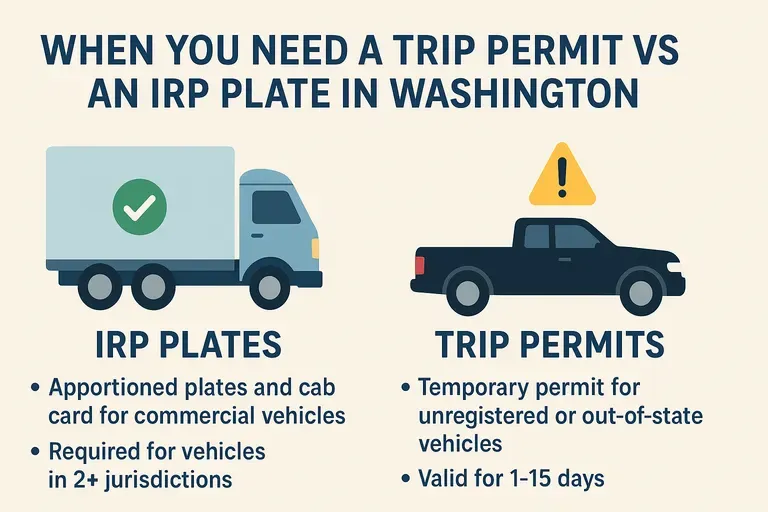
When an IRP Plate Is Required
According to the Washington State Department of Licensing (DOL) for the IRP (prorate) program:
-
If you operate a vehicle that has a gross vehicle weight (GVW) of 26,000 pounds or more and the vehicle operates in two or more jurisdictions (states/provinces) you must register under IRP.
-
Also required if the vehicle has three or more axles, regardless of weight, when traveling in two or more jurisdictions.
-
Once registered under IRP, you receive apportioned plates and a “cab card” listing the jurisdictions where you may operate.
So: If you’re operating interstate (or into Canada) with a heavy vehicle meeting these criteria, IRP is the correct registration path.
When a Trip Permit Is Appropriate Instead
A Trip Permit may apply when you do not have IRP plates but are entering Washington (or passing through) under certain conditions. For example:
-
According to the DOL page for “Trip permits for unlicensed vehicles,” such permits allow “unlicensed vehicles” to operate temporarily — including when the vehicle tabs are expired or the current gross weight license isn’t adequate.
-
Permit-service sources state that Washington requires a trip permit if the vehicle (or combination) is not IRP-registered and one of these applies:
-
The vehicle has 3 or more axles.
-
The vehicle has a gross weight (or combination and registered weight) over 26,000 lbs.
-
The tow vehicle plus trailer combo exceeds 26,000 lbs gross/registered weight.
-
Thus: If you’re an out-of-state carrier without IRP credentials and your vehicle meets those thresholds, you’d likely need a trip permit for Washington instead of (or prior to) going full IRP.
Key Comparison Table
| Situation | Use IRP Plate | Use Trip Permit |
|---|---|---|
| Vehicle operates in 2 or more jurisdictions (states/provinces) | Required (if weight/axle threshold met) | — |
| Vehicle stays only in Washington or home state | Possibly intrastate only => IRP not required | Possibly — if no IRP and thresholds met |
| Vehicle has 3 or more axles | IRP likely required if interstate | Trip permit may apply if no IRP and only transient |
| Vehicle gross/registered weight > 26,000 lbs (or combo > 26,000) | IRP required if multiple jurisdictions | Trip permit may apply if single trip/transit and no IRP |
| Vehicle has IRP plates already | Use IRP credential | Trip permit not needed (for that credential) |
| Vehicle is going through Washington temporarily, not based there | Trip permit may suffice (rather than full IRP setup) | Applicable |
Practical Tips
-
Always check: “Is the vehicle based in my home state, and do I travel regularly in multiple states?” If yes, IRP is the logical route.
-
If you’re making a one-time or limited trip into/through Washington with a heavy truck and you don’t have IRP, then a Trip Permit may be the compliant, simpler solution.
-
Keep clear records: mileage, jurisdictions traveled, weight/axle counts — especially for IRP. Washington requires that kind of detail.
-
Make sure to fill out the Trip Permit correctly (vehicle number, dates, weight, etc.) — mistakes could invalidate it.
-
If you plan to operate regularly across multiple states, it’s often more cost-effective and efficient to convert to IRP rather than repeatedly getting trip permits.